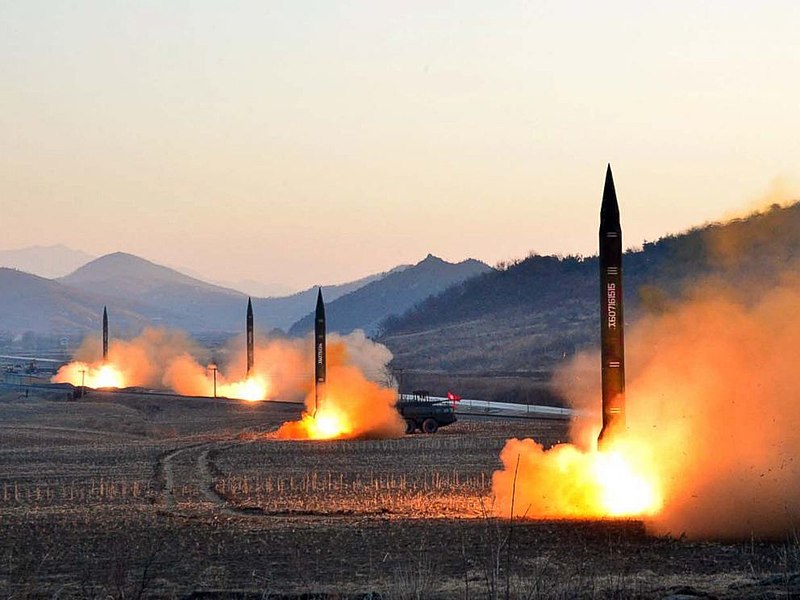
According to Senator Lindsey Graham (R-South Carolina), the U.S. is getting much closer to war with North Korea. Last week, Graham stated that if North Korea conducts a seventh nuclear test, there is a 70 percent likelihood that Donald Trump will launch a preemptive war. (See http:// nymag.com/daily/intelligencer/2017/12/graham-70-percent- chance-of-war-if-n-korea-tests-7th-nuke.html.)
In prior posts, I have discussed boost phase intercept (BPI)
of North Korean missiles. Not too long ago, our near term capability and the need to be able to do this seemed remote, but the world seems to have changed
rapidly. First we saw photos of what the North Koreans claimed to be a modern miniaturized hydrogen bomb, and then they demonstrated a credible intercontinental ballistic missile that could reach all of the U.S. The surprise was
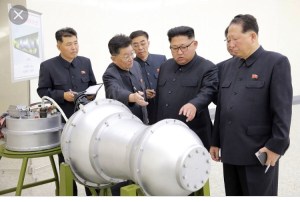
they had both an H bomb as well as a long range ICBM. This capability threatens a near term EMP (electromagnetic pulse) attack that could damage our electric grid. Recently, we saw reputable experts quoted as claiming that “North Korea could kill 90 percent of Americans” with an EMP nuclear explosion delivered over the U.S. Some experts claim such a single weapon could be very effective. William Graham, President Reagan’s science advisor, testified to Congress regarding this danger in October, 2017 (http://docs.house.gov/meetings/HM/HM09/20171012/106467/HHRG-115-HM09-Wstate-PryP-20171012.pdf). Should we worry? Naturally, it depends on whom you ask. A recently released report said the U.S. Air Force “has microwave weapons that could fry Kim’s missiles.”

EMP is an old story and even 10 years ago a congressionally-mandated commission reported that EMP could damage our electronics and our electric power grid so severely that the very existence of our entire society could be threatened. The report caused an enormous yawn because nobody could conceive of a perpetrator who would have the desire and capability to do such a thing. But now we have all been surprised by the rapid development of the North Korean threat, and we seem to be caught with a major intelligence failing.
I reported that we might be able to respond to a missile attack with our midcourse interceptors if the countermeasures such as decoys were limited, but that a more effective approach would be boost phase intercept using high velocity air to air missiles on high altitude drones. The addition of BPI to midcourse intercept would enhance the effectiveness of the entire defense system.

Is electromagnetic energy so lethal that it can destroy our grid or even be used to disarm missiles about to be launched? Well, sort of. It depends on a lot of details that are hard to quantify without extensive tests and analysis. So the EM vulnerability of electronic systems and the rigorous ability to destroy electronic systems using EM waves has yet to be adequately quantified. For every attack mode there are many countermeasures to defeat the attack and survive, so it is a question of experimental and analytical risk evaluation. In my opinion, there is a need for affordable infrastructure hardening, as well as a short- term missile defense response. Fast missiles on drones seems to be the most likely to succeed. Fortunately Congress is considering a $4 billion addition to the defense budget for rapid development of both cyberattacks and a drone approach to BPI. I hope we will expedite our response and avoid any more surprises.
 SDI Guy
In the short term things will get worse quick. So a conventional preemptive strike is by far the most reliable approach compared to either BPI or Mid Course intercept approach (after which we will still need to invade). It reminds me the ‘nth country experiment” (its on the internet). After doing a Pu device in a year, a team of post docs in Livermore did the Super in much much shorter time (and that was in 1965). The N Korean were a bit slow considering how much open knowledge is now available. I expect them to do the EMP and the Neutron Bomb in much shorter time too. What the benefit of waiting?
LikeLike
Gerry, I suspect that unfortunately NK has had help from either PRC OR Russia or both. It may well be that other highly industrialized countries made have sold them materials and componentry that a country like NK would have trouble developing. As mentioned elsewhere in this thread the physics of nuclear weapons is prett well developed and understood. The precision engineering and the component development needed to create a weapon reliable enough to deploy is another thing. I think NK has gone beyond any Strategic role in tilting power scales that say the PRC ever envisioned. Nuclear stand offs with countries like China who have rational national policies are one thing. Dealing with unstable actors who either have nothing to lose or who misjudge consequences is an altogether different thing
Bill
LikeLike