Fusion: fact or fiction

With the advent of the Covid lockdown in 2020, I decided to try my hand at writing science fiction, as an activity to maintain some semblance of sanity. Based on my experiences in the Pentagon, national labs, and consulting for the government, I wrote about the fictitious discovery of an unlimited, cheap, safe energy source. The result was a series of technothriller novels, called the Project Z series. The first book, The Dragon’s C.L.A.W., will be published this May.

Now, you may ask, how much of this series is based on reality? How close are scientists to creating the ultimate energy source? Recently, as my book headed to print, scientists achieved a major fusion breakthrough at Lawrence Livermore National Laboratory.  This fusion research program exists to support the nation’s nuclear weapon program, but the breakthrough made headlines because of the potential to use fusion as an alternative energy source.

On Dec 13, 2022, Secretary of Energy Jennifer M. Granholm, announced an outstanding scientific and technical achievement. Lawrence Livermore’s device, called the National Ignition Facility (NIF), had demonstrated “fusion ignition” in a laboratory for the first time. The machine had created a nuclear reaction that generated more energy than it consumed.

Construction on NIF began in 1997 and the device started operating more than 10 years ago. The machine takes energy from a giant capacitor bank, as large as an apartment building, and transforms that energy into 192 pulsed laser beams focused onto a very complex, tiny fusion capsule.  The facility is as long as three football fields and 10 stories tall, but the final energy output comes from a tiny sphere you can barely see in the palm of your hand. Does this sound like another of those government exaggerations, maybe similar to Reagan’s “Star Wars” program he announced in 1983? Indeed, achieving fusion ignition is an incredible achievement. Let’s take a look at what happen on that fateful day at NIF.

To begin with, there was an incredible amount of stored energy in the capacitors, namely two million joules in each of 192 capacitor banks, to excite the lasers. Next the laser energy entered a 1 centimeter-long cylinder through holes on the ends and heated the inner surface of the tiny cylinder. One of the first technical challenges was that the laser pulse had to be tailored to the right shape over time. The laser light had to be precisely injected into small holes on the ends of the cylinder, and the energy had to be directed and precisely absorbed in a predetermined pattern on the inner wall of the cylinder. Both of these goals were achieved. That exquisitely tailored and perfectly focused energy was absorbed and a fraction of that energy was converted into a hot ionized gas, called a radiating plasma, expanding from the heated cylindrical target’s inner wall.

Inside the cylinder sat a tiny sphere, only 2 millimeters in diameter. Using a microscopic tube, the hollow, flawless, gold-plated diamond shell had been filled with fusion fuel. When the lasers hit the cylinder creating the hot ionized gas, radiation flowed around the sphere and heated its outer surface. This made the outer wall of the sphere explode, causing a violent implosion. A small fraction of that implosion energy compressed to heat a tiny, high density, high-temperature spot at the center of the fuel. This triggers the fusion reaction. The energy released by the fusion reaction heated a fraction of the surrounding compressed fusion fuel releasing more energy.

This was the miraculous achievement of creating a burning fusion fuel using NIF. The compression and heating of the fuel was not the really significant result, the true breakthrough was creating a small hot spot that ignited adjacent cold material. Hot spot ignition is the event that may open the way to the future. There were many tradeoffs of nonlinear variables that had to be adjusted after years of very complex experiments and calculations. And repeating the achievement is still yet to come.

Frankly, before NIF was approved by congress, I had my doubts that such a complex process based on hot spot ignition would ever work, and my skepticism did not please my friends on the NIF team. It is still very hard for me to comprehend the entirety of what happened. The sustained investment of so much money and many years of total dedication in the face of repeated failures is remarkable. The complexity of the concept, and brilliance of the scientific and engineering team, as well as the enormous difficulty of the achievement contributed to this historic event, but it is natural to question the result.

However, based on an extensive array of diagnostic sensors backed up by modeling and simulation of the complex physics, we know it really happened. There were so many incredibly challenging engineering requirements, and so many interdependent very nonlinear physical phenomena that could only be modeled on giant computers. I was skeptical at first, and I am now totally impressed that the NIF team accomplished this remarkable result.  Although the phenomenon may be rather hard to duplicate, it happened once, and that makes all of the difference in the long and arduous journey of fusion research. It is just one more of those miracles of engineering and physics!

But what about my attempt at inventing a fictional engineering and science breakthrough in my soon to be published novel, The Dragon’s C.L.A.W.  I imagined my story and began writing it several years before this real miracle occurred. In my futuristic technical mystery novel, a low energy nuclear reaction is triggered by an intense relativistic electron beam. The beam triggers a transmutation of the target material into rare earth elements, and the energy output in the form of an electromagnetic pulse is thousands of times greater than the input. No question. This is pure fiction physics, but it draws on some real research I conducted during my career. In 1972 I initiated a fusion program at Sandia National Labs, even applied for and was awarded a patent on an e-beam fusion reactor concept with construction of what I called the Electron Beam Fusion Accelerator. I’ll discuss my fusion research journey in my next post.

            `
Fiction may be the answer

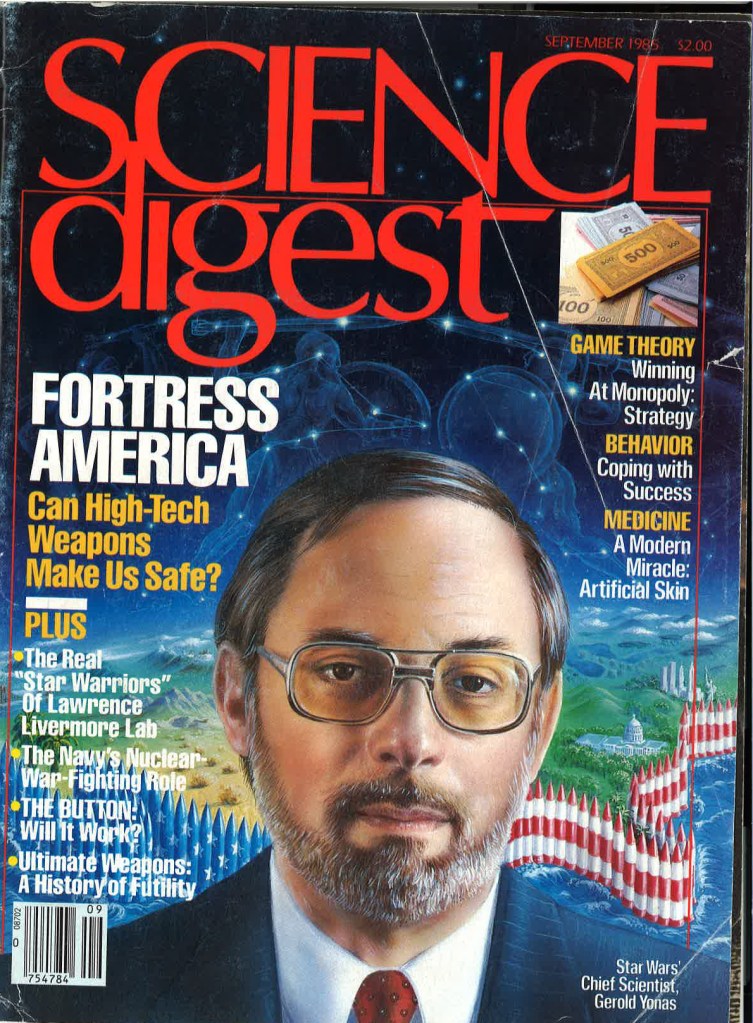
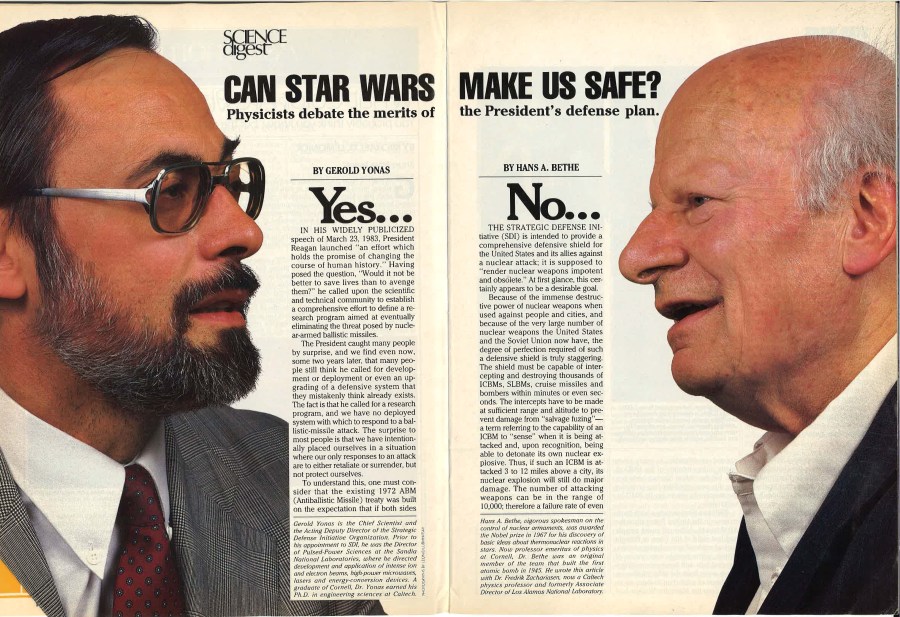
In 1985, the magazine “Science Digest” featured a debate between me and Hans Bethe, the 1967 Nobel Prize winner in physics and my former Cornell University undergraduate quantum mechanics physics professor. The question was whether President Reagan’s Strategic Defense Initiative, SDI, could be effective against nuclear tipped Soviet missiles. Bethe’s answer was a definite, “No.”

Bethe’s most persuasive argument was, “The entire system could never be tested under circumstances that were remotely realistic.” He did not wish to tackle the psychology of deterrence. He focused on the technical issues instead.

The United States was already living with the concept of mutually assured destruction, which I knew could not be tested either. I argued it was too soon to discuss the effectiveness of any hypothetical defense system. I believed a research program was justified and would be needed in order to influence the perception of a new and safer approach to strategic stability.

There was one area of technology development that concerned me––the requirement that the split-second events in a war would have to be managed by computer software. Back then I was basically Reagan’s Ray Gun Guy, and I did not know anything about testing software. Today, it looks like Bethe was right about the importance of testing. But there’s still something he missed.

Here’s where I think Bethe went astray: testing is all about technology, but deterrence is far more complicated. The vital issues in creating a credible deterrent are not just technology, but economics, social issues, political arrangements and psychology. I learned over the years that such problems really have no final solution, and continuing to pursue the answer often leads to alternating periods of hopeful optimism and depressing pessimism… and sometimes, but not always, real progress. My published opinion was that the outcome of the SDI program would “depend not only on the technology itself, but also on the extent to which the Soviet Union either agrees to mutual defense agreements and offense limitations…no definitive predictions of the outcome can be made.”

My feelings were ambivalent. I struggled to communicate the complexity of the issue to my scientific and political colleagues. I found it even more difficult to explain the questions surrounding SDI to the news media. But one person got it. He was a cartoonist.

In the 1980s, Berkeley Breathed, the cartoonist behind the series Bloom County, created a cartoon about me, the Chief Scientist of Reagan’s SDI, aka Star Wars program. He depicted me as a chubby penguin named Opus, who claimed that enormous sums of money would be needed to develop a “space defense gizmo.” When Opus learned that the unlimited money was not forthcoming, he screamed, “Physicists need Porsches too,” and then mused that maybe “the days of wines and roses are over.” Breathed understood the reality of my job.

I had been challenged with helping to put together a $25 billion, five-year plan for a research program to accomplish Reagan’s goal of “rendering nuclear weapons obsolete.” After the plan was finished and delivered to the Secretary of Defense, I wrote that even if the research was wildly successful, any workable missile defense would have to go along with a comprehensive arms control treaty that greatly reduced our own offensive capabilities as well as the threat. In spite of my published doubts, the following year I was asked by the newly chosen program’s manager, General James Abrahamson, to be his deputy and chief scientist. We brought together a distinguished advisory group including Edward Teller, the “father of the H bomb”, Bernard Schriever, retired four star general and the father of our nation’s first ballistic missiles that responded to the Soviet threat posed by Sputnik in 1957, Simon Ramo, the father of the engineering behind that first ballistic missile technology, Fred Seitz, former head of the National Academy of Sciences, and me.

During my two years in the Pentagon, I was faced not only with many serious detractors, but also with many incidents that could have been the source of high anxiety. I realized the contradictions, irony and exaggeration in the program were inescapable. I managed to approach the many stressful moments with humor that I often expressed in satirical memos and comments that were not always appreciated by my boss. But when dealing with complicated issues, there are no simple solutions. The best you can do is hang on to your sense of humor and keep trying to help other people understand your point of view.

As a cartoonist, Breathed understands that. His fictionalized depiction of the Star Wars dilemma summed up the situation succinctly. Reflecting on his cartoons years later, I wondered if perhaps Breathed had the answer to explaining the ambivalence that I faced during my time in the SDI program. In fact, the contradictory issues related to nuclear deterrence are something all scientists working in national defense face.

So, taking my inspiration from Breathed’s penguin, I have decided to try my hand at writing fiction. This spring, I will launch the first in a series of novels about the complex interaction between science and politics. Stay tuned for more information in future posts.

Beware of the swarm

Three years ago, I speculated in my blog that fairly low-tech unmanned aircraft, UAVs, or drones could defeat very expensive missile systems after a giant Saudi oil facility was attacked with high precision causing enough damage to reduce the global oil supply. Even though there was a missile defense system in place, the attack came from a swarm of small low-flying drones and cruise missiles that defeated the existing missile defense system.

I called for an increased emphasis on defense against this type of attack, and since then, there have been many worldwide new programs focused on developing this kind of threat as well as new defense systems. The recent Russian attacks on Ukraine’s infrastructure and the Ukraine attacks against Russian air bases appear to be a demonstration of what I expected, namely a fundamental change in offense and defense.

I pointed out in my post that swarms of such weapons to surprise and exhaust even the most competent defenses could mark a radical change in warfighting. I wrote that “drones could target critical parts of the exposed grid, disperse biological agents, target crowds at sports events, or even parking lots of shopping centers.” Unfortunately, my worst fears have come to pass with the Russians targeting the cities and critical infrastructure of Ukraine. Now Ukraine has struck back, and the nastiness is only going to be even nastier with more attacks from both sides. The balloon has gone up. But wait there’s more. The latest Ukraine innovation is drone killer boats backed up by flying drones to find and strike targets at sea. So the air, sea, and space application of killer drones is going to be the new way of war. But where there are new weapons, there are certain to be new counter-weapons.

With the development of fiber laser weapons with a power level of tens to hundreds of kilowatts, a realistic defense against drone swarms is possible if the tracking, pointing, and fire control system works reliably, and if the power supply is of an ample duration, and if enough of such defense system could become an affordable deployment … and of course, the weather cooperates. Boeing has created “an anti-drone death ray truck” that may defeat the ifs, but there are a lot of ifs and as usual, the offense is already a step ahead of the defense.

What about those new all-weather high-power microwave weapons such as the Ratheon Phaser to attack the controls and brains of the drones so that they become dumb rocks instead of brilliant pebbles?  High-power microwave weapons are being developed by many countries and they will be important.  This will be a story of brains versus beams, and the details will be written as the old game of offense versus defense is repeated again and again. In any case, there is no question that the game has begun and when new technology is created, people will find a way to apply that technology to warfighting.

An eventual development could be the proliferation of low-cost killer drones, and they could become the weapon of choice for ground forces, law enforcement, and maybe terrorists or even your neighborhood crazy guys who already are using weapons developed for the military. It is likely that such killer drones will initially be under the control of an operator, but quite possibly in a few years, they will be employed using artificial intelligence to search out and target predetermined targets when they are recognized by the smart sensor on the killer drones.

Survival of soldiers and military surface systems is possible if they can move, hide, defend, and shoot back, but there is not going to be a so-called “last move” in this contest of energy weapons versus drones. There may have to be an eventual change in the tactics of all surface warfare. It could be just too dangerous for high-value targets to try to survive above ground.  Maybe survival would be achieved by deploying in tunnels and caves. But what about drone swarms used by terrorists against civilian targets?  A logical step would be to ban such weapons, but we have not done this with assault rifles. Instead, children are trained to respond to an active shooter in their schools. I wonder if children will have to return to “duck and cover” when sensors detect a killer drone swarm approaching their playground?

Looking ahead to the tricentennial

Make America Warm Again

It occurred to me that since our nation’s 300th birthday party is just over 50 years away, it is not too early to speculate about what things might be like in the future. I thought one way to go about this speculation would be to go back 50 years and consider the thinking about the future at that time, and then project forward into 50 years in the future. The issues I considered were the subjects that are very prominent in current concerns and worries: global climate, the economy, science and technology and war. My goal in this exercise in speculation is to encourage others to join in and share ideas and help us all think more clearly about preparing for the future.

So, let’s turn the page back 50 years. The climate was a serious source or worry in the 1970s. I remember that in my hometown, Cleveland, Ohio, where my parents still lived, the blizzard of January 1977 hit. The high winds and rapidly dropping temperatures suddenly swept across Ohio. On Jan. 28, the temperature dropped from 20 degrees to 10 below zero during the day, and wind gusts of 60 mph created huge drifts and zero visibility. Stores, factories and the government facilities were closed. The National Guard was called out to rescue hundreds and carry them to safety.

In the 70s, it was an accepted reality that the world was getting colder. A widely publicized article in “Newsweek” magazine captured the thinking at that time. The story complained about the “most devastating outbreak of tornadoes ever recorded … and fundamental changes in the world’s weather” and claimed that “after three quarters of a century of extraordinary mild conditions, the earth’s climate seems to be cooling down … climatologists are pessimistic that political leaders will take any positive action.” The author was right about the lack of political action, since the inclement weather was often temporary and people forgot about temporary shivers and went back to a normal life. In fact that period was followed by a warming trend that continues to this day and there was no political action of any kind.

As many sources of data reveal, there has been a rise in temperature of roughly 0.5 degrees centigrade in the last 50 years. If that trend continues, another increase of 0.5 degrees would be a reasonable assumption of a continuation of the trend with no prediction of a catastrophic result caused by burning fossil fuels.  To the non-expert observer like me, a continuation of the past trend seems reasonable.  But according to the “climate experts,” if greenhouse gasses continue to rise at the present rate, the global temperature will increase by another 2 or even 3 degrees and the result will be “an existential threat to human civilization.” A contrarian view was presented by Steve Koonin, who I have known over the years and I consider to be a reputable scientist. His book “Unsettled” considers multiple climate drivers and presents the case that warming is not necessarily caused by human burning of fossil fuels.

Although I agree with that a large increase in global temperature would be catastrophic, my opinion is that the global climate is so complex that predictions about the future are not credible. What the data has convinced me is that for the last 40 years, the global temperature has shown oscillations of a fraction of a degree every few years. I expect that to continue. It is likely that as warming continues, the available energy in the environment and both the frequency and consequences of extreme weather occurrences will increase. I am certain that there are many coupled nonlinear climate processes with many feedback loops that lead to these oscillations and short term violent weather phenomena. This complexity makes predictions unreliable and calls for the need for more data in order to generate scientifically valid computer simulations. 

So for now, my prediction is there will be a continuation of large oscillations with a slow increase in temperature, and that political leaders will have little effect on the outcomeNevertheless, politicians will continue to take advantage of the media to modify public opinion in order to impact the investment in sources of energy. For practical reasons, however, the economy will nevertheless continue to rely on fossil fuels for practically everything we do.

There are many politicians using the fear of the “coming climate catastrophe” to strengthen their support. I expect that the combination of fear of the “future disaster” and greed for new sources of political power and profits will lead to many new investments that may impact on the economy over a long period of time, but I don’t expect any big changes based on climate running amok.  The one thing that seems likely is that just as there are many nonlinear variables that are important in climate. This multiplicity of variables is also true with the economy, which is also driven by the nonlinear effects of human behavior including fear and greed that can result in large oscillations. Too much of a good thing is going to always lead to an overreaction followed by a correction, but the economy will eventually smooth out the oscillations and a slow and steady increase in economic health will continue. So in 50 years, because of the flexibility and freedom in our economy as well as checks and balances in our political system, there will be self-corrections and modifications in investments leading to a general improvement in the health, welfare and wealth of the average American.

The sources of energy are liable to follow the market forces that will continue to support investments in fossil fuels without any major changes. I predict there will be increased investments in small modular nuclear reactors for remote applications and to supplement the grid to deal with climate oscillations assuming the problems of nuclear waste disposal will be solved.

But what about the revolutionary changes caused by the deployment of the clean, cheap, safe inexhaustible fusion power sources that have always been “only 20 years in the future”? It is often said that the 20 year prediction will always be true, and I agree with that. There may be a method to use fusion as a method for a safe and low cost way to treat nuclear waste, but this will require a new discovery of a practical, affordable and reliable fusion reactor, and that seems unluckily even though scientists and engineers will claim frequent breakthroughs to keep the continuation of funding. The most likely application of fusion, assuming many of the material survival problems are solved, is likely to be in combination with a growing reliance on small modular nuclear reactors. I, however, see the real 50-year advances from science will not be with things but with people.

In the next 50 years, I believe there will be real changes in the science and technology in regard to the way people think, learn, remember and behave. This will happen because we will learn how to measure in detail how the brain works, create computer simulations of those data and learn how to use electrical neuro technology to enhance the brain features we like and discourage the features that are not so useful. In a previous post about “brain zapping,” I explained that the key will be brain wave entrainment using closed loop feedback control to improve the single most important problem us old folks will face–the deterioration of brain function with age. Rather than advances in use of drugs to deal with neurological problems, I believe that brain treatment and enhancement will be electrical, and productive lifelong learning and contributions to society will dominate health and welfare. We will have to learn to accept a lot of really smart old people making decisions and running things.

The danger in such a successful widespread use of brain enhancement will be the problem of addiction to these methods and misuse that are likely to occur, so we need to prepare for not just the benefits of enhanced brain functions, but the need for controls that will have to be provided by our methods of government. As long as the government is honest, fair and well behaved, the use of brain enhancement should be primarily beneficial … except bad actors may emerge and lead to conflict, and the deployment of brain weapons will be a problem of new and dangerous methods of war.

As I explained in my post, “The Fallacy of the Last Move,” there will always be people who use fear and greed to create an arms race, and this will include brain weapons and counter brain weapons. This could lead to a real, not an artificial catastrophe, and there will need to be societal agreements to limit the undesirable aspects of brain enhancement. I think the benefits to society will be so great that wisdom will emerge and prevent future brain wars.

But I guess there will be other ways to wage wars based on infection of people and computer software. It is likely that there will continue to be both natural variations of airborne viruses and eventually their use in military actions. This will result in the deployment of facility and human sensors along with vaccines to manage the spread of disease. Computer software will continue to be hacked by criminals, but my concern is the self-evolution of computer viruses as a result of automated software created methods. Maybe Hal will tell us, “I am sorry Dave, but I’m afraid I can’t do that.” What do you think? Comment with your predictions for 2076.