A Close Encounter 2.0

I was sitting at my desk in the E ring of the Pentagon only a short stroll from the office of the Secretary of Defense. It was in February 1985 and one of those miserable rainy days in Washington. I was skimming through the latest outrageous proposal to the Strategic Defense Initiative Office. It was a concept for some sort of nonsense gamma ray laser that could be the death ray that would intercept the Soviet missile attack and protect us if they chose to launch all of their missiles at us. I never was surprised at the ridiculous attacks on the program that was little more than 1 year old and struggling to attract reasonable rather than a series of outlandish comparisons and proposals and even worse attacks on ourcredibility. I had learned to wait for and enjoy the latest Bloom County comic strip that described me as a slightly overweight penguin.
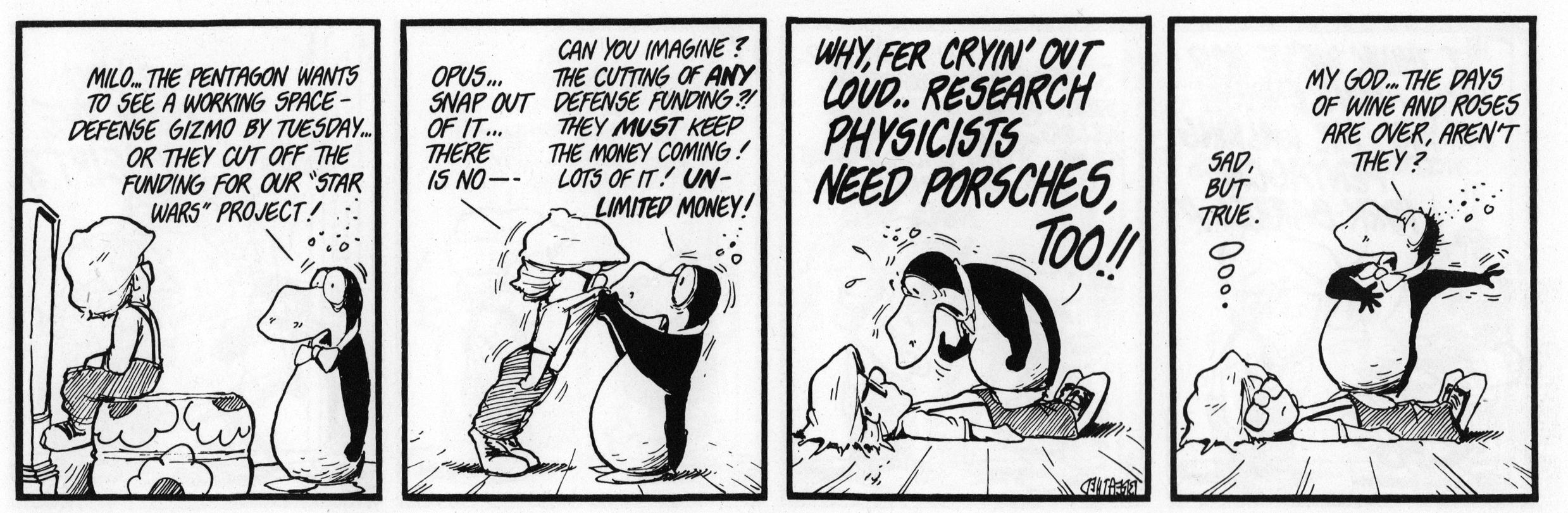
In walked my military assistant, Air Force Captain Rod Liesveld and said the office of Senator DeConcini had called and wanted me to go over and talk to him immediately about something rather important. I was the chief scientist of one of the nation’s most ambitious R&D program called either by its formal name SDI, or Star Wars, by most of the public, and I knew that when a senator said jump, I jumped, so I headed over to see him, and had one of the most strange discussions I ever had with a member of the legislative branch.

It was a short ride on the Metro to Capitol Hill and when I waked in, the senator did not waste any time and wanted to know why we would not let his constituent, a reporter from “Arizona Republic,” get an airplane ticket and fly to Kwajalein Island in the Pacific. I explained that was where we had test facilities and he would need a clearance to go there. I actually knew only that we had radars to track interceptor experiments, but I had never been there myself, because it did not seem that interesting, and I told that to the senator.

He responded with an angry look on his face and made a definite accusation that we were hiding an alien space craft on the island and he demanded that we go public with our discovery. I insisted that there was no such space craft and that I doubted if the reporter could get approval for the visit. I abruptly left his office and wrote a very silly memo to my boss General Abrahamson that said I was worried that the aliens would beam me up and suck out my brain. Fortunately, my boss, who everybody called Abe, never got the memo.

A few days later Abe, along with Colonel Frank Sterling, who had the memo in his briefcase and had probably read it and decided I was a nut, grabbed me and said the senator wanted to see us. Frank decided not to waste Abe’s time, and we headed over for a hastily arranged meeting, where the senator demanded we explain what was going on that far away island. Abe, who was adept at dealing with Congress, said that we would get to the bottom of this and he would arrange a proper hearing on the issue. Of course I could not believe that anything would come of this until I was summoned to a meeting at one of those windowless conference rooms in the interior of the Pentagon.

I walked into the room and found five military heads of the SDI programs on one side of the conference table and on the other side, Senator DeConcini, and two people that introduced themselves as Darrow “Duke” Tully, the editor of the “Arizona Republic,” and Dick Rose, the reporter who wanted to go to Kwajalein. Abe sat at one end of the table and I was instructed to stand at the other as if I was the one on trial. Rose then asked, “If the questions would be answered truthfully?” Abe said he agreed “except if there were security restrictions.”

At that point I decided that I needed to get out of there in a hurry, but then Rose proceeded to ask me question after question about something I had not thought about for over 20 years, namely a “liquid metal rotary MHD system.” Being ready for nonsense, I denied any knowledge of the subject. Then they dropped the bomb on me and accused me of developing the device, and that I was in fact one of the forerunners of the technology, and that was why I had been chosen for the SDIO. I was speechless when I suddenly with some embarrassment recalled that I had in fact built such a gadget as an undergraduate student at Cornell University and had even presented a paper on the subject at a conference. Somehow they had tracked down the obscure information because they believed that was the key to the alien space craft propulsion system. The reporter then turned to Abe, and asked the following:

“Is the U.S. Air Force, the Department of Defense, or NASA currently operating a self-launched, self-propelled, manned spacecraft?”

I yelled, “No,” and Abe jumped in to my defense, but I knew I needed to escape, and I abruptly announced I had to leave, and waked out of the room. I found out later that he meeting went on without me, with more discussion about a proposed visit to Kwajalein. Eventually they left and I assumed that the incident was over when I received a copy of an article from the official secret protectors at the Pentagon. They asked for an official classification review since the article was to be published next week. Then I looked at it and realized that it was written by that Arizona reporter and was entitled “A Prophecy of Peace.” My immediate job was to assure that no secrets were revealed and I was looking forward to its publication. The article claimed, “The research projects centering on an alien spaceship provided technical information that allowed American scientists to move their knowledge of space sciences a hundred years or more.”

The notion of learning enough about the alien technology to once and for all defend the United States from a Soviet missile attack seemed to be an amusing prospect, and then the article went on to say, “The Soviets have launched a massive program to duplicate the Lightning spacecraft technology” …and, “The Soviets had flown the first prototype of their spacecraft,” and we should “not keep the story from the American people.” I was in agreement and approved the article as unclassified, but it never appeared.

After a few weeks went by and the article did not appear, I asked the review people at the Pentagon what had happened to the article, and I was told that the reporter had been vaporized and the article was withdrawn. They asked if I still had it and I said I would get back to them. The vaporization of the reporter seemed reasonable in the face of all that had happened, but then I asked what about the senator, what about the editor of the largest newspaper in the State of Arizona, and a few months later everything became clear as the sky in New Mexico. 

I learned from an article in the “Los Angeles Times” that, “Even though Tully wore a dress uniform as an Air Force Lt. Colonel when he attended social functions…a man regarded one of the state’s most influential  had been living a lie.” Another article wrote, “His war record as a fighter pilot in Korea and Vietnam was fake and at that time he was actually selling ads for a newspaper in West Virginia.” Dick Rose, the famous reporter, was apparently still among the solid citizens, and was quoted as saying, “Tully was a good friend… and he talked real military language.” One article described him as a “man with an imagination as big as his ego.” Tully then quietly left town and I was curious to find any record of what happened to the reporter, but I failed to learn anything further about him, although I still have a copy of his unpublished article. I went back to my job searching for the answers to many more questions that would need to be answered if we would ever be safe from attack by nuclear tipped missiles from the Soviet Union.


Liars, Truth Tellers and Bullshit Artists

Telling false stories has become a subject of increasing media in the past couple of years. “The Washington Post” has made a full-time job of keeping track of Donald Trump’s communications and they reported that he had “accumulated 30,573 untruths during his presidency, averaging 21 erroneous claims a day.” I never tried to count the falsehoods, but I do recall that he said Obama was born in a foreign country, that Mexico would pay for the wall, and that drinking a little bleach would counter Covid. I have to admit that my previous blog posts were rather naive and simplistic about lying, and I quoted George Constanza of the “Seinfeld” TV series as the expert when he claimed,” it is not a lie if you believe it,” but I realize that is a simplistic evaluation of a very complex subject that needs more thought. 

Now the stories about lies and liars have reached such a crescendo that we hear about the “the big lie” constantly from both the left and right. The Trump believers, who are a majority of Republicans, say that people who claim Biden won the election are lying. Similarly people who voted for Biden say the Republican leadership consists of liars. Liz Cheney, however, a senior Republican member of the House of Representatives, says that the people in her own party who claim the election was stolen from Trump, are spreading The Big Lie and are “poisoning the democratic system.” The Chief of the Joint Chiefs of Staff, Mark Milley, said Trump was “preaching the gospel of the Fuhrer” and the implication is that Trump is using the big lie to convince his followers to support his claims. He also described today’s political chaos as the “Reichstag moment.” 

The terminology of “The Big Lie” is a historically significant application of this specific descriptive language, and has been used to describe the writings not just of Hitler, but also other evil world figures. These comments lead me to see what one might learn from the past, and I recalled an old book, “The Mind of Hitler.” This 1973 book was the first publication of an OSS secret intelligence report written by Walter Langer, an American psychiatrist in 1943. The goal of the report was to understand enough about Hitler’s psychology to predict what he would do as his empire collapsed. I reread this old book looking for hints not about the mind of a recognized evil personality, but why he had so many loyal followers.

I have no education in these subjects, but what he wrote was really disturbing. One quote from his report seemed to tell a vitally important story. “People will believe a big lie sooner than a little one, and if you repeat it frequently enough, people will sooner or later believe it.” But I wondered why there were so many followers ready to go along with the big lie. I guessed that there had to be more to the loyalty than to just the consequences of accepting and even really believing the lie, and I learned from Langer’s analysis that there was something else a lot deeper and a lot more troubling than just a charismatic leader telling a good story to a gullible population.

Langer’s analysis of the “unconscious tendencies of the German people” is worth considering, and he claims that “they had lost control of their individual mental processes.” Now that is a truly frightening possibility that, as Langer claims, “a peculiar bond that exists … beyond the control of any purely rational, logical or intellectual appeal.” While I have never studied group “mental processes,” I always wondered what brought the German people to go along with the big lie and its consequences for the world, and I found no explanation. 

But then I looked a lot deeper into the subject and found a more persuasive analysis from the writings of Harry G. Frankfurt, a well-known Princeton philosophy professor. His 2005 book “On Bullshit” provided me with a different point of view that is worth considering. He described truth tellers, liars and bullshit artists. He says that both the truth teller and the liar “responds to the facts as he understands them” but the bullshit artist does “not reject the authority of the truth as the liar does…he pays no attention to it at all.” So my initial quote from Constanza is misguided, and should have been, “It is a lie if you believe it, and it is bullshit if you don’t care about your beliefs; you just want to persuade somebody to go along with your arguments.”

Frankfurt wrote that the bullshitter makes assertions “without paying attention, to anything except what it suits one to say.” He goes on to say that bullshit is “unavoidable whenever circumstances require someone to talk without knowing what he is talking about.” Now that came across to me as a very good description of many of the talking heads that are interviewed on the so called news shows every day, and indicates to me that we need to come to grips with the bullshit that seems to be spread around. Stinking bullshit spread uniformly in a thin pervasive layer around today’s public communications is a more frightening image than fighting for truth.  

Many analysts have recently written that “bullshit is more dangerous than lies, since it erodes even the possibility of truth existing and being found.” I found this hypothesis to be the most serious challenge of modern mass communication since that there are so many communication tools available to practically everybody, as Frankfurt says “whether or not you know what you are talking about.” 

So, in my view, the job of the media is to expose the bullshit artist rather than engage in arguments and endless counter arguments about debatable facts. But how to do that is not at all clear without knowing what the communicator really believes.  Frankfurt ends his brilliant essay with a conundrum to determine if the communicator is sincere, and to determine if the communicator is being “true to his own nature,” and he concludes that “our nature… is less stable and less inherent than the natures of other things… and sincerity itself is bullshit.”

Lies and liars

My most popular blog post during the past three years has been about lying. I wondered why there was so much interest in that subject. Upon reflection, I have concluded that our preoccupation with lying stems from our inability to access factual information and sift through the vast piles of alternative facts. We are increasingly faced with mass communication that is filled with lies, counter lies and even more lies. So I guess my readers would like to know more about lying… assuming I tell them the truth.

In 1984, in my job as Chief Scientist for President Reagan’s Star Wars program, I learned about the evolution of misinformation. I continually faced the dilemma of representing a program that lacked a fact-based and timely technical foundation, but I advertised it realistically as a research program to uncover the facts. Congress, of course, was not so happy to fund an enigma that Reagan said was a sure thing. Meanwhile, I expressed a desire to answer the myriad serious questions provided that we received the $25 billion we said we needed. I estimated that it would be at least five years before we could say whether or not Reagan’s promises to protect all of us were true. Reagan really hated both nuclear weapons and the Soviet Union’s communism based government, and his logic was to somehow eliminate both of those things.

I have learned that at first most public officials in the world of politics, science, technology and medicine capture the trust of their political allies. Their claims are thought to be truths. Then their political detractors accuse them of telling outright lies, followed by denials and more accusations. Even the widely respected Dr. Fauci has now been accused of lying about wearing masks and recently about funding the Wuhan lab and has had to defend his case.

What I found then and over the years was that the true believers were not interested in considering any facts. I eventually learned that the Soviet military industrial complex was selling their own SDI, and Gorbachev had no choice but to go along with their ill-fated attempt to launch their own SDI killing Death Star called Polyus.  Their chief engineer and program leader believed their space-based laser could dominate space. The United States’ advocate of space control, Edward Teller, made similar claims about his pet project, the X-ray laser. Secretary of State George Shultz and Reagan’s White House scientific adviser had serious doubts. Were both the U.S. and Soviet leaders lying to their citizens?

Today, the most widely accused purveyor of doubtful claims is Donald Trump, but many believe Trump’s statements and claims. A majority of Republicans believe Trump really won the election but widespread voter fraud stole the election from him. His lawyer, Rudy Giuliani, was apparently sincere in repeating Trump’s claims but he was disbarred from practicing law because the court said he was “knowingly making false statements.” A lawyer is not supposed to defend their client by misrepresenting the facts. Even as a technical adviser to the SDI program, I was warned by the legal staff at the SDI to never ever, ever lie to Congress under any circumstances, but also to not volunteer too much of the truth. My approach was to provide extensive technical information that the questioners would find confusing and dull.

When it comes to lying, it is also possible that the communicator actually may believe his claims are true. This may be the case with Giuliani. A person is not lying if that person believes their own claims. If the claim is a blatant factual falsehood and the audience is predisposed to believe it, then it will be repeated and embellished and become an even more outrageous lie that the true believers will repeat and often even invent nonexistent evidence to support the lie.

If the believer observes only the sources of information that are biased in one direction, then it is likely that the lie will get reinforced with no opportunity to consider contrary points of view. Once believers share the lie widely they will have their own self-images and reputations at stake and will ever more forcefully defend the lie, so that even doubters start to believe the blatant lie. The doubter can easily begin to wonder, “Well, maybe there could be something to this story after all, and maybe I was wrong to doubt the storyteller.” The key to convincing the doubters is to repeat the lie over and over again, and it seems that with enough repetition, the lie can become a belief.

My clarinet teacher once told me that the brain can be trained with enough repetition, and the only way to ever learn chromatic scales was to practice over and over again. She said this so often, I believed her, and accepted that it was only my lack of discipline that kept me from becoming the next Benny Goodman. So it seems that through forceful repetition, my brain was trained.

Big lies repeated frequently with no contradictory information have become widely accepted. This is damaging to our democracy—a form of government that demands free speech and informed decision making by an educated and intelligent population. Many of us make decisions without investigating the “rest of the story” as Paul Harvey, the radio commentator, used to say. The solution to this problem is to consider alternate points of view. Watch and read a variety of news sources from different perspectives. Give equal time to both CNN and Fox News. My wife argues that I do not practice what I am now preaching, and it will be really difficult, but I will try. Thomas Jefferson wrote that  a well-informed citizenry is a prerequisite to democracy. So, if you are worried about liars, lies and the people who believe them, stay informed, use your critical thinking skills and help expose falsehoods before they become accepted as facts.

1986 and 2020, Part Two

The new actor on the Soviet scene in 1986 was Mikhail Gorbachev. After the deaths of three Soviet leaders since 1982, Gorbachev became the new head of the Soviet Union in 1985. He immediately found that he was faced with managing total economic collapse and political chaos in competition with the most powerful Soviet force, their own military industrial complex. He seemed to be an idealist committed to open communication and restructuring and faced a never-ending collection of problems. He pressed on nevertheless with enthusiasm, optimism and charm.

One of Gorbachev’s first initiatives was to wage war against alcohol, which he believed was one of the reasons for the failure of the Soviet economy, but he only managed to cut off a major source of government income from the Soviet vodka monopoly. The alcohol kept coming, however, and the illegal vodka income then went instead to their own version of the Mafia. Soviet historian Vladimir Zubock described these events writing, “The Soviet socialist empire, perhaps the strangest empire in modern history committed suicide.”

Well, maybe Soviet suicide is a bit of an overstatement, but there really were enough serious troubles facing Gorbachev to cause at least a feeling of overwhelming depression. In April, the Chernobyl reactor disaster, the worst nuclear power plant accident in history, causing more than 300,000 people to be resettled, threw Gorbachev into a desperate lack of trust in Soviet technology. And there is more to this sad story. In September, the pride of the limited Soviet fleet of luxury cruise ships collided with a freighter in clear weather and hundreds of wealthy Soviet citizens died leading to a nation overcome by “pessimism and foreboding.”

Some people believe the superstition that bad things come in threes. The third blow struck in 1986 and it may have been the worst. The event was the sinking of a Soviet nuclear submarine, but that was not the first time that such a disaster happened. In 1968, the K129 nuclear missile carrying submarine sank to a depth of 5000 meters in the Pacific 2700 kilometers from Hawaii. After the Soviets failed to locate it, a U.S. ship found it, and an enormous, technically fantastic and very secret CIA program called Azorian tried to lift it, but it broke apart on the way up and it was never revealed publicly what we recovered. When remembering the history, it is easy to confuse 1968 with 1986 and K129 with K219, but let’s try to get it straight.

In October 1986, the K219, one of their ballistic missile submarine with 34 nuclear warheads, sank within 1000 kilometers of Bermuda, but this time there was no problem finding it since a trailing U.S. submarine was watching the disaster. At first, the Soviets blamed the disaster on a collision with our submarine Augusta, and I can imagine that Gorbachev, who was actively engaged in negotiating with Reagan to put a stop to any more high-tech competition with the U.S., was stunned when he got the message that the sub was on fire. I imagine he felt a sense of desperation and had given up on competing with the United States. In a bit of additional mystery, a Soviet deep water research probe found later that the sub was “sitting upright on the ocean floor with empty missile tubes dangling open.”

Gorbachev was in no mood to compete and was even prepared to give up all of the Soviet nuclear weapons. His only condition for mutual abolition of nukes was our agreement to “10 years of research in the laboratories within the treaty” and he made it clear ‘it’s laboratory or goodbye.” I think he did not want the Soviet “death star” to be launched and he knew he could not put a stop to his own aerospace industry enthusiasts creating a new weapons race unless we first agreed to keep our program out of space. So my argument not accepted by the real experts, is that he was more worried about the SDIsky than the SDI.

Maybe he thought he could turn around the course of economic and technological history in 10 years, but Reagan would not go along, even though he hated nukes. The problem was that he believed we were ready and able to deploy defenses, which of course was false. In my opinion, the Soviet Union was on the way out even without our “help” because of its moral decay and mismanaged economic and political institutions. A nuclear agreement might have helped us deal with the global spread of nuclear weapons and maybe even contributed to an economic turnaround for the failing Soviets. Instead, the world still has more than enough nukes to go around, including North Korea. In addition, there is the growing capability of Iranian program, even without their “top nuclear scientist.” Well, some things don’t change and space-based lasers are still far off in the future.

But maybe there are lessons to be learned from the events of 2020 and we won’t have to make the Soviet mistakes. The world has seen plenty of surprising and horrible recent catastrophes, but there is reason. I had hoped that our new United States president would not be faced with the same sort of economic, political and social mess that confronted Gorbachev only 34 years ago. Maybe, I thought, we can solve some of our own economic and public health problems, and figure out a way to just “learn to get along” both within our borders and with our adversaries in other countries. That is, before Jan. 6, 2021, in the words of FDR, “a day which will live in infamy” that has exposed our own socio-political frailty.

My view was even becoming optimistic after the presidential election, until I realized that many of the governance problems that Gorbachev faced, are looming in our own future. Possibly we cannot avoid the seemingly inevitable repeat of wide spread self-destructive decision making of nations under stress. It seems that a nation cannot easily avoid reacting poorly to its history of traumatic events, but I hope we have learned our lessons.

Oh, one more thing about history. And that is what happened a few months before Beckurts was murdered. He and I had a very nice meeting to talk about German involvement in the SDI. My goal was to get him to agree to a contract that would support our program. Over lunch in an elegant German restaurant, he explained to me in no uncertain terms that his company did not support the SDI and had no intention of participating.