Brilliant pebbles

Space is a dangerous place.

The trouble with good ideas…


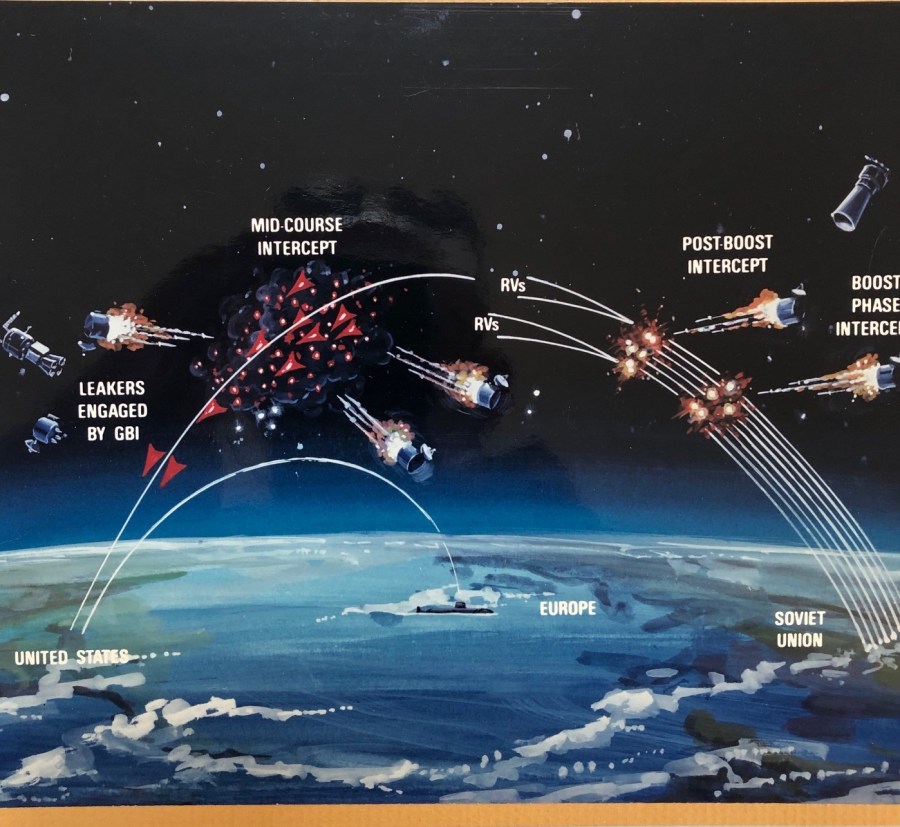
Brilliant pebbles are a really good idea, at least some scientists think so. No one doubts that the technology exists now to deploy thousands of small missiles (called brilliant pebbles) permanently orbiting the planet. These missiles coupled to an extensive space based satellite sensor constellation could automatically go after and intercept intercontinental ballistic missiles shortly after they lift off in their very visible boost phase. Burning boosters are very vulnerable to a high velocity collision with even a light object, and the boosters would come crashing down together with their lethal payloads possibly not even far from their launch area. Assuming that the sensors are operational and not spoofed, the automated decision process is reliable and most of the so called pebbles are in good working order, this low earth orbiting cloud of defensive missiles would greatly contribute to our defense against the ever greater proliferation of ballistic missiles and some of these might even have nuke payloads.

Some cost estimates of this defense investment do not seem unreasonable … but wait for the rest of the story. Any competent adversary who had counted on achieving a convincing threat would not be so happy with our deployment and would know far in advance about our plans and observe our deployment process. They might complain about our “militarization of space” and even threaten to put a stop to our bad behavior before we got too far into our plan. They might even do something nasty just to get our attention, and they might even use anti-satellite methods to harass and even destroy our early deployments. They might even start deploying their own missile constellation to tag along closely with our defensive missiles, and we might tell them to stop that and ask them to back off.  If we hurry up and get going before they can do too much, we could get our convincing defensive capability in place and declare our ownership of space and not allow further deployments of means to attack our purely defensive missiles. They might then turn their military investments to high power lasers on the ground that could over a period of time harass, blind and destroy our missiles and sensors. It turns out that low earth space orbits can be a very dangerous place if ground based high power lasers exist, but wait there are clouds that could get in the way, so they might not have the freedom of action they desire.

Another approach to laser deployment could be on high altitude aircraft that could operate above the clouds and conveniently track and shoot up at satellites. The laser power supplies would be chemicals that would have to be replenished, but there could be multiple aircraft, and the adversary could take their time to mess up our deployment. But wait there would be more to this story since we could attack the large, slow and vulnerable aircraft with our advanced fighter planes and their lasers that shoot toward satellites would provide them with no protection, so they might use their own advanced fighter planes to attack ours. By then we might have our own high power lasers on our fighter planes and we could defeat their lower power lasers, while they try to use their anti-satellite missiles against our purely defensive pebbles.

But wait, they might not be ready to start a space/air shooting war and instead attack our extensive but very vulnerable electric grid using their cyber weapons, which would trigger our own cyber-attack on their command, control, communications, intelligence (c3i). They might then try to destroy our c3i so we would no longer be able to manage the rapidly deteriorating chaos of our purely defensive pebbles. Somebody might even try to nuke somebody, or maybe their terrorist buddies could dump biological agents in a few of our cities, since nobody is managing the chaos, and things might get really messy real fast. Oh well, brilliant pebbles seemed like a good idea.

The Fallacy of the Last Move 2.0

Last year, Russian President Vladimir Putin putinannounced that Russia had developed the Avangard hypersonic vehicle that would soon be deployed and he claimed could defeat any sort of missile defense. The concept is a re-entry vehicle that would be launched on a ballistic missile and instead of continuing to its target on a predictable ballistic trajectory through space, it would dive down into the top of the atmosphere and glide to its target. It would glide along without propulsion and could maneuver over large distances so that interception would only be possible in the short time close to its eventual target. Such a maneuvering re-entry vehicle is not entirely new idea, but presumably the Avangard has solved the problems of targeting, maneuvering and high temperature materials.
 

If this technology is successful, then the warhead could be a nuke, or a high explosive or even a basket full of high density rods. The notion of hypervelocity rods is also not a new idea, and we used to call them ‘Rods From God’ (RFG) that could potentially strike any target on the earth with high precision and extreme lethality to any relative soft target such as an aircraft carrier or even somebody standing on the corner.  hqdefaultAnother application would be to strike a stationary high value target, say in a building, but with no collateral damage to the building next door. We used to call this a conventional precision strike on a time urgent target. The problem of getting to a target in a hurry is probably not the least of the limitations of such a weapon, since a precision strike would have to be accompanied by time-urgent precision decision making. The precision targeting would require time-urgent knowledge and might have to involve a close-in sensor that could perch and search before the weapon lurch. The aspect of very fast and very precise decisions probably requires that the entire process of reconnaissance of the area, surveillance of the specific target, target acquisition, target kill and kill assessment be automated. All of that seems very difficult, but certainly possible, and could mean that targets anywhere in the world would be vulnerable … unless they were underground.

Very impressive tunnel boring machines have been developed over the years, and a future of RFG weapons and societies hiding in tunnels is not entirely crazy. But wait there is more. If the only defense is the threat of a retaliatory strike, there would be no way to know if the warhead is a nuke or a conventional warhead. So a “relatively” limited attempt to bump off that bad guy on the corner could be misunderstood as a nuclear strike and lead to instant nuclear retaliation.  A predictable response to the Russian development would be our version of the same thing, and our similar programs are moving ahead with some urgency to catch up, so a future of unstable decision making on both sides is possible.

But what about the claim that no missile defense is possible? Back in the good old SDI days, we were concerned that ballistic missile countermeasures, such as decoys, could make defense against a large scale very competent attack ineffective, so we advocated boost phase defense to intercept the booster before it deployed re-entry vehicles and the inevitable countermeasures. I discuss this in great detail in my book “Death Rays and Delusions” available at https://www.amazon.com/Death-Delusions-Gerold-Yonas-Ph-D/dp/0692919554/ref=sr_1_1?crid=10EBJNPO83JNY&keywords=death+rays+and+delusions&qid=1560807394&s=gateway&sprefix=death+rays+and+%2Caps%2C182&sr=8-1. As I point out in the book, one approach to intercepting boosters would be fleets of small missiles permanently deployed in space and ready to be launched based on launch detection using space based sensors. This concept is being considered again, but my own preference to BPI is high power laser beams relayed by space based mirrors directed to the target, and projected from high power lasers on aircraft.

All of this discussion sounds a bit like the “fallacy of the last move” that I discussed in my Dec. 24, 2018, blog post (https://sdiguy.blog/2017/09/18/boost-phase-intercept-bpi-with-high-power-lasers-could-defeat-north-korean-missiles/), and the alternate path would be an arms control regime based on agreements and mutual trust that seems to be in short UN AGING 2050supply, so the weapons racing will likely just go on. I offered an alternate approach in my post based on my belief that we face the impending cash flow dilemma that I called the “Geezer Threat” caused, not by the much feared global warming, but what I think is more likely, global aging. The Soviet Union provided us with a good illustration that cash flow problems can destroy one of the most powerful empires in the history of the world.



The Art of Walking Away

Last month in Vietnam, two leaders of their countries sat down one-on-one to negotiate on the subject of regime survival and prevention of a nuclear war as the first step toward elimination of nuclear weapons in a region of the world. The two leaders had created a working relationship based on increased feelings for the other and even some level of fondness. Each had his own understanding of the other side, but both had incomplete information of what the other was really thinking. They both had confidence that they could use their interpersonal skill in persuasion to get the other side to go along in order to get along. In my view, the situation was not unlike what happened 33 years ago during the strategic weapon negotiations between Reagan and Gorbachev. Both meetings ended abruptly with no agreement because one of the participants walked away.
Reagan and Gorbachev
Donald Trump says sometimes you have to walk away from a negotiation since no deal is better than a bad deal, and, if you want to eventually make a good deal, it is best to walk away. There are arguments that this is what Reagan did at the Reykjavik summit in 1986, but I don’t agree.  Many analysts claim that Trump, like Reagan, was doing the right thing by walking away from a bad deal.  But the comprehensive U.S. and Soviet records of that summit in Reykjavik showed that Gorbachev walked away when they were on the verge of an agreement that would change the world. The deal fell apart because Reagan wanted to test SDI in space. Unlike Trump, Reagan did not walk away. In fact Reagan was almost on the verge of getting everything he wanted. Gorbachev was also close to getting everything he wanted, but at the last moments of their meeting, he walked away.

Contrary to some accounts of the event, Gorbachev did not demand the end of SDI, but he insisted that it stay in the laboratory for 10 years. He said, “It’s the laboratory or goodbye.” Reagan, however, argued that space testing was necessary to continue the program that he was willing to share.

What Reagan did not know was that the Soviets were preparing to test their own giant space-based laser weapon, and Gorbachev desperately wanted to stop it by getting Reagan to go along with his demand for the U.S. to “stay in the laboratory.” Faced with a crumbling society riddled with corruption, deception and economic mismanagement Gorbachev believed the only way to salvage the situation would be to put an end to the enormous commitment to ever increasing military budgets. Starting a new space weapons race was the last thing he wanted, and getting Reagan to go along with keeping SDI testing out of space would give him the leverage to put a stop to his own program.

As their negotiation reached its culmination, both Reagan and Gorbachev agreed to their shared vision to get rid of all nuclear weapons and they even agreed to go along with missile defense research, which was far from any realistic applications. Ten years of laboratory research would be a reasonable approach for the United States’ struggling program. The notion to jointly rid the planet of nuclear weapons and cooperate on missile defense to transition to a safer world was Reagan’s long term goal, and Gorbachev was in total agreement. Contrary to much incorrectly written about the Reykjavik summit, Gorbachev did not want to stop our SDI, he wanted desperately to stop his own SDI, and the price of the agreement was for all of us to “stay in the laboratory.” More than likely the military, industrial and congressional complexes of both super powers would have fought the agreement that almost happened, but the two global leaders had the opportunity to at least try to make it happen, but Gorbachev walked away, and Reagan had no idea why Gorbachev was so desperate to keep SDI in the laboratory. I believe they missed the best chance to gradually and eventually de-nuke the planet.

So what about an agreement to de-nuke the Korean peninsula? The key is not to walk away, but to convince Kim Jong Un to get what he wants as long as we get what we want. I believe we want to de-nuke North Korea, and Kim wants to stay in power. So we should start by agreeing to not threaten the North Korean regime, and they should agree to gradually and eventually get rid of their nukes. That does not sound so terribly hard to me as long as nobody walks and we keep on talking. In the meantime, as I have argued in this blog, we should deploy drone based missile defense to destroy any threatening North Korean missiles in their early flight. A jointly managed 10 year transition to reduced offensive threats, steady reductions in any nuclear weapons and a limited boost phase intercept capability would be a reasonable approach if the talks continue. Sadly, North Korean officials are now threatening to resume nuclear and missile tests. The breakdown of the Hanoi summit is the second time talks to achieve denuclearization have failed after a negotiator walked away.

It’s not a lie if you believe it

One of the most famous lines from the TV show “Seinfeld” was, “It’s not a lie…if you It's not a lie if you believe itbelieve it.” This concept also applies to intersection between science and politics. My last post discussed a commonly believed fallacy in the world of military technology development. The engineers and scientists who believe their latest invention will lead to certain victory and when they market that idea with the certainty of their faith, they are not lying.


One of the strongly marketed ideas currently for missile defense is the concept called “Brilliant Pebbles.” This idea has a long history going back to the 1958 Bambi

Brilliant Pebbles
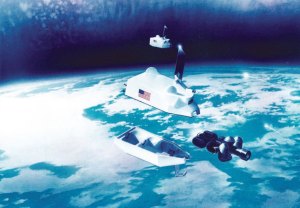
This image shows a Brilliant Pebble anti-ballistic missile interceptor emerging from its protective “life jacket”, the white shell. It shows an earlier model of the interceptor design with three fuel tanks, later designs had four much larger tanks wrapped around the missile body. A second Pebble remains inside its life jacket in the background. Several Soviet missiles are shown in the lower right, but these would be too close for the Pebbles to intercept.

concept of hundreds of space based missiles that would detect the launch of attacking missiles and destroy them early in their flight. The technology of the time was far from adequate, and the concept reappeared in 1979 as the High Frontier concept, advocated by General Daniel Graham who claimed the technology was off the shelf. The advocates believed they had the certain path to an effective missile defense, but the dream of the ultimate space based defense weapon in the form of giant spaced based lasers captured the imagination and funding of the Pentagon. The laser weapon funding grew rapidly after Reagan’s Star Wars speech in 1983, and the laser advocates believed they finally had the answer, but again technology was wanting and the funding drifted down after a few years.

The enthusiasm for small space based missiles was reborn as “smart rocks.” This

Pebbles presentation
In March 1988, Teller and Wood (on the left) present the original Pebbles concept to Reagan, Bush, Abrahamson and members of the SDIO. The model of the pebble was theatrically draped in black cloth to hide it from the reporters.

approach achieved enhanced support when Lowell Wood’s LLNL concept became “brilliant pebbles” that would be so small and inexpensive that they could be permanently deployed in space and do the job of boost phase intercept. That idea gained support for a while and then it died in the early 90s, but the true believers never lost faith, and the idea is back again, and is being touted, by Henry Cooper of the new High Frontier organization as a possible component of Donald Trump’s Space Force proposal.

The technology has advanced to the point that the new system concepts are focusing on cost effective approaches to actual deployment using the industrial adaptations of the new ideas for small satellites. With enough space based missile interceptors, there could be a multilayer defense all the way from boost phase, to midcourse, to early re-entry. So this is the new last move that will finally and certainly solve the problem of missile defense, and the Pentagon is showing interest. And the advocates believe it … so it is not a lie.deception

I believe that this “last move” is one more fallacy, and there are certain to be reactions to this latest “last move.” These reactions, called counter measures, can come in the form of physical attacks on the space based hardware including jamming of the communications, dazzling and blinding of the sensors and hacking of the software. The reaction to these countermeasures will be “hardening” to achieve a robust and resilient system to counter the countermeasures, and the advocates will claim they have the final answer this time, as modifications and enhancements will lead to program extensions and cost growth that were not anticipated, but everybody involved will honestly claim that nobody was lying when they provided the initial cost estimates.

Is there any way out of what will become a new escalating space race? Is there no way out? How will this new space arms race end? There could be negotiated agreements that we used to call “arms control,” but today’s global strategic environment is more complex than it used to be. Today Russia and the U.S. are facing space competitors from China and before too long India. But what about Europe, Japan and Israel? Here we go again with the warning of President Eisenhower to beware of the growing power of the military industrial complex. It is too late for agreements – so fasten your seat belts and get ready for a fast and very expensive ride toward an unknown outcome.