
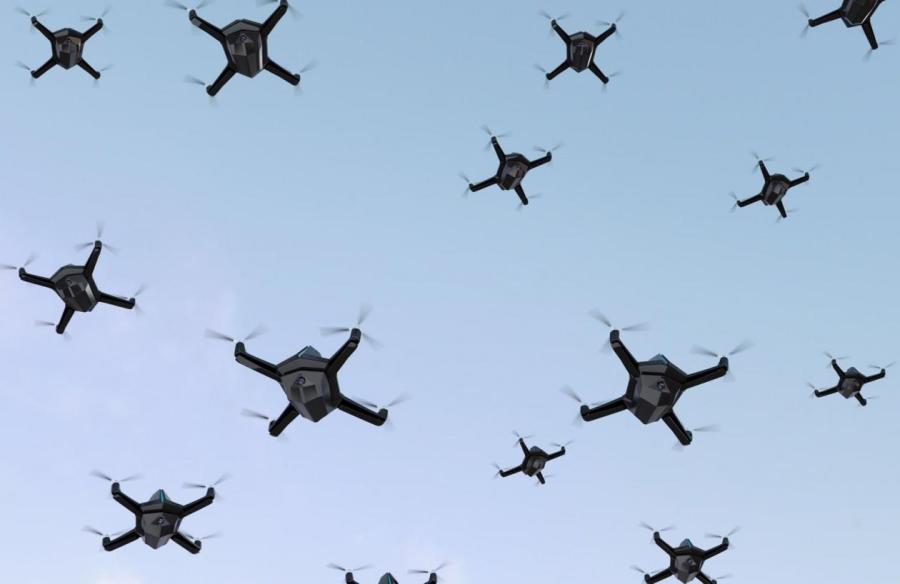
 In my last post, I imagined that a potential strategic threat from swarms of drones could be developed from existing technology. I speculated that a cargo ship in a harbor could deliver biological agents or radioactive clouds to large coastal cities. Such an attack would best be prevented through deterrence, but it might be difficult or impossible to determine the attacker. The counter to this strategic threat is certainly knowledge of enemy preparations and real time intelligence. We would need a declared policy in regard to such a strategic attack and we would need to figure out how to convince any adversary that we know more than they know.
A more likely near term threat would be on the theater battlefield where drone swarms could threaten land warfare systems, including armored vehicles. Even a heavily armored tank would e vulnerable to even a small explosive charge if delivered down the barrel of the main gun.
A recent article in the C4ISRNET reported that Russian engineers have proposed a concept called Flock-93 that would employ “hundreds of drones, each armed with an explosive charge” to attack “terrorists and high-tech adversaries.” The application of drones to theater warfare seems to be likely and the counter measures already suggested include “jammers, lasers, high power microwaves” and more speculatively even counter-robot swarms. Can you imagine a future war where the sky over the battlefield is filled with thousands of drones and counter drones?
The battlefield of the future will also be complicated by the dependence on C4ISR and use of attacks against information and surveillance capabilities. But, as the TV infomercials say, “But wait, there’s more.”  We already anticipate that space-based sensors and communications will be relied on and will be vulnerable to attack at the earliest stage of a conflict. Even before that, both sides in the conflict will heed the words of Sun Tzu, the 512 BCE Chinese philosopher who wrote in his classic work, “The Art of War,” “All war is based on deception.”
One of my favorite quotes from Sun Tzu is: “To secure ourselves against defeat lies in our own hands, but the opportunity of defeating the enemy is provided by the enemy himself.” If the reader is familiar with my book, “Death Rays and Delusions,” you will recall that I believe the Soviet Union provided the mechanism for its own defeat. I quoted a scholar of Soviet history, Vladimir Zubok, who wrote, “The strangest empire in modern history committed suicide.” The noted American historian on the Cold War, John Gaddis, agreed with my claim that the “Soviet Union might have been more interested in confining Soviet testing” than in worries about our testing of our space-based weapons.
So, getting back to Sun Tzu’s response to drone swarm attacks, the key will be to convince the adversary that the future application of such technology will be futile and even self-defeating, so they should not even try. The future is likely to be dominated, as always, by a mind war that I believe has already begun.


 announced that Russia had developed the Avangard hypersonic vehicle that would soon be deployed and he claimed could defeat any sort of missile defense. The concept is a re-entry vehicle that would be launched on a ballistic missile and instead of continuing to its target on a predictable ballistic trajectory through space, it would dive down into the top of the atmosphere and glide to its target. It would glide along without propulsion and could maneuver over large distances so that interception would only be possible in the short time close to its eventual target. Such a maneuvering re-entry vehicle is not entirely new idea, but presumably the Avangard has solved the problems of targeting, maneuvering and high temperature materials.
 Another application would be to strike a stationary high value target, say in a building, but with no collateral damage to the building next door. We used to call this a conventional precision strike on a time urgent target. The problem of getting to a target in a hurry is probably not the least of the limitations of such a weapon, since a precision strike would have to be accompanied by time-urgent precision decision making. The precision targeting would require time-urgent knowledge and might have to involve a close-in sensor that could perch and search before the weapon lurch. The aspect of very fast and very precise decisions probably requires that the entire process of reconnaissance of the area, surveillance of the specific target, target acquisition, target kill and kill assessment be automated. All of that seems very difficult, but certainly possible, and could mean that targets anywhere in the world would be vulnerable … unless they were underground.
 supply, so the weapons racing will likely just go on. I offered an alternate approach in my post based on my belief that we face the impending cash flow dilemma that I called the “Geezer Threat” caused, not by the much feared global warming, but what I think is more likely, global aging. The Soviet Union provided us with a good illustration that cash flow problems can destroy one of the most powerful empires in the history of the world.
