Beware of the swarm

Three years ago, I speculated in my blog that fairly low-tech unmanned aircraft, UAVs, or drones could defeat very expensive missile systems after a giant Saudi oil facility was attacked with high precision causing enough damage to reduce the global oil supply. Even though there was a missile defense system in place, the attack came from a swarm of small low-flying drones and cruise missiles that defeated the existing missile defense system.

I called for an increased emphasis on defense against this type of attack, and since then, there have been many worldwide new programs focused on developing this kind of threat as well as new defense systems. The recent Russian attacks on Ukraine’s infrastructure and the Ukraine attacks against Russian air bases appear to be a demonstration of what I expected, namely a fundamental change in offense and defense.

I pointed out in my post that swarms of such weapons to surprise and exhaust even the most competent defenses could mark a radical change in warfighting. I wrote that “drones could target critical parts of the exposed grid, disperse biological agents, target crowds at sports events, or even parking lots of shopping centers.” Unfortunately, my worst fears have come to pass with the Russians targeting the cities and critical infrastructure of Ukraine. Now Ukraine has struck back, and the nastiness is only going to be even nastier with more attacks from both sides. The balloon has gone up. But wait there’s more. The latest Ukraine innovation is drone killer boats backed up by flying drones to find and strike targets at sea. So the air, sea, and space application of killer drones is going to be the new way of war. But where there are new weapons, there are certain to be new counter-weapons.

With the development of fiber laser weapons with a power level of tens to hundreds of kilowatts, a realistic defense against drone swarms is possible if the tracking, pointing, and fire control system works reliably, and if the power supply is of an ample duration, and if enough of such defense system could become an affordable deployment … and of course, the weather cooperates. Boeing has created “an anti-drone death ray truck” that may defeat the ifs, but there are a lot of ifs and as usual, the offense is already a step ahead of the defense.

What about those new all-weather high-power microwave weapons such as the Ratheon Phaser to attack the controls and brains of the drones so that they become dumb rocks instead of brilliant pebbles?  High-power microwave weapons are being developed by many countries and they will be important.  This will be a story of brains versus beams, and the details will be written as the old game of offense versus defense is repeated again and again. In any case, there is no question that the game has begun and when new technology is created, people will find a way to apply that technology to warfighting.

An eventual development could be the proliferation of low-cost killer drones, and they could become the weapon of choice for ground forces, law enforcement, and maybe terrorists or even your neighborhood crazy guys who already are using weapons developed for the military. It is likely that such killer drones will initially be under the control of an operator, but quite possibly in a few years, they will be employed using artificial intelligence to search out and target predetermined targets when they are recognized by the smart sensor on the killer drones.

Survival of soldiers and military surface systems is possible if they can move, hide, defend, and shoot back, but there is not going to be a so-called “last move” in this contest of energy weapons versus drones. There may have to be an eventual change in the tactics of all surface warfare. It could be just too dangerous for high-value targets to try to survive above ground.  Maybe survival would be achieved by deploying in tunnels and caves. But what about drone swarms used by terrorists against civilian targets?  A logical step would be to ban such weapons, but we have not done this with assault rifles. Instead, children are trained to respond to an active shooter in their schools. I wonder if children will have to return to “duck and cover” when sensors detect a killer drone swarm approaching their playground?

Russian Scientist Reveals Secret of H Bomb Part Three

In 1977, our Sandia team responded to the competition with Russia with our own claim of successful e beam driven fusion only one year after Rudakov’s announcement. Our concept was called “magnetic thermal insulation,” and our experimental result called “the Phi target” was announced to have produced a similar number of neutrons as the Rudakov claim one year earlier. The basic idea was not amenable to simple analysis, since it involved extremely complex physics of the plasma stability of thermal insulation. At our annual review from the government and outside experts we learned it was not favorable to the plasma physics theory community, but is in fact a key attribute of today’s Sandia inertial confinement fusion program. We made no mention of the so-called Rudakov secret target, and both groups went different directions. An article in “Physics Today” helped to excite the feeling of competition between the two groups with a title: “Sandia and Kurchatov groups claim beam fusion” and we were happy to receive continuing funding, in no small part due to the “help” from our Russian friends.

Those of us with weapons clearances were sworn to protect the radiation drive concept, but this left room for speculation by the media. For instance one story claimed, “The Soviets are nearing a breakthrough in developing nuclear weapons 100 times more powerful than the largest current weapon–a gigaton hydrogen bomb–a doomsday bomb that could destroy the world in one blow.” Two prominent U.S. weapons physicists argued in private over whether to acknowledge the revealed concept and eventually the weapons community acknowledged that there was no longer a secret to protect. Both countries were off and running in a race to be the first to prove the concept that was called the hohlraum secret, except by then the very concept of radiation coupling to a fusion target had disappeared from any public discussion, and the concept no longer seemed to exist in the Soviet Union, or at least no more was said about it. 

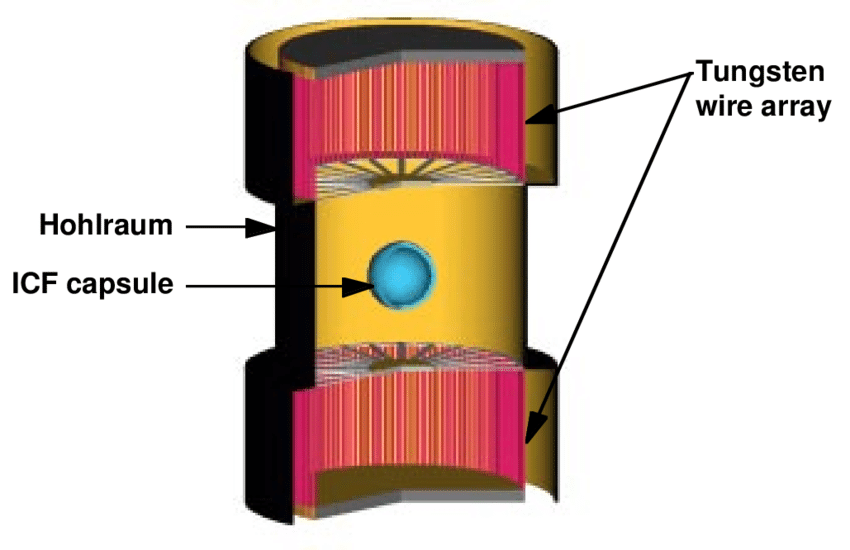
The technical problem we both faced became how to get enough energy into the hohlraum fast enough to do the job. Our simple calculations showed that would require 1000 TW, and that was almost inconceivable. We thought maybe the combination of radiation drive and magnetic thermal insulation might permit ignition at 100 TW.  At an international fusion conference in 1975, Rudakov had already published a concept for an e beam fusion reactor and the e beam was certainly not in the 1000 TW class.  Rudakov was not alone in rather wild extrapolation, since in 1974 we had already applied for a U.S. patent on an e beam fusion reactor concept and the patent was award in 1975 and expired in 1992, so I never got any royalties. I did publish a “Scientific American” article in 1978 entitled “Fusion Power with Particle Beams” and similar to the continuing saga of fusion “breakthroughs” claimed frequently, success was only 20 years away. 

By 1979, the Soviets announced that they were operating the first module of their machine called Angara 5, and they claimed as reported in “Pravda,” “When it is completed we hope to obtain a controlled thermonuclear reaction…producing more energy than it consumes … demonstrate that an industrial pilot plant can be built.” The “New York Times” picked up the story with a front page article “Soviet Reports Major Step toward a Fusion Plant.” The article went on to say the similar facility at Sandia is expected to start operation in a year and cited “the middle 1980s as a possible time when researchers may achieve a breakeven point … and another before a fusion reactor produces more power than it uses, opening the way for the production of a useful energy source.”

In 1981, the U.S. Department of Energy advertised their inertial confinement fusion program as proceeding toward a 1987 goal when, “ignition experiments at Sandia and at the Lawrence Livermore Lab, provided a simultaneous evaluation of trade-offs between lasers and particle beam drivers.” The Kurchatov group continued to innovate ideas for electron beams, and our group changed the focused beam approach from electrons to ions that could provide a more certain method to heat a thin shell. We pressed ahead with construction plans. Our timing for the change to ions was rather fortunate, because the Department of Energy had already decided our electron beam approach was a dead end, but I convinced the head of energy research that I was also “negative on electrons and positive about ions.” The race was on, and the participants believed the outcome was certain to be resolved in only a few more years.

By 1983, Rudakov’s group was silent about any more hohlraum ideas, and for the next 10 years I was not involved in the Sandia program.  After Ronald Reagan’s famous speech on March 23, 1983, to embark on a fundamental change in our strategic weapons investments from offense to defense, I was asked by former Los Alamos lab director Harold Agnew to work for three months with a team of experts from the labs and industry to put together a five-year Pentagon directed energy weapon plan. One concept was that a low altitude space-based constellation of powerful chemical lasers could attack and destroy the giant SS 18 boosters as they slowly rose above the atmosphere. There were many other concepts that were “imaginative.” After only a short time, Agnew told me he had become convinced there was “no pony in that pile of horse droppings,” and he became uninvolved in the process. 

We did complete a plan that we delivered to the president in the fall of 1983, and it became part of the $25 billion five-year proposal that went to the congress and Secretary of Defense Weinberger was dedicated to make it a reality. By then I was sure the entire venture was going nowhere, but the president had decided that missile defense could make nuclear weapons “impotent and obsolete” and few people realized that he hated nuclear weapons as much as he disliked Soviet communism.  A few months later, I was chosen by General James Abrahamson as his acting deputy and the Chief Scientist for Reagan’s Strategic Defense Initiative, AKA Star Wars program, with an assignment to help make the president’s vision a reality. 

Much of my two years in the Pentagon involved defending the program that I claimed was research to resolve the enormous number of questions about technology that the president claimed was almost ready for deployment. He repeatedly said he wanted to share everything we learned with the Russians if they would agree with us to give up all our nuclear weapons.  The scientific community, including many of the people I had worked with, were inclined to accept Agnew’s opinion, but one MIT professor advocated that we keep very secret anything we learned of value, but that we share everything that did not work. It seemed to me two years later that the technology was no closer than when we had started. The advances in offensive countermeasures moved ahead much more rapidly than the defense technologies. There were, however, actually two true believers that did remain, and one was the Ronald Reagan and the other was Mikhail Gorbachev, but that is yet a different story I published in an article entitled “Its Laboratory or Goodbye.”

After I left the Pentagon, and after a three years trying to manage defense contracts at a private sector defense contractor, I conclusively demonstrated my inability to manage cash flow. When I learned that Al Narath, who had hired me at Sandia in 1972 had returned to Sandia after a stay at Bell Labs, I decided to rejoin him at Sandia. Eventually I was reassigned back to the fusion program, and Narath, who had supported me in my early quest based on the promise of pulsed power engineering 20 years earlier, was becoming “a bit impatient.” Our work at Sandia had gone from the initial electron beam work in 1972, then on to EBFA, to the transition to ion beams on PBFA I, then the larger PBFA II that fired its first shot in 1985. The pulsed power technology was a success, but the problem was that the ion beam generation and focusing research was in a rut, and now a miracle was needed to get to 100TW and even the more daunting challenge of 1000TW.

Then the brilliant discovery involving many very creative scientists at several labs was that a pulsed power driven Z pinch could produce levels of radiation above 100 TW to drive a fusion capsule. The basic idea of the Z pinch is to slowly build up the power in a magnetic field that compresses and heats a plasma that implodes to high density and temperature, and then becomes a powerful source of radiation as it collapses on itself. The PBFA II sign came down, and the machined was renamed Z. The ion beam approach was discontinued in a burst of enthusiasm for the new way ahead.

After the demonstration of what I claimed was “the most powerful X-ray source in the world,” my marketing juices were flowing again. I proposed to use a two sided Z pinch hohlraum concept with an even larger machine I called X-1 that probably would require a $1 billion investment.  I advertised this idea in 1998 in my second “Scientific American” article entitled “Fusion and the Z Pinch” 20 years after my first installment in that magazine article on particle beam fusion.

The basic idea was to employ two identical Z pinches to drive a hohlraum at radiation power levels approaching 1000TW and with a pulse duration of 10 billionths of a second that could deliver 10 million joules to a target. That appeared from calculations to be the right amount of energy to ignite fusion burning and obtain high output gain. I was convinced we could reach our goal before the laser program at Lawrence Livermore National Laboratory could get there, but that competition did not make the Department of Energy happy since they had already decided that the National Ignition Fusion (NIF) laser approach was the right way as they brilliantly demonstrated last year, over 20 years after they convinced the DOE that I was wrong, as they achieved fusion burn demonstrated with NIF and two sided irradiation using 192 laser beams delivering almost 2 million joules to the hohlraum. 

My marketing activity, however, resulted in my permanent removal by DOE from the program in 1998. My Russian friend also departed from their ICF program and he left the Kurchatov Institute and immigrated to the United States. His colleague Valentine Smirnov became the head of the Russian program that was concentrating on the Z pinch approach. The Sandia pulsed power program continued and prospered without my further interference, with an upgrade leading to improvement in machine performance and diagnostics leading to several scientific discoveries related to materials at extreme temperatures and pressures.

Now the Sandia program has changed course again and is focusing on a new concept called MagLIF for ignition based on a Z pinch to implode a magnetic thermally insulated and laser preheated cylindrical target. Ironically, the use of magnetic insulation in a pulsed power driven target was what I had proposed with electron beams in the Phi target. 

The hohlraum is essential to the NIF laser fusion approach, but is no longer part of the chosen concept at Sandia.  I would, however, not be surprised if the advantages of trapped and symmetric radiation-driven implosion may be reinvented someday, possibly in China.  The history of foreign competition seems to be repeating itself as the Chinese have claimed to be building a machine “20 times more powerful than Z,” which is probably an exaggeration, but I am sure it will be in the 1000TW range–that is if it really is funded. Their publications demonstrate a thorough knowledge and ability to harness the needed modern pulsed power technology. 

It has been 25 years since the Sandia approach became the use of the Z pinch, and to celebrate that event, the seven Sandia pulsed power directors who have provided leadership for the pulsed power science program since 1978, came together last year to share their memories and provide the incentive to continue the journey on a path I started over 50 years ago. The advance of science and technology continues, but sadly it seems that human behavior has not improved that much. It seems now that Reagan and Gorbachev had a rather good idea about eliminating nuclear weapons after all. 

Russian scientist reveals the secret of H bomb, Part Two

Let’s return to the story of the Russian scientist who revealed the secret of the H bomb. In an earlier post, I explained how, in 1976, “The New York Times” reported that Soviet scientists had made a fusion breakthrough using electron beams. None of the physics of this Russian breakthrough had been revealed. The scientific community was anticipating some sort of an announcement at an upcoming conference; however, the big disclosure actually began on a beach in Santa Barbara, California three months after “The New York Times” ran the story. Lyonid Rudakov, my colleague and friend from the Kurchatov Institute in Moscow, and I sat on the sand in a hastily arranged, totally private and completely unexplained meeting at high noon.

Rudakov had asked me to meet him. On the way to “the secret meeting,” I wondered if this was some scene from one of those spy movies. We sat there in silence, and then Rudakov reached for a twig and drew a simple figure in the sand beginning with an empty cone, much like an ice cream cone without ice cream. Then he added a thin curved layer. He explained that the drawing was of a conical indentation in a lead plate. Then he explained that there was an outer shell composed of a thin gold layer, curved in a spherical shape. Inside of that was a thin plastic shell containing thermonuclear fuel. The outer shell was heated by the tightly-focused electron beam and when it became sufficiently hot, the inner shell was heated by radiation. The thin inner shell then imploded into the conical shape, compressing and heating the thermonuclear fuel and producing a reaction output consisting of a pulse of about 1 million fusion neutrons.  My jaw fell open. My friend, a Soviet scientist, was revealing the secret and extremely closely-held concept of radiation-driven fusion weapons.

That evening Rudakov was scheduled to give a paper describing his work, and I, representing the competing U.S. program, was to introduce him at the after-dinner meeting at the Gordon Conference. Conferences such as that were low key opportunities for scientists to share unpublished work. The conference rule was that the information shared be held until a real publication was released. Rudakov must have known that what he planned to share was certain to shock many of the attendees who were from nuclear weapon labs, and I guessed that he did not want to surprise me that evening in front of the crowd.  For some reason I never understood, Rudakov had received permission to reveal this radiation-driven concept as essential to his use of electron beams to ignite a fusion reaction. He was prepared to share his results widely during his visit to the U.S.

In the following days, Rudakov went on to visit U.S. nuclear weapon labs and deliver the same talk, but by then, the government had warned anybody involved not to repeat anything. The FBI followed up by confiscating the blackboards used in the presentations. Rudakov was rather casual about the entire episode, but he did make one serious request during his visit to the United States. He wanted me to know that I needed to help him with a desperate problem. I wondered if that scene from that imagined spy movie was about to take place. I was in for a shock.

Rudakov explained that he wanted to buy a pair of blue jeans. He could not return to Moscow without the garment that was impossible to get in Russia.  I was relieved that I was not involved in some mystery, and took him to the local shopping mall. We went to several stores, with a variety of options and different prices.  Rudakov looked confused. He asked me why there was not just one price determined by the government. He could not cope with the free market concept and went away empty-handed. He was obviously disturbed by this interaction with the American economy.

At the same time, Rudakov never seemed to realize the swirling controversy he had created in the nuclear weapons community. His disclosure was a major development in fusion research. The fact that the Russian experiment had been revealed, but not explained, caused quite a stir. Earlier, “The New York Times” had only whetted the appetite of its physics readers, but nobody knew about the use of a radiation-driven implosion. A few months later, the entire event became the talk of the physics world. One widely accepted science magazine ran the headline: “Thermonuclear Fusion: U.S. Puts Wraps on Latest Soviet Work.”

Rudakov was anxious to spread the word that they were going ahead with building a giant electron beam machine that would cost 50 million rubles and would supposedly achieve fusion ignition. Scientists who did not know the secret of the H bomb were bewildered. The reason for the secrecy was not that the U.S. government was worried about classified information leaking out to the Soviets, but that the Soviet secrets would leak out to others. One scientist commented, “The work at Sandia was classified but the same work in the Soviet Union was unclassified.” Everyone involved was faced with mind numbing contradictions.

One thing was clear however: the Soviets were ready to race with us. I knew that their creation and advertising of a competition would help them enhance the credibility of their program help them obtain funding for further research. Of course that would not be so bad for us either.  The race really had become well-known three years before at the fusion conference in Moscow. At that 1973 meeting, Rudakov had announced they were embarking on a program to achieve fusion using electron beams to heat a BB sized spherical pellet filled with thermonuclear fuel. He neglected to mention the radiation drive. He claimed then that a few million joules would have to be deposited in the heavy metal shell of the pellet in a pulse of a few nanoseconds. The requirement was for a beam of 1000 trillion watts, and the highest power machine that they had was only 1 trillion watts. Their plan was to build a machine only in the 100 trillion watts range. Now, the use of a radiation-driven thin shell seemed to explain the contradiction. The breakthrough was the radiation-driven implosion.  It now appeared that the much lower power level would be useful using a low density, thin-walled target driven by radiation. They had neglected to mention that in 1973.

I should point out that was more to this competition than innovative physics, but in the U.S. we had the advantage of our ability to rapidly exploit modern technology that was driven by our free market economy and development of technology. Rudakov had an economics lesson trying to buy jeans, but he was not alone in learning about the economics of his competing country. The Moscow meeting was held at the giant Moscow University built in Stalinist style in the 1950s. I will never forget the giant ornate auditorium where I made my presentation. I also remember the food at the cafeteria.  I never resolved the mystery of that strange fruit-like liquid substance. I ate it, but I still wonder what it was.

I was staying at the enormous, slightly rundown Rossiya hotel overlooking Red Square, advertised as the largest hotel in the world. It was a fairly cold June and they had disconnected the heat for the summer. The hotel’s elevator operator, a nice old Russian grandmother who spoke no English, seemed rather disturbed when I complained to her in my version of broken Russian/English about the temperature in my room. I rubbed my body to demonstrate how cold I was. Apparently, she didn’t conclude I wanted an extra blanket, but rather another, more intimate, source of warmth. I tried not to feel insulted when she laughed vigorously in response.

I also had time to walk over to the giant Gum department store looking for some souvenirs to take home. I found long lines of depressed looking, shabbily dressed people and totally empty counters. I also found a nearby store for tourists that only accepted American money. The so-called Beryozka had a fantastic collection of Russian folk art including beautiful amber jewelry and the obligatory Matryoshka dolls. I discovered a fine woven tapestry that cost $73, the equivalent to 150 rubles. It hangs on my wall today and is pictured in the image accompanying this blog post. I was continually impressed with the creativity, the culture and the scientific discipline of the Soviets, but found their ability to develop commercial products and technology applications seemed to be frozen in the past, just like the architecture of Moscow University.

At the meeting in Moscow, we announced the results of our similar electron beam fusion program and claimed ignition would be possible at only 100 trillion watts based on our concept of an electromagnetically stopped relativistic electron beam. We were planning to build a machine we called the Electron Beam Fusion Accelerator or EBFA. When I told my Russian colleagues that the machine was called EBFA, they intentionally mispronounced the acronym to sound like a Russian insult that went with the Russian word for mother.

Nobody had a clue for a concept of a 1000 trillion watts electron beam accelerator, so both teams worked on other ideas for power multiplication or new ideas to reduce the theoretical power requirement. The threat of violating classification rules in effect put a break on not just implementing, but even thinking about any concepts involving radiation-driven implosions. I wondered if we had already lost the race. As it turned out, we responded with our new invention that I will explain in my next post, part 3 and the last installment of this true story.

Are you kidding?

Are you kidding … nobody would believe that. You can’t be serious!

I am writing a sci/fi novel that tries to make a coherent fictional story somewhat based on the real history of death ray inventors and their inventions.  A portion of the true story is recounted in the book “Death Rays and Delusions” about my exploits as the chief scientist for Ronald Reagan’s SDI aka Star Wars program. My soon-to-be published novel, called “The Dragon’s CLAW” draws upon a real story that will cause the reader to exclaim, “Are you kidding… nobody would believe that. You can’t be serious.”

This totally true story begins with H G Wells’ 1897 “The War of the Worlds” that includes Martian invaders using infrared beams, or “the sword of heat,” that melt the metal weapons of the earth defenders. Hard to believe, but the primary space based laser weapon developed for the SDI program in the 1980s was a real sword of heat, an infrared laser called Miracle. It was going to be deployed in space and would have required miracles to ever be feasible. There is a famous picture of Ronald Reagan standing in front of a giant mock-up of the nonexistent laser weapon. But we were not alone in inventing miracles, and the Soviet Union developed their own version of a space based laser, and went far beyond a mock up. They even tried in 1986 to deploy parts of it on the world’s largest booster, Energia.

But let’s go back to the 1930s when the Serbian genius, Nikola Tesla, who probably should have, but did not receive the Nobel Prize for his electrical engineering inventions, designed a particle beam weapon that he claimed could defend the U.S. against “10000 enemy air planes at a distance of 250 miles.” It was not seriously pursued until after he died, and then after the start of WW II, the FBI seized his papers and asked MIT professor and Donald Trump’s uncle George to analyze them, but he saw nothing of value. As a footnote to this history, Donald claimed in 2020 that his uncle was a genius and “It’s in my blood. I’m smart.”

The idea of particle beam weapons, actually relativistic election beams, was resurrected in 1958 by ARPA, now called DARPA, to defend ships at sea and the entire U.S. against attacking reentry vehicles. The so called See Saw concept was to build giant electron beam accelerators that would generate beams that could bore a hole in the atmosphere and deliver a killing pulse to the attackers. The fatal flaw was that the beams whipped around like a giant high pressure fire hose, and sometimes even turned back and struck the accelerator.

The concept was dropped, but was replaced by an old Soviet idea from the 50s to use the electron beam to trap and accelerate ions to relativistic velocities. The collective forces of the electron beam would trap the ions that would reach billions of volt energies accelerated only over distances of meters. This Collective Ion Acceleration concept that we called the “CIA” would become a practical way to produce stable particle beams, and the intelligence community thought that the Soviets were up to their old tricks at an enigmatic facility at their nuclear test site in Kazakhstan.

The site was called a possible nuclear test site and its nickname was PNUTS. Satellite photos of the site became a mystery that attracted the attention of many U.S. physicists, some of whom thought it was a “CIA” facility, but most were sure that their own programs needed more funding because of what the Soviets were doing. The famous U.S. magazine “Aviation Week,” with the nickname Aviation Leak, because it often seemed to know real secrets, claimed it was a particle beam weapon facility. Indeed the head of the U.S. Air Force Intelligence organization went public in 1977 claiming the Soviets had made a breakthrough and their new weapon could neutralize our entire strategic deterrent.

The real CIA asked several accelerator physicists to stare at the somewhat blurry photos, to get help to solve the mystery, but eventually the intelligence community turned to remote viewers in a psychic phenomenon program called Stargate to visualize the goings on at this enigmatic facility. One of the viewers, who was given just the geographical coordinates, and without any help from any satellite photos, made a drawing of a giant crane that was moved on eight wheels over the facility. A friend of mine visited after the end of the Cold War, and sent me a photo of that crane.

Even though the use of PNUTS had nothing to do with beam weapons, its phony reputation allowed the Soviets to attract unknowing scientists to this god forsaken part of the world, only to be disappointed that it was only a nuclear rocket test facility. We also had such a program but canceled it because of environmental issues, but they continued for decades and just made the program invisible and a total enigma to us.

There was one very serious U.S. directed energy program and that was the development of a nuclear explosion driven X-ray laser, but we were not the first to consider such nuclear powered weapons. The Soviets claimed that a “nuclear explosion creates a stream of metallic fragments of small mass that travel at more than 10 kilometers per second, and are capable of string targets in space, including warheads, with a direct hit. One underground test showed the potential plausibility of accelerating a small mass to high speeds.”

The Soviets also claimed that we were far ahead of them in development of nuclear powered weapons, and they could catch up with us in 10 years if we were slowed by an arms control agreement, but even the early advocates of this approach became discouraged after initial experiments. One of the early strong supporters who was Reagan’s chief scientific adviser, later called the directed nuclear weapons “unadulterated lies,” but I recall Edward Teller requesting an acceleration of the test program, and claimed “the president has already promised these additional funds … and do you really want me to go back to the president and say the money is not available?”

There were other mysteries during my SDI career like the claim by the editor of the biggest Arizona newspaper that the SDI radar facility in the Pacific was really the location of the alien space craft that we were back engineering, and that I was in cahoots with the aliens based on my studies as an undergrad at Cornell University. The editor suddenly departed from the scene when it was discovered that he was a fraud and had no experience that matched his phony uniform, trophies, and medals and the story of my alleged treachery never appeared, although I have a copy.

The particle beam quest was not dead, however, and use of electrons to neutralize ion beams was supported for several years by SDI as a space weapon. That program was canceled when support for SDI energy weapons drastically declined. After the end of the Cold War, the U.S. then proposed to develop a neutral beam accelerator in a joint U.S./Russia nuclear reactor powered space NPB program for planetary geology research.  The Pentagon then decided it was really interested in starting up a new NPB space weapon program and in 2018 announced it was planning a development program leading to a test in space in 2023. Then in 2019 without a lot of notice, the Pentagon announced it was not that interested in the NPB after all because it was too far off, but lasers, the original sword of heat from 1897, was now mature enough to move forward aggressively, and real advances in solid state lasers have energized an accelerated program.

One should not discount the inventiveness of energy weapon advocates, and yet another new weapon that is being supported is based on powerful microwave generators.  Some even claim that such weapons are the cause of the “Havana Syndrome” that messes with the minds of diplomats. Now after many claims of fear of foreign attackers, the CIA says that of “2000 U.S, officials in diplomat posts worldwide” who have claimed symptoms, most are not really from foreign attackers but from some sort of a natural malady. But what about the rest? A CIA panel of “experts” concluded some “small number of the cases …a plausible explanation is a directed pulsed radio frequency energy.”

Can you believe any of this? Well, the true story goes on. Truth may be stranger than fiction, but stay tuned for the fictionalized version, coming soon.