Are you kidding?

Are you kidding … nobody would believe that. You can’t be serious!

I am writing a sci/fi novel that tries to make a coherent fictional story somewhat based on the real history of death ray inventors and their inventions.  A portion of the true story is recounted in the book “Death Rays and Delusions” about my exploits as the chief scientist for Ronald Reagan’s SDI aka Star Wars program. My soon-to-be published novel, called “The Dragon’s CLAW” draws upon a real story that will cause the reader to exclaim, “Are you kidding… nobody would believe that. You can’t be serious.”

This totally true story begins with H G Wells’ 1897 “The War of the Worlds” that includes Martian invaders using infrared beams, or “the sword of heat,” that melt the metal weapons of the earth defenders. Hard to believe, but the primary space based laser weapon developed for the SDI program in the 1980s was a real sword of heat, an infrared laser called Miracle. It was going to be deployed in space and would have required miracles to ever be feasible. There is a famous picture of Ronald Reagan standing in front of a giant mock-up of the nonexistent laser weapon. But we were not alone in inventing miracles, and the Soviet Union developed their own version of a space based laser, and went far beyond a mock up. They even tried in 1986 to deploy parts of it on the world’s largest booster, Energia.

But let’s go back to the 1930s when the Serbian genius, Nikola Tesla, who probably should have, but did not receive the Nobel Prize for his electrical engineering inventions, designed a particle beam weapon that he claimed could defend the U.S. against “10000 enemy air planes at a distance of 250 miles.” It was not seriously pursued until after he died, and then after the start of WW II, the FBI seized his papers and asked MIT professor and Donald Trump’s uncle George to analyze them, but he saw nothing of value. As a footnote to this history, Donald claimed in 2020 that his uncle was a genius and “It’s in my blood. I’m smart.”

The idea of particle beam weapons, actually relativistic election beams, was resurrected in 1958 by ARPA, now called DARPA, to defend ships at sea and the entire U.S. against attacking reentry vehicles. The so called See Saw concept was to build giant electron beam accelerators that would generate beams that could bore a hole in the atmosphere and deliver a killing pulse to the attackers. The fatal flaw was that the beams whipped around like a giant high pressure fire hose, and sometimes even turned back and struck the accelerator.

The concept was dropped, but was replaced by an old Soviet idea from the 50s to use the electron beam to trap and accelerate ions to relativistic velocities. The collective forces of the electron beam would trap the ions that would reach billions of volt energies accelerated only over distances of meters. This Collective Ion Acceleration concept that we called the “CIA” would become a practical way to produce stable particle beams, and the intelligence community thought that the Soviets were up to their old tricks at an enigmatic facility at their nuclear test site in Kazakhstan.

The site was called a possible nuclear test site and its nickname was PNUTS. Satellite photos of the site became a mystery that attracted the attention of many U.S. physicists, some of whom thought it was a “CIA” facility, but most were sure that their own programs needed more funding because of what the Soviets were doing. The famous U.S. magazine “Aviation Week,” with the nickname Aviation Leak, because it often seemed to know real secrets, claimed it was a particle beam weapon facility. Indeed the head of the U.S. Air Force Intelligence organization went public in 1977 claiming the Soviets had made a breakthrough and their new weapon could neutralize our entire strategic deterrent.

The real CIA asked several accelerator physicists to stare at the somewhat blurry photos, to get help to solve the mystery, but eventually the intelligence community turned to remote viewers in a psychic phenomenon program called Stargate to visualize the goings on at this enigmatic facility. One of the viewers, who was given just the geographical coordinates, and without any help from any satellite photos, made a drawing of a giant crane that was moved on eight wheels over the facility. A friend of mine visited after the end of the Cold War, and sent me a photo of that crane.

Even though the use of PNUTS had nothing to do with beam weapons, its phony reputation allowed the Soviets to attract unknowing scientists to this god forsaken part of the world, only to be disappointed that it was only a nuclear rocket test facility. We also had such a program but canceled it because of environmental issues, but they continued for decades and just made the program invisible and a total enigma to us.

There was one very serious U.S. directed energy program and that was the development of a nuclear explosion driven X-ray laser, but we were not the first to consider such nuclear powered weapons. The Soviets claimed that a “nuclear explosion creates a stream of metallic fragments of small mass that travel at more than 10 kilometers per second, and are capable of string targets in space, including warheads, with a direct hit. One underground test showed the potential plausibility of accelerating a small mass to high speeds.”

The Soviets also claimed that we were far ahead of them in development of nuclear powered weapons, and they could catch up with us in 10 years if we were slowed by an arms control agreement, but even the early advocates of this approach became discouraged after initial experiments. One of the early strong supporters who was Reagan’s chief scientific adviser, later called the directed nuclear weapons “unadulterated lies,” but I recall Edward Teller requesting an acceleration of the test program, and claimed “the president has already promised these additional funds … and do you really want me to go back to the president and say the money is not available?”

There were other mysteries during my SDI career like the claim by the editor of the biggest Arizona newspaper that the SDI radar facility in the Pacific was really the location of the alien space craft that we were back engineering, and that I was in cahoots with the aliens based on my studies as an undergrad at Cornell University. The editor suddenly departed from the scene when it was discovered that he was a fraud and had no experience that matched his phony uniform, trophies, and medals and the story of my alleged treachery never appeared, although I have a copy.

The particle beam quest was not dead, however, and use of electrons to neutralize ion beams was supported for several years by SDI as a space weapon. That program was canceled when support for SDI energy weapons drastically declined. After the end of the Cold War, the U.S. then proposed to develop a neutral beam accelerator in a joint U.S./Russia nuclear reactor powered space NPB program for planetary geology research.  The Pentagon then decided it was really interested in starting up a new NPB space weapon program and in 2018 announced it was planning a development program leading to a test in space in 2023. Then in 2019 without a lot of notice, the Pentagon announced it was not that interested in the NPB after all because it was too far off, but lasers, the original sword of heat from 1897, was now mature enough to move forward aggressively, and real advances in solid state lasers have energized an accelerated program.

One should not discount the inventiveness of energy weapon advocates, and yet another new weapon that is being supported is based on powerful microwave generators.  Some even claim that such weapons are the cause of the “Havana Syndrome” that messes with the minds of diplomats. Now after many claims of fear of foreign attackers, the CIA says that of “2000 U.S, officials in diplomat posts worldwide” who have claimed symptoms, most are not really from foreign attackers but from some sort of a natural malady. But what about the rest? A CIA panel of “experts” concluded some “small number of the cases …a plausible explanation is a directed pulsed radio frequency energy.”

Can you believe any of this? Well, the true story goes on. Truth may be stranger than fiction, but stay tuned for the fictionalized version, coming soon.

Remembering the Russian scientist who revealed secret of H bomb

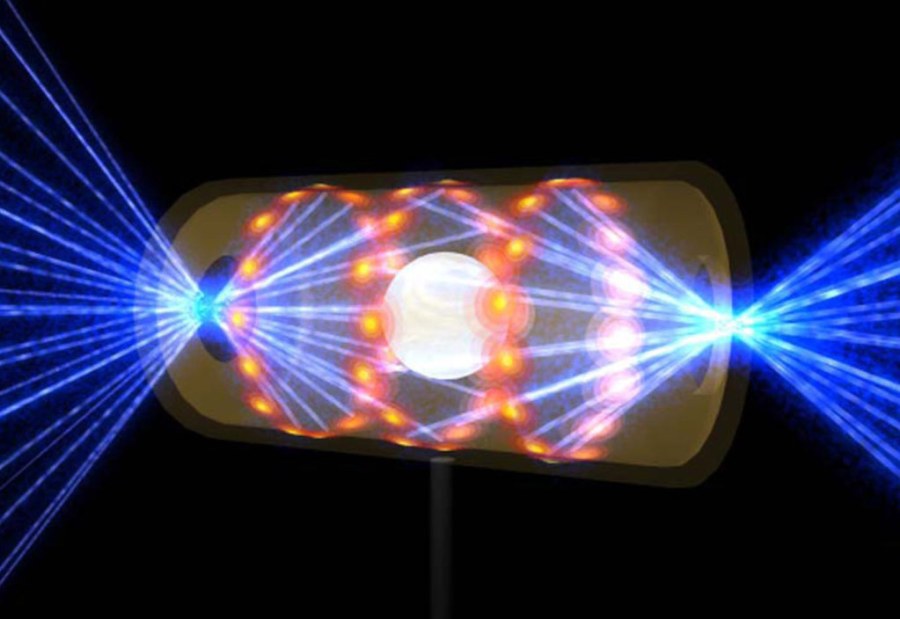
It is widely known that one promising way to create fusion in the laboratory is called inertial confinement fusion (ICF). It is based on the concept of spherically imploding, compressing and thus heating thermonuclear fuel. Indeed, the recent laser fusion breakthrough at the Livermore National Laboratories demonstrated efficient hot spot ignition and self-heating of cold fuel. There were many complex requirements in this outstanding technical achievement, but probably the most significant was spherically symmetric implosion of the fusion capsule. This was accomplished not by directing the 192 ultra high power laser beams at the target, but instead heating the inner walls of the tiny chamber containing the fusion pellet, and using the radiation trapped in the chamber to symmetrically heat the pellet. This chamber is called a hohlraum, which is a German word for a hollow volume of cavity in a structure. When I first became interested in fusion research, I had no notion of this vital ICF concept. In fact, just revealing the very idea of heating the target with indirect radiation rather than direct heating by the laser beams would have resulted in a severe penalty, or even jail time. Today, the hohlraum concept is totally unclassified.

In 1967, when I became interested in fusion, I knew that the physics worked well in the sun and in H bombs, but I knew little else about the subject. I was attracted to work for a small startup company that was pioneering work on pulsed power technology. This was a very new field of electro technology dedicated to creating machines that generated very short pulses of electric power levels of 1 trillion watts (TW).  The purpose of these machines was to create laboratory sources of pulsed radiation to test the vulnerability of reentry electronics faced with an H bomb tipped missile defense. The issue was to determine the exact vulnerability of the electronics to such a pulse. I was drawn to that company, Physics International, not because of the question of missile electronics vulnerability, but because the founders of the company had previously been H bomb development leaders at the Lawrence Livermore Lab, and they convinced me that such machines could be used to make a tiny H bomb explosion in the lab using the new pulsed power technology.

On a warm and clear day in June 1971, at the University of Wisconsin student union, I met with a well-known plasma physics theorist, Lyonid Rudakov, from the Kurchatov Institute in Moscow. He and I sat there in the sun like old friends drinking coffee and chatting about the subject of creating fusion with electron beams.  We were both in our thirties, and had just met and learned that we had a common interest in using high intensity electron beams to create fusion. I knew exactly what I could and could not discuss, and I had no idea about the connections of Rudakov to any Soviet secret information. Rudakov was very outgoing and obviously comfortable with people he did not know well, and from the first I recognized that we had one thing in common. We both were in the business of marketing our ideas on fusion to get funding.

As we talked, we shared a fantasy of building giant pulsed power machines, maybe hundreds of times bigger than anything in existence, and focusing relativistic electron beams onto BB size pellets. Rudakov already had an established program at a major Soviet research laboratory, and I, with no continuing government program support, was mostly concentrating on getting funding every year for my small program dedicated to simulation of nuclear weapons effects. I knew that I would never get very far with my vision unless I established a major program in a national laboratory.

One year later, I found that there were others who shared my fantasy, and I moved to Sandia National Labs in Albuquerque. After I received my clearance, the first question I asked was about the physics of the H bomb. I learned that the highly protected secret was the use of a fission device to produce radiation and it was the radiation trapped in a hohlraum that drove an implosion and fusion ignition. I thought that electrons, if they could be focused highly enough, could be used instead of radiation. I invented an imaginative, if not realistic, program based on my published very early experimental work with electron beam focusing but still with no real quantitative knowledge of the power level that would be needed for fusion ignition.

Rudakov had the backing of the most influential Soviet scientific/political engineer but I was unknown in the scientific community. I had a vision and motivation based on my experience at my first job after I completed my Ph.D. at Caltech. I received my Ph.D. in Engineering Science and Physics in 1967 and continued on at the Jet Propulsion Lab where I had done my research on magneto fluid dynamics since 1962. The lab had failed six times to take close-up photos of the surface of the moon and was faced with a major transition. The question that they were trying to resolve was if the proposed moon lander would sink into deep dust.  Unfortunately their payload, called Ranger, either was destroyed during the launch or crash landed time after time with no data. Although the lab went on to success, they had decided its job was exploring space and not basic research. My small fluid physics group was disbanded and they gave me the opportunity to move on, and that resulted in my first job as a new Ph.D. Married, with a 1-year-old daughter, I was highly motivated to succeed.

When I got to Sandia I found out that since the U.S. had agreed with the Soviet Union to prohibit anti-ballistic missiles, funding for development of nuclear weapons and lab funding had decreased. There would be a 10% reduction in force. I was a first level manager, but my quota for the layoff was to fire one person, and I was given freedom, as my boss said, “Go out for a pass.” The misfortunate layoff had a silver lining since I had the support to do something Sandia was not too experienced with, namely lobbying the Congress for funding.

After spending a lot of time getting to know our representatives from New Mexico and prowling the halls of Congress, I managed to influence Senator Joseph Montoya, who was primarily known for his somewhat inadequate but televised questions when he served on the Senate Watergate Committee. He was not a technically educated person, but he was sympathetic and told me he always rooted for the underdog. When he learned we were competing with a powerful lab in California that already had funding for laser fusion, he agreed to try to get minimal startup funding for my program. I also had support from the fusion research organization at the AEC because they also were happy to create competition with the laser program managed by the weapons division. This caused a negative reaction from the weapons program to my dealing with the “wrong organization.” I agreed to accept weapons program funding that was far more generous as long as I had no more dealings with those “research guys.”

Our plans were not advertised publicly until the July 1973 European Conference on Controlled Fusion and Plasma Physics in Moscow. At that meeting I together with my Sandia colleagues, who were as new to the game as I was, claimed that very high current electron beams could be self magnetically stopped in a thin shell driving the implosion, and could achieve fusion breakeven with “extensions of present day technology.” Rudakov, together with a well-known Soviet mathematician from the Institute of Applied Mathematics, carried out detailed calculation of the needed power for 1000 TW and they included the vital concept of self-heating of the fuel after ignition as demonstrated last year on NIF “only” 50 years later with 1000 times more energy than they had originally calculated in 1972.

After the meeting in Moscow, Rudakov and I became technical colleagues with reciprocal visits, and we continued to share information as both of us advertised the start of major competitive programs. Sandia began construction of prototype devices at power levels of a few TW, and advertised the development of a machine in the 100 TW class, but both of us were competing with the rapidly growing programs in the U.S. and Soviet Union that had much more funding for the use of high power lasers. I knew that electron beams created with low cost and efficient pulsed electrical power would be far more energetic than lasers. I guessed that even if millions of joules would be needed for ignition, it would be a more reasonable approach than the very expensive and inefficient lasers.

The LLNL results were achieved using the NIF laser to deliver 2 million joules to heat the walls of a hohlraum containing the fuel pellet and using the symmetric flow of energy in the hohlraum to heat the outer surface of the pellet. The physics of the hohlraum is based on the fact that the heated cavity walls come into thermal equilibrium with the energy in the cavity, delivering energy symmetrically to the fuel capsule. The reason for the closely held secret in the 70s was the idea of using the radiation in a hohlraum to implode and heat a fusion capsule. This is called the Teller/Ulam principle, the secret of the H bomb.  The H bomb concept relied on a two stage process with the radiation from a fission explosion to heat and compress a fusion device, but that was very secret in the 70s.  The reason for the high level of secrecy was not because we were afraid the Soviets would get the secret, which we knew they had, but for fear others would catch on and that would lead to proliferation of hydrogen bomb technology. So both programs progressed, but Rudakov knew something he was not sharing. In 1976, he announced with no details that his lab had produced the first fusion reaction using electron beams. The March 1976 “New York Times” reported, “Russians report fusion using electron beams,” but with no details. There is more to this story, to be continued in my next blog post.

Liars, Truth Tellers and Bullshit Artists

Telling false stories has become a subject of increasing media in the past couple of years. “The Washington Post” has made a full-time job of keeping track of Donald Trump’s communications and they reported that he had “accumulated 30,573 untruths during his presidency, averaging 21 erroneous claims a day.” I never tried to count the falsehoods, but I do recall that he said Obama was born in a foreign country, that Mexico would pay for the wall, and that drinking a little bleach would counter Covid. I have to admit that my previous blog posts were rather naive and simplistic about lying, and I quoted George Constanza of the “Seinfeld” TV series as the expert when he claimed,” it is not a lie if you believe it,” but I realize that is a simplistic evaluation of a very complex subject that needs more thought. 

Now the stories about lies and liars have reached such a crescendo that we hear about the “the big lie” constantly from both the left and right. The Trump believers, who are a majority of Republicans, say that people who claim Biden won the election are lying. Similarly people who voted for Biden say the Republican leadership consists of liars. Liz Cheney, however, a senior Republican member of the House of Representatives, says that the people in her own party who claim the election was stolen from Trump, are spreading The Big Lie and are “poisoning the democratic system.” The Chief of the Joint Chiefs of Staff, Mark Milley, said Trump was “preaching the gospel of the Fuhrer” and the implication is that Trump is using the big lie to convince his followers to support his claims. He also described today’s political chaos as the “Reichstag moment.” 

The terminology of “The Big Lie” is a historically significant application of this specific descriptive language, and has been used to describe the writings not just of Hitler, but also other evil world figures. These comments lead me to see what one might learn from the past, and I recalled an old book, “The Mind of Hitler.” This 1973 book was the first publication of an OSS secret intelligence report written by Walter Langer, an American psychiatrist in 1943. The goal of the report was to understand enough about Hitler’s psychology to predict what he would do as his empire collapsed. I reread this old book looking for hints not about the mind of a recognized evil personality, but why he had so many loyal followers.

I have no education in these subjects, but what he wrote was really disturbing. One quote from his report seemed to tell a vitally important story. “People will believe a big lie sooner than a little one, and if you repeat it frequently enough, people will sooner or later believe it.” But I wondered why there were so many followers ready to go along with the big lie. I guessed that there had to be more to the loyalty than to just the consequences of accepting and even really believing the lie, and I learned from Langer’s analysis that there was something else a lot deeper and a lot more troubling than just a charismatic leader telling a good story to a gullible population.

Langer’s analysis of the “unconscious tendencies of the German people” is worth considering, and he claims that “they had lost control of their individual mental processes.” Now that is a truly frightening possibility that, as Langer claims, “a peculiar bond that exists … beyond the control of any purely rational, logical or intellectual appeal.” While I have never studied group “mental processes,” I always wondered what brought the German people to go along with the big lie and its consequences for the world, and I found no explanation. 

But then I looked a lot deeper into the subject and found a more persuasive analysis from the writings of Harry G. Frankfurt, a well-known Princeton philosophy professor. His 2005 book “On Bullshit” provided me with a different point of view that is worth considering. He described truth tellers, liars and bullshit artists. He says that both the truth teller and the liar “responds to the facts as he understands them” but the bullshit artist does “not reject the authority of the truth as the liar does…he pays no attention to it at all.” So my initial quote from Constanza is misguided, and should have been, “It is a lie if you believe it, and it is bullshit if you don’t care about your beliefs; you just want to persuade somebody to go along with your arguments.”

Frankfurt wrote that the bullshitter makes assertions “without paying attention, to anything except what it suits one to say.” He goes on to say that bullshit is “unavoidable whenever circumstances require someone to talk without knowing what he is talking about.” Now that came across to me as a very good description of many of the talking heads that are interviewed on the so called news shows every day, and indicates to me that we need to come to grips with the bullshit that seems to be spread around. Stinking bullshit spread uniformly in a thin pervasive layer around today’s public communications is a more frightening image than fighting for truth.  

Many analysts have recently written that “bullshit is more dangerous than lies, since it erodes even the possibility of truth existing and being found.” I found this hypothesis to be the most serious challenge of modern mass communication since that there are so many communication tools available to practically everybody, as Frankfurt says “whether or not you know what you are talking about.” 

So, in my view, the job of the media is to expose the bullshit artist rather than engage in arguments and endless counter arguments about debatable facts. But how to do that is not at all clear without knowing what the communicator really believes.  Frankfurt ends his brilliant essay with a conundrum to determine if the communicator is sincere, and to determine if the communicator is being “true to his own nature,” and he concludes that “our nature… is less stable and less inherent than the natures of other things… and sincerity itself is bullshit.”

Lies and liars

My most popular blog post during the past three years has been about lying. I wondered why there was so much interest in that subject. Upon reflection, I have concluded that our preoccupation with lying stems from our inability to access factual information and sift through the vast piles of alternative facts. We are increasingly faced with mass communication that is filled with lies, counter lies and even more lies. So I guess my readers would like to know more about lying… assuming I tell them the truth.

In 1984, in my job as Chief Scientist for President Reagan’s Star Wars program, I learned about the evolution of misinformation. I continually faced the dilemma of representing a program that lacked a fact-based and timely technical foundation, but I advertised it realistically as a research program to uncover the facts. Congress, of course, was not so happy to fund an enigma that Reagan said was a sure thing. Meanwhile, I expressed a desire to answer the myriad serious questions provided that we received the $25 billion we said we needed. I estimated that it would be at least five years before we could say whether or not Reagan’s promises to protect all of us were true. Reagan really hated both nuclear weapons and the Soviet Union’s communism based government, and his logic was to somehow eliminate both of those things.

I have learned that at first most public officials in the world of politics, science, technology and medicine capture the trust of their political allies. Their claims are thought to be truths. Then their political detractors accuse them of telling outright lies, followed by denials and more accusations. Even the widely respected Dr. Fauci has now been accused of lying about wearing masks and recently about funding the Wuhan lab and has had to defend his case.

What I found then and over the years was that the true believers were not interested in considering any facts. I eventually learned that the Soviet military industrial complex was selling their own SDI, and Gorbachev had no choice but to go along with their ill-fated attempt to launch their own SDI killing Death Star called Polyus.  Their chief engineer and program leader believed their space-based laser could dominate space. The United States’ advocate of space control, Edward Teller, made similar claims about his pet project, the X-ray laser. Secretary of State George Shultz and Reagan’s White House scientific adviser had serious doubts. Were both the U.S. and Soviet leaders lying to their citizens?

Today, the most widely accused purveyor of doubtful claims is Donald Trump, but many believe Trump’s statements and claims. A majority of Republicans believe Trump really won the election but widespread voter fraud stole the election from him. His lawyer, Rudy Giuliani, was apparently sincere in repeating Trump’s claims but he was disbarred from practicing law because the court said he was “knowingly making false statements.” A lawyer is not supposed to defend their client by misrepresenting the facts. Even as a technical adviser to the SDI program, I was warned by the legal staff at the SDI to never ever, ever lie to Congress under any circumstances, but also to not volunteer too much of the truth. My approach was to provide extensive technical information that the questioners would find confusing and dull.

When it comes to lying, it is also possible that the communicator actually may believe his claims are true. This may be the case with Giuliani. A person is not lying if that person believes their own claims. If the claim is a blatant factual falsehood and the audience is predisposed to believe it, then it will be repeated and embellished and become an even more outrageous lie that the true believers will repeat and often even invent nonexistent evidence to support the lie.

If the believer observes only the sources of information that are biased in one direction, then it is likely that the lie will get reinforced with no opportunity to consider contrary points of view. Once believers share the lie widely they will have their own self-images and reputations at stake and will ever more forcefully defend the lie, so that even doubters start to believe the blatant lie. The doubter can easily begin to wonder, “Well, maybe there could be something to this story after all, and maybe I was wrong to doubt the storyteller.” The key to convincing the doubters is to repeat the lie over and over again, and it seems that with enough repetition, the lie can become a belief.

My clarinet teacher once told me that the brain can be trained with enough repetition, and the only way to ever learn chromatic scales was to practice over and over again. She said this so often, I believed her, and accepted that it was only my lack of discipline that kept me from becoming the next Benny Goodman. So it seems that through forceful repetition, my brain was trained.

Big lies repeated frequently with no contradictory information have become widely accepted. This is damaging to our democracy—a form of government that demands free speech and informed decision making by an educated and intelligent population. Many of us make decisions without investigating the “rest of the story” as Paul Harvey, the radio commentator, used to say. The solution to this problem is to consider alternate points of view. Watch and read a variety of news sources from different perspectives. Give equal time to both CNN and Fox News. My wife argues that I do not practice what I am now preaching, and it will be really difficult, but I will try. Thomas Jefferson wrote that  a well-informed citizenry is a prerequisite to democracy. So, if you are worried about liars, lies and the people who believe them, stay informed, use your critical thinking skills and help expose falsehoods before they become accepted as facts.