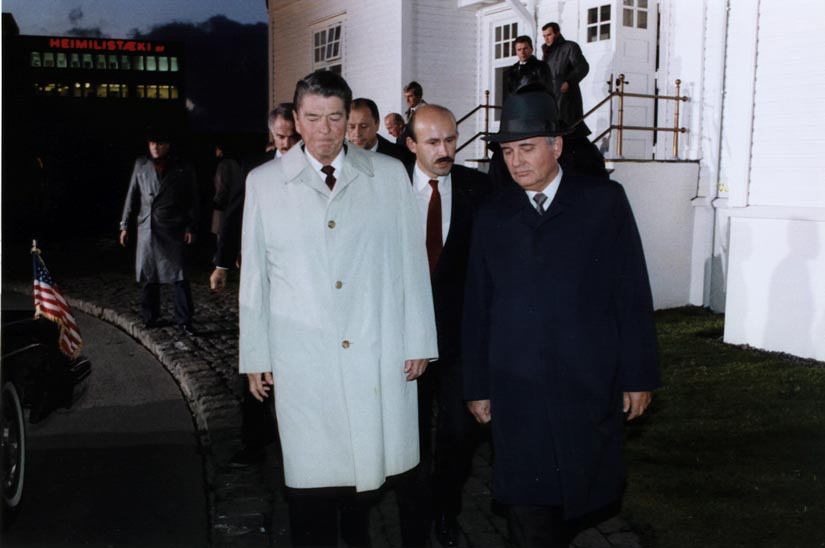
Reagan and Gorabchev leaving Reykjavik

1986 and 2020, Part Two

The new actor on the Soviet scene in 1986 was Mikhail Gorbachev. After the deaths of three Soviet leaders since 1982, Gorbachev became the new head of the Soviet Union in 1985. He immediately found that he was faced with managing total economic collapse and political chaos in competition with the most powerful Soviet force, their own military industrial complex. He seemed to be an idealist committed to open communication and restructuring and faced a never-ending collection of problems. He pressed on nevertheless with enthusiasm, optimism and charm.

One of Gorbachev’s first initiatives was to wage war against alcohol, which he believed was one of the reasons for the failure of the Soviet economy, but he only managed to cut off a major source of government income from the Soviet vodka monopoly. The alcohol kept coming, however, and the illegal vodka income then went instead to their own version of the Mafia. Soviet historian Vladimir Zubock described these events writing, “The Soviet socialist empire, perhaps the strangest empire in modern history committed suicide.”

Well, maybe Soviet suicide is a bit of an overstatement, but there really were enough serious troubles facing Gorbachev to cause at least a feeling of overwhelming depression. In April, the Chernobyl reactor disaster, the worst nuclear power plant accident in history, causing more than 300,000 people to be resettled, threw Gorbachev into a desperate lack of trust in Soviet technology. And there is more to this sad story. In September, the pride of the limited Soviet fleet of luxury cruise ships collided with a freighter in clear weather and hundreds of wealthy Soviet citizens died leading to a nation overcome by “pessimism and foreboding.”

Some people believe the superstition that bad things come in threes. The third blow struck in 1986 and it may have been the worst. The event was the sinking of a Soviet nuclear submarine, but that was not the first time that such a disaster happened. In 1968, the K129 nuclear missile carrying submarine sank to a depth of 5000 meters in the Pacific 2700 kilometers from Hawaii. After the Soviets failed to locate it, a U.S. ship found it, and an enormous, technically fantastic and very secret CIA program called Azorian tried to lift it, but it broke apart on the way up and it was never revealed publicly what we recovered. When remembering the history, it is easy to confuse 1968 with 1986 and K129 with K219, but let’s try to get it straight.

In October 1986, the K219, one of their ballistic missile submarine with 34 nuclear warheads, sank within 1000 kilometers of Bermuda, but this time there was no problem finding it since a trailing U.S. submarine was watching the disaster. At first, the Soviets blamed the disaster on a collision with our submarine Augusta, and I can imagine that Gorbachev, who was actively engaged in negotiating with Reagan to put a stop to any more high-tech competition with the U.S., was stunned when he got the message that the sub was on fire. I imagine he felt a sense of desperation and had given up on competing with the United States. In a bit of additional mystery, a Soviet deep water research probe found later that the sub was “sitting upright on the ocean floor with empty missile tubes dangling open.”

Gorbachev was in no mood to compete and was even prepared to give up all of the Soviet nuclear weapons. His only condition for mutual abolition of nukes was our agreement to “10 years of research in the laboratories within the treaty” and he made it clear ‘it’s laboratory or goodbye.” I think he did not want the Soviet “death star” to be launched and he knew he could not put a stop to his own aerospace industry enthusiasts creating a new weapons race unless we first agreed to keep our program out of space. So my argument not accepted by the real experts, is that he was more worried about the SDIsky than the SDI.

Maybe he thought he could turn around the course of economic and technological history in 10 years, but Reagan would not go along, even though he hated nukes. The problem was that he believed we were ready and able to deploy defenses, which of course was false. In my opinion, the Soviet Union was on the way out even without our “help” because of its moral decay and mismanaged economic and political institutions. A nuclear agreement might have helped us deal with the global spread of nuclear weapons and maybe even contributed to an economic turnaround for the failing Soviets. Instead, the world still has more than enough nukes to go around, including North Korea. In addition, there is the growing capability of Iranian program, even without their “top nuclear scientist.” Well, some things don’t change and space-based lasers are still far off in the future.

But maybe there are lessons to be learned from the events of 2020 and we won’t have to make the Soviet mistakes. The world has seen plenty of surprising and horrible recent catastrophes, but there is reason. I had hoped that our new United States president would not be faced with the same sort of economic, political and social mess that confronted Gorbachev only 34 years ago. Maybe, I thought, we can solve some of our own economic and public health problems, and figure out a way to just “learn to get along” both within our borders and with our adversaries in other countries. That is, before Jan. 6, 2021, in the words of FDR, “a day which will live in infamy” that has exposed our own socio-political frailty.

My view was even becoming optimistic after the presidential election, until I realized that many of the governance problems that Gorbachev faced, are looming in our own future. Possibly we cannot avoid the seemingly inevitable repeat of wide spread self-destructive decision making of nations under stress. It seems that a nation cannot easily avoid reacting poorly to its history of traumatic events, but I hope we have learned our lessons.

Oh, one more thing about history. And that is what happened a few months before Beckurts was murdered. He and I had a very nice meeting to talk about German involvement in the SDI. My goal was to get him to agree to a contract that would support our program. Over lunch in an elegant German restaurant, he explained to me in no uncertain terms that his company did not support the SDI and had no intention of participating.
Schools need multi-layer COVID defense

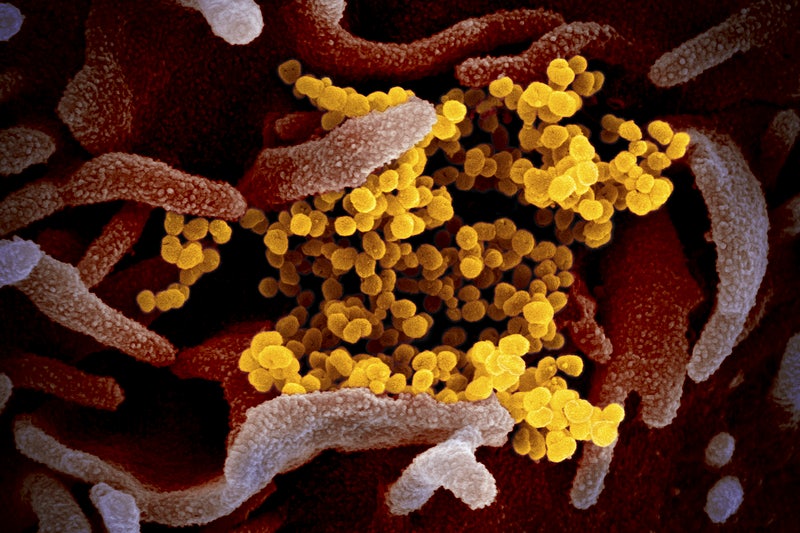
In my April blog post, I suggested a multi-layer defense against the COVID-19 pandemic that is plaguing the world, and since then, the response has been inadequate. That is, except for the miraculous development of vaccines, which should hopefully in the near term greatly improve our survival and return our normal lives if used as the first layer of defense.

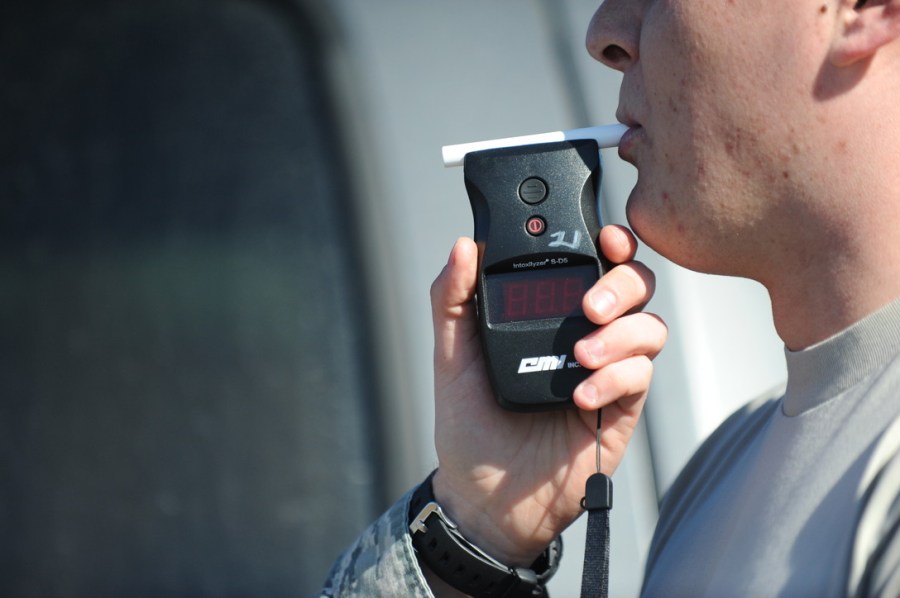
As the second layer, I proposed an approach that involved a virus detection breath analyzer at the portal to a virus free facility.  The device would instantly detect a potential spreader of the disease, prevent the entry and preserve the safety of the occupants. I am not aware of any progress toward such a sensor, but I am optimistic that such a sensor will eventually be developed. Nevertheless, we have learned that such viruses mutate and others will appear and I suggest we will need to develop and deploy methods to protect all indoor facilities in the future, and the most immediate need is to open our schools.

We all want the kids to be able to go back to school, interact with their class mates and their  teachers, but instead they are sitting at home staring at a computer, which is admittedly likely to be increasingly the route to education. Nevertheless, in-person learning will still be necessary for at least part of all  educational experiences. We are told by the epidemiologists that the primary problem with indoor education is the danger of becoming infected by sharing  other  people’s air. In my April post on multi layer virus defense, the last defense layer for schools has to be virus free air in the class room. A major modification of the ventilation in schools including HEPA filters would certainly help, but that might be impractical or  prohibitively expensive particularly in older construction. So a reasonable near term approach would be the use in each class room of a portable air purifier using a HEPA filter that includes a sensitive and specific sensor to detect a virus in the intake air flow. The sensor could set off an alarm when detecting a virus and would require putting on masks and evacuating the room.

Several months ago, I suggested, based on published  reviews of virus detectors,  a real time bio/optical virus sensor that would be both specific and sensitive, and I am sure that many researchers are pursuing this approach as well as many other virus detectors.  Even with successful near term development of vaccines, and eventually portal monitors, schools will still need air purifiers and virus warning systems, as common as today’s smoke detectors and fire suppression systems in all clas rooms. In my opinion, the system engineering, manufacturing and deployment of smart air purifiers in classrooms should be given the highest  priority.

Introducing the COVID Defense Initiative (CDI)

Gerry Yonas introduces COVID Defense Initiative
Illustration by Jenna Gibson

On March 23, 1983, President Ronald Reagan gave a televised address on national security that surprised everyone as he challenged “the scientific community who gave us nuclear weapons to turn their great talents now to the cause of mankind and world peace to give us the means of rendering these nuclear weapons impotent and obsolete.” His brief words led to the creation of the Strategic Defense Initiative (SDI) and initiated my involvement in a giant program that, although it did not lead to an effective missile defense, did effectively flummox the Soviet Union.

Now we face a global health, economic, political and social threat that could possibly be as risky for all of us as the strategic missile threat we faced in the 1980s. I think we need to approach this real threat from a systems engineering approach, starting with a presidential call for action not just to the bioscience community, but also to the nation’s engineering community.

What I am suggesting is a multilayer defense involving detection and response similar to the concepts we created in the 1983 Fletcher Study. I described this study in my book “Death Rays and Delusions” and the basic approach was an information-based layered system of systems. The needed technology did not exist at that time and is still not available, so the notion of applying this methodology to a very dangerous, contagious and asymptomatic virus may seem a bit unrealistic The biggest deficiencies at that time were the need for space deployed high sensitivity and high specificity sensors, directed energy and kinetic interceptors and the command and control for the entire system.

I may be overly optimistic, but I am suggesting that the COVID Defense Initiative can provide an extremely useful approach. The virus defense technology needed for this system is no more available today than the technology we needed 35 years ago for the SDI, but now is the time for the national commitment and investment to make it real.

I envision a future system beginning with a readily available real time virus detection system. The  reliable sensors would be coupled through the Centers for Disease Control and Prevention National Syndromic Surveillance Program to other symptomatic measurements and would provide the means to identify the threat and track it using millions of other simultaneous data sources.

Facility design would be required to prevent the infected person from entering an otherwise virus free location. A next step would be an immediate antiviral treatment  that might be provided using an inhaler. If the detection, reporting and treatment are included in a widely available system of systems, we could achieve a highly effective defense system that could be coupled with a vaccine to reduce the probability of infection. This multilayer approach would reduce the probability of spreading of the disease. As in our multilayer SDI system concept, there would still be a threat, but the probability of infection would become acceptably small .

Multi-layer missile defense and the coronavirus

My suggested missile defense approach to defense against the coronavirus would require a layered defense involving a  futuristic breathalyzer and inhaler.

I assume the virus is mostly transmitted by droplets in coughs, but the problem of pneumonia is caused by virus in the lungs,  not the nose or throat.  So I suggest the first layer of defense would be to examine a person who tries to enter a previously sterilized facility through a secure positive pressure  revolving door. The interior of the revolving door would be sterilized to intercept any virus on the person.

The person would first blow into a breath analyzer that would capture the air from the lungs.  After a strong exhale into the collector, a breath analyzer would detect any virus in exhaled droplets. An as-yet-to-be-developed sensor could be an instant  laser induced fluorescence and spectral analyses.  I assume the fluorescence is unique, but this needs to be determined. This is similar to the mid course discrimination problem where we require an excellent ROC curve.

This sensor could be embodied in a miniaturized virus  breathalyzer including a miniature laser and light spectrum analyzer. If the sensor is very sensitive, but not very specific, an  RNA based very specific real time sensor  might  be necessary after the first  positive reading.

If the virus is detected, the next layer would trigger the intercept of the virus. This would be an inhaler function possibly attached to the analyzer that sprays a virus killing drug into the lungs. Such drugs have  already been demonstrated in vitro and are being tested in hospitals.

If the result is a true negative, the person is allowed to enter the already certified facility. The next layer is needed if the person is detected as a true positive, and after treatment with the inhaler,  entrance is prohibited by the door.

The next layer of defense begins with a GPS labeled  signal that is sent to the defense management computer. Information giving the detection and treatment  information then permits contact  tracking and follow up of the person.