Heraclitus, QMU, and Laser Fusion

Heraclitus had many famous quotes, but the one I often remember is, “No man ever steps in the same river twice. For it’s not the same river and he’s not the same man.” My take away from this is relevant to many of the complex problems I have worked with over my 50 odd years of dealing with various science and technology problems. Also, I can claim without contradiction that my career has never been blemished with even a single success.

For some reason, I always seemed to be interested in really challenging problems that were limited by not just engineering and physics, but also by constraints of politics, economics, and human decision making. I have written about this general class of problems that are best described as “wicked.” They are characterized as not having any closed form solution. Working on such problems provides the participants with alternating experiences of euphoria and utter depression. Maybe that is why poor Heraclitus had a problem crossing a river.

People in charge of maintaining the United States’ nuclear weapons stockpile are facing a particularly wicked problem. Their job is to assure that the weapons are safe, secure, and reliable… but without the ability to fully test them by detonating any of these weapons. This approach is called Quantification of Margins and Uncertainty (QMU).  It is a process of highly diagnosed but sub critical experiments and comprehensive computer simulations to allow decision making about the risk involved in the performance and reliability of the stockpile.

An extremely important and challenging aspect of this program is the use of lasers to ignite fusion ignition in the laboratory. The recent experiment at the National Ignition Facility (NIF) recently demonstrated fusion ignition with more energy output than delivered to the target by the lasers. This is the first time that actual “fusion ignition” has been achieved in a lab.

In my Feb.23 post “Fusion Fact or Fiction,” I explained the seemingly “miraculous” achievement involving many tradeoffs on nonlinear variables adjusted over years of complex experiments and calculations requiring continuing political support with ever-increasing budgets. I stated then (and as far as I know now) the achievement has yet to be repeated. The lab director explained recently, “We haven’t had the kind of perfect capsule that we had in December.” Perfect capsules will require a “perfect” budget.

An additional issue is the performance of the laser. Pushing the laser to its limits causes damage to the optical system that is expensive and time consuming to fix. There is also the political pressure created by the association of fusion research with the desire to develop the ultimate clean, cheap, unlimited source of energy.  

So, how can leaders deal with this wicked problem? I think the methodology that will be useful is QMU that focuses on establishing the needed margins of performance of all the components of NIF experiments that will have uncertain outcomes. Each experiment will be a different man stepping into a different river.  Heraclitus would certainly get his feet wet, but he might get swept away.

Truth versus Fiction

Truth may be stranger than fiction, but fiction is more fun.

At the end of 2022 when Lawrence Livermore Laboratory achieved a major fusion breakthrough, my novel, The Dragon’s C.L.A.W. was already at the printers.  This struck me as amusing, since the book tells the story of a fictional clean energy breakthrough. In the novel, scientists at Los Alamos National Laboratory create a compact clean low-cost energy source using electron beams to trigger a Low Energy Nuclear Reaction that generates electromagnetic energy and then directly convert that into electricity.

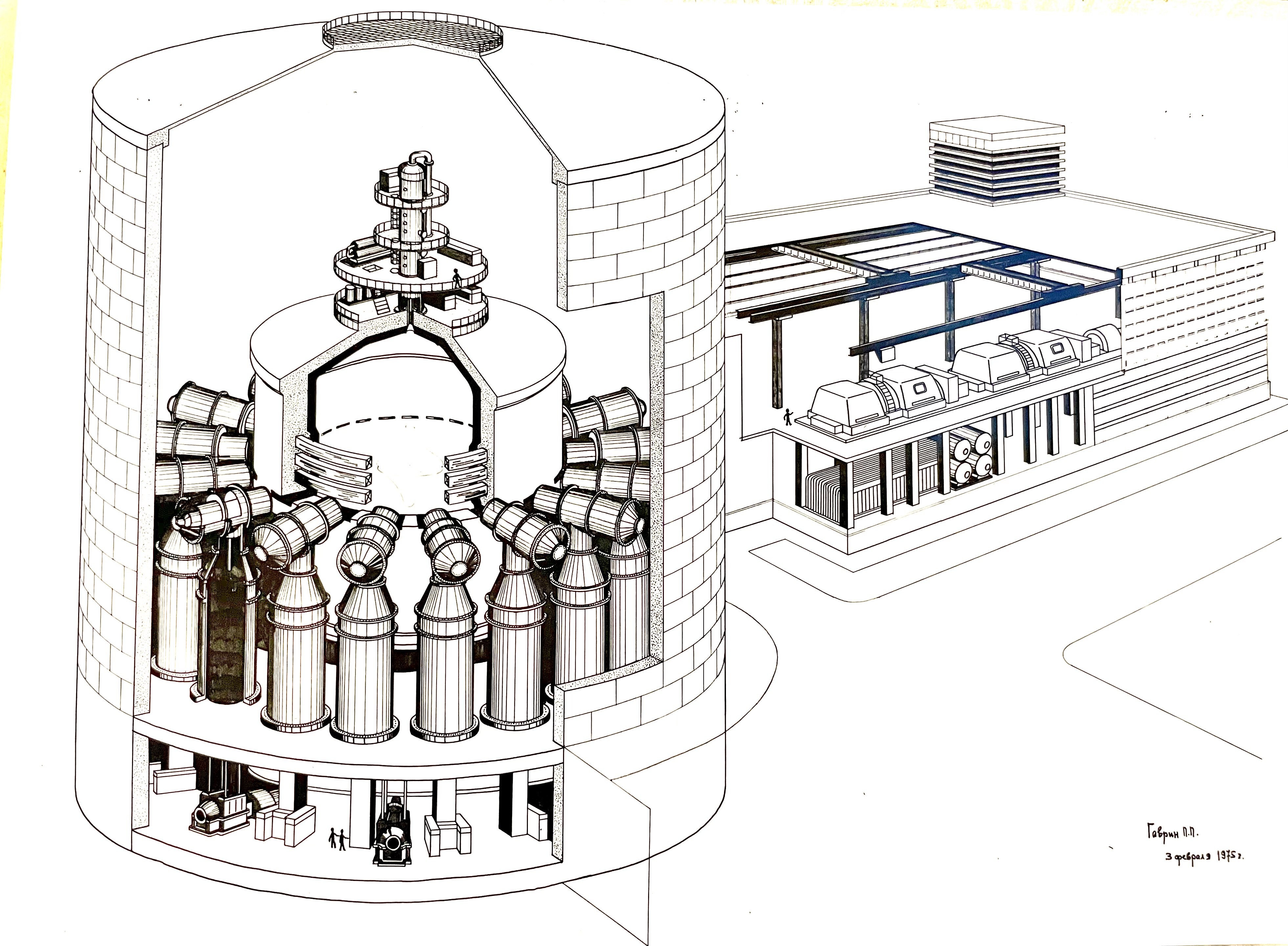
Russia’s 1975 electron beam fusion reactor

The fictional breakthrough discovery is an accident that generates one thousand times more energetic output.  In addition to intended entertainment, my book’s basic messages are first that surprises happen in research when one’s imagination, creativity and enthusiasm is as important as careful well-founded analysis. My second theme is that discovery of new science is like a knife. A knife can be used to butter your bread or slit someone’s throat. Technology is a literal double-edged sword. I believe that there will always be applications of scientific achievements that are both civilian and military—that can be used for peaceful innovation or for weapons of war. I also believe that there will always be people who can invent and stimulate ideas as well as people who know how to stand in the way of progress. The path to scientific innovation often involves the sort of characters that appear in the pages of The Dragon’s C.L.A.W. 

I spent much of my career striving to achieve a breakthrough that could lead to clean, unlimited energy. Now, as an author I have created a fictional breakthrough that reaches that goal. So, naturally that begs the question—will scientists achieve that fusion goal in real life? When it comes to recent fusion breakthroughs, the rhetoric is exciting and invigorating. Examples of recent not too specific government fusion statements are “a game changer for efforts to achieve President Biden’s goal of a net-zero carbon economy,” and “new ways to power our homes and offices in future decades.” When I read such announcements, I cannot but help remembering Reagan’s Star Wars speech in 1983 that the goal of his missile defense program would make “nuclear weapons obsolete.” The outcome of the Reagan initiative was not technical but a strategic/political event that took place at Reykjavik Iceland in 1986 as told in my Potomac Institute article, It’s Laboratory or Goodbye.

Another famous president’s call for action was Kennedy’s 1962 challenge to “land a man on the moon” by 1970. In my first year as a grad student, after I listened to a detailed Caltech colloquium after the Kennedy speech, I was convinced that the technology was already well developed, the achievement was not that far off and a race with the Soviets would provide plenty of political support for the program. Kennedy’s words shaped public enthusiasm for the space program. Words can change the way people think about science. Words can change the way governments fund science.

This approach to imagining and planning for a very distant future suggested to me a story that begins with “it was dark and stormy night.” The story is about two cave men who sat in the cold, dark, dampness of their cave when a bolt of lightning struck and ignited for the first time in the history of human development, a pile of wet branches at the mouth of their cave. The pile of wet wood was ignited into a growing fire rather than just a thin whisk of smoke they had previously experienced.  One cave man could hardly believe that a lightning bolt could create a roaring fire in wet wood. He was astonished, warm, happy, and started to roast a small rodent on a stick, but the other, probably one of the first human engineers spoke up, “What if the lightning bolt ignited a new reaction that transformed the wood into new materials and created a way to make cheap, clean, inexhaustible energy?”

If you want to spend more time thinking about the scientific process, the quest for inexhaustible energy and the unavoidable connection between peaceful innovation and military applications, pick up a copy of The Dragon’s C.L.A.W. at your local bookstore or order online:

Fusion: fact or fiction

With the advent of the Covid lockdown in 2020, I decided to try my hand at writing science fiction, as an activity to maintain some semblance of sanity. Based on my experiences in the Pentagon, national labs, and consulting for the government, I wrote about the fictitious discovery of an unlimited, cheap, safe energy source. The result was a series of technothriller novels, called the Project Z series. The first book, The Dragon’s C.L.A.W., will be published this May.

Now, you may ask, how much of this series is based on reality? How close are scientists to creating the ultimate energy source? Recently, as my book headed to print, scientists achieved a major fusion breakthrough at Lawrence Livermore National Laboratory.  This fusion research program exists to support the nation’s nuclear weapon program, but the breakthrough made headlines because of the potential to use fusion as an alternative energy source.

On Dec 13, 2022, Secretary of Energy Jennifer M. Granholm, announced an outstanding scientific and technical achievement. Lawrence Livermore’s device, called the National Ignition Facility (NIF), had demonstrated “fusion ignition” in a laboratory for the first time. The machine had created a nuclear reaction that generated more energy than it consumed.

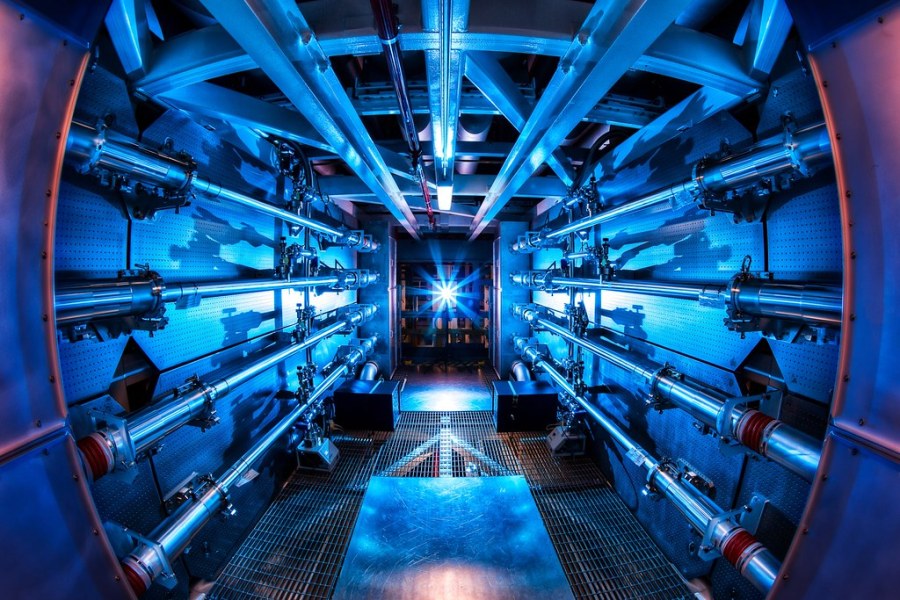
Construction on NIF began in 1997 and the device started operating more than 10 years ago. The machine takes energy from a giant capacitor bank, as large as an apartment building, and transforms that energy into 192 pulsed laser beams focused onto a very complex, tiny fusion capsule.  The facility is as long as three football fields and 10 stories tall, but the final energy output comes from a tiny sphere you can barely see in the palm of your hand. Does this sound like another of those government exaggerations, maybe similar to Reagan’s “Star Wars” program he announced in 1983? Indeed, achieving fusion ignition is an incredible achievement. Let’s take a look at what happen on that fateful day at NIF.

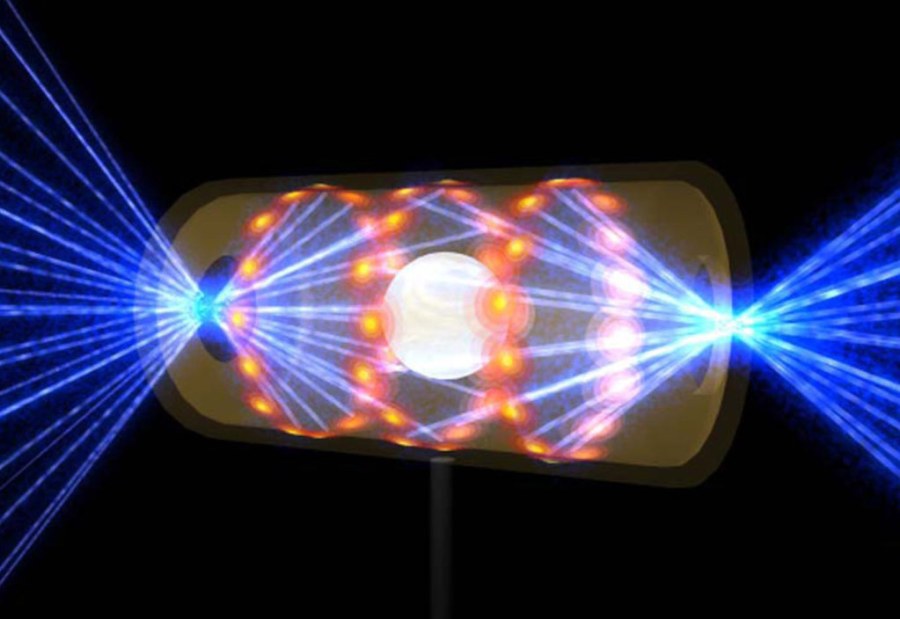
To begin with, there was an incredible amount of stored energy in the capacitors, namely two million joules in each of 192 capacitor banks, to excite the lasers. Next the laser energy entered a 1 centimeter-long cylinder through holes on the ends and heated the inner surface of the tiny cylinder. One of the first technical challenges was that the laser pulse had to be tailored to the right shape over time. The laser light had to be precisely injected into small holes on the ends of the cylinder, and the energy had to be directed and precisely absorbed in a predetermined pattern on the inner wall of the cylinder. Both of these goals were achieved. That exquisitely tailored and perfectly focused energy was absorbed and a fraction of that energy was converted into a hot ionized gas, called a radiating plasma, expanding from the heated cylindrical target’s inner wall.

Inside the cylinder sat a tiny sphere, only 2 millimeters in diameter. Using a microscopic tube, the hollow, flawless, gold-plated diamond shell had been filled with fusion fuel. When the lasers hit the cylinder creating the hot ionized gas, radiation flowed around the sphere and heated its outer surface. This made the outer wall of the sphere explode, causing a violent implosion. A small fraction of that implosion energy compressed to heat a tiny, high density, high-temperature spot at the center of the fuel. This triggers the fusion reaction. The energy released by the fusion reaction heated a fraction of the surrounding compressed fusion fuel releasing more energy.

This was the miraculous achievement of creating a burning fusion fuel using NIF. The compression and heating of the fuel was not the really significant result, the true breakthrough was creating a small hot spot that ignited adjacent cold material. Hot spot ignition is the event that may open the way to the future. There were many tradeoffs of nonlinear variables that had to be adjusted after years of very complex experiments and calculations. And repeating the achievement is still yet to come.

Frankly, before NIF was approved by congress, I had my doubts that such a complex process based on hot spot ignition would ever work, and my skepticism did not please my friends on the NIF team. It is still very hard for me to comprehend the entirety of what happened. The sustained investment of so much money and many years of total dedication in the face of repeated failures is remarkable. The complexity of the concept, and brilliance of the scientific and engineering team, as well as the enormous difficulty of the achievement contributed to this historic event, but it is natural to question the result.

However, based on an extensive array of diagnostic sensors backed up by modeling and simulation of the complex physics, we know it really happened. There were so many incredibly challenging engineering requirements, and so many interdependent very nonlinear physical phenomena that could only be modeled on giant computers. I was skeptical at first, and I am now totally impressed that the NIF team accomplished this remarkable result.  Although the phenomenon may be rather hard to duplicate, it happened once, and that makes all of the difference in the long and arduous journey of fusion research. It is just one more of those miracles of engineering and physics!

But what about my attempt at inventing a fictional engineering and science breakthrough in my soon to be published novel, The Dragon’s C.L.A.W.  I imagined my story and began writing it several years before this real miracle occurred. In my futuristic technical mystery novel, a low energy nuclear reaction is triggered by an intense relativistic electron beam. The beam triggers a transmutation of the target material into rare earth elements, and the energy output in the form of an electromagnetic pulse is thousands of times greater than the input. No question. This is pure fiction physics, but it draws on some real research I conducted during my career. In 1972 I initiated a fusion program at Sandia National Labs, even applied for and was awarded a patent on an e-beam fusion reactor concept with construction of what I called the Electron Beam Fusion Accelerator. I’ll discuss my fusion research journey in my next post.

            `

Remembering the Russian scientist who revealed secret of H bomb

It is widely known that one promising way to create fusion in the laboratory is called inertial confinement fusion (ICF). It is based on the concept of spherically imploding, compressing and thus heating thermonuclear fuel. Indeed, the recent laser fusion breakthrough at the Livermore National Laboratories demonstrated efficient hot spot ignition and self-heating of cold fuel. There were many complex requirements in this outstanding technical achievement, but probably the most significant was spherically symmetric implosion of the fusion capsule. This was accomplished not by directing the 192 ultra high power laser beams at the target, but instead heating the inner walls of the tiny chamber containing the fusion pellet, and using the radiation trapped in the chamber to symmetrically heat the pellet. This chamber is called a hohlraum, which is a German word for a hollow volume of cavity in a structure. When I first became interested in fusion research, I had no notion of this vital ICF concept. In fact, just revealing the very idea of heating the target with indirect radiation rather than direct heating by the laser beams would have resulted in a severe penalty, or even jail time. Today, the hohlraum concept is totally unclassified.

In 1967, when I became interested in fusion, I knew that the physics worked well in the sun and in H bombs, but I knew little else about the subject. I was attracted to work for a small startup company that was pioneering work on pulsed power technology. This was a very new field of electro technology dedicated to creating machines that generated very short pulses of electric power levels of 1 trillion watts (TW).  The purpose of these machines was to create laboratory sources of pulsed radiation to test the vulnerability of reentry electronics faced with an H bomb tipped missile defense. The issue was to determine the exact vulnerability of the electronics to such a pulse. I was drawn to that company, Physics International, not because of the question of missile electronics vulnerability, but because the founders of the company had previously been H bomb development leaders at the Lawrence Livermore Lab, and they convinced me that such machines could be used to make a tiny H bomb explosion in the lab using the new pulsed power technology.

On a warm and clear day in June 1971, at the University of Wisconsin student union, I met with a well-known plasma physics theorist, Lyonid Rudakov, from the Kurchatov Institute in Moscow. He and I sat there in the sun like old friends drinking coffee and chatting about the subject of creating fusion with electron beams.  We were both in our thirties, and had just met and learned that we had a common interest in using high intensity electron beams to create fusion. I knew exactly what I could and could not discuss, and I had no idea about the connections of Rudakov to any Soviet secret information. Rudakov was very outgoing and obviously comfortable with people he did not know well, and from the first I recognized that we had one thing in common. We both were in the business of marketing our ideas on fusion to get funding.

As we talked, we shared a fantasy of building giant pulsed power machines, maybe hundreds of times bigger than anything in existence, and focusing relativistic electron beams onto BB size pellets. Rudakov already had an established program at a major Soviet research laboratory, and I, with no continuing government program support, was mostly concentrating on getting funding every year for my small program dedicated to simulation of nuclear weapons effects. I knew that I would never get very far with my vision unless I established a major program in a national laboratory.

One year later, I found that there were others who shared my fantasy, and I moved to Sandia National Labs in Albuquerque. After I received my clearance, the first question I asked was about the physics of the H bomb. I learned that the highly protected secret was the use of a fission device to produce radiation and it was the radiation trapped in a hohlraum that drove an implosion and fusion ignition. I thought that electrons, if they could be focused highly enough, could be used instead of radiation. I invented an imaginative, if not realistic, program based on my published very early experimental work with electron beam focusing but still with no real quantitative knowledge of the power level that would be needed for fusion ignition.

Rudakov had the backing of the most influential Soviet scientific/political engineer but I was unknown in the scientific community. I had a vision and motivation based on my experience at my first job after I completed my Ph.D. at Caltech. I received my Ph.D. in Engineering Science and Physics in 1967 and continued on at the Jet Propulsion Lab where I had done my research on magneto fluid dynamics since 1962. The lab had failed six times to take close-up photos of the surface of the moon and was faced with a major transition. The question that they were trying to resolve was if the proposed moon lander would sink into deep dust.  Unfortunately their payload, called Ranger, either was destroyed during the launch or crash landed time after time with no data. Although the lab went on to success, they had decided its job was exploring space and not basic research. My small fluid physics group was disbanded and they gave me the opportunity to move on, and that resulted in my first job as a new Ph.D. Married, with a 1-year-old daughter, I was highly motivated to succeed.

When I got to Sandia I found out that since the U.S. had agreed with the Soviet Union to prohibit anti-ballistic missiles, funding for development of nuclear weapons and lab funding had decreased. There would be a 10% reduction in force. I was a first level manager, but my quota for the layoff was to fire one person, and I was given freedom, as my boss said, “Go out for a pass.” The misfortunate layoff had a silver lining since I had the support to do something Sandia was not too experienced with, namely lobbying the Congress for funding.

After spending a lot of time getting to know our representatives from New Mexico and prowling the halls of Congress, I managed to influence Senator Joseph Montoya, who was primarily known for his somewhat inadequate but televised questions when he served on the Senate Watergate Committee. He was not a technically educated person, but he was sympathetic and told me he always rooted for the underdog. When he learned we were competing with a powerful lab in California that already had funding for laser fusion, he agreed to try to get minimal startup funding for my program. I also had support from the fusion research organization at the AEC because they also were happy to create competition with the laser program managed by the weapons division. This caused a negative reaction from the weapons program to my dealing with the “wrong organization.” I agreed to accept weapons program funding that was far more generous as long as I had no more dealings with those “research guys.”

Our plans were not advertised publicly until the July 1973 European Conference on Controlled Fusion and Plasma Physics in Moscow. At that meeting I together with my Sandia colleagues, who were as new to the game as I was, claimed that very high current electron beams could be self magnetically stopped in a thin shell driving the implosion, and could achieve fusion breakeven with “extensions of present day technology.” Rudakov, together with a well-known Soviet mathematician from the Institute of Applied Mathematics, carried out detailed calculation of the needed power for 1000 TW and they included the vital concept of self-heating of the fuel after ignition as demonstrated last year on NIF “only” 50 years later with 1000 times more energy than they had originally calculated in 1972.

After the meeting in Moscow, Rudakov and I became technical colleagues with reciprocal visits, and we continued to share information as both of us advertised the start of major competitive programs. Sandia began construction of prototype devices at power levels of a few TW, and advertised the development of a machine in the 100 TW class, but both of us were competing with the rapidly growing programs in the U.S. and Soviet Union that had much more funding for the use of high power lasers. I knew that electron beams created with low cost and efficient pulsed electrical power would be far more energetic than lasers. I guessed that even if millions of joules would be needed for ignition, it would be a more reasonable approach than the very expensive and inefficient lasers.

The LLNL results were achieved using the NIF laser to deliver 2 million joules to heat the walls of a hohlraum containing the fuel pellet and using the symmetric flow of energy in the hohlraum to heat the outer surface of the pellet. The physics of the hohlraum is based on the fact that the heated cavity walls come into thermal equilibrium with the energy in the cavity, delivering energy symmetrically to the fuel capsule. The reason for the closely held secret in the 70s was the idea of using the radiation in a hohlraum to implode and heat a fusion capsule. This is called the Teller/Ulam principle, the secret of the H bomb.  The H bomb concept relied on a two stage process with the radiation from a fission explosion to heat and compress a fusion device, but that was very secret in the 70s.  The reason for the high level of secrecy was not because we were afraid the Soviets would get the secret, which we knew they had, but for fear others would catch on and that would lead to proliferation of hydrogen bomb technology. So both programs progressed, but Rudakov knew something he was not sharing. In 1976, he announced with no details that his lab had produced the first fusion reaction using electron beams. The March 1976 “New York Times” reported, “Russians report fusion using electron beams,” but with no details. There is more to this story, to be continued in my next blog post.