Hawaii missile mistake alert

What if the missile attacks were real?

In January, an early-morning emergency alert mistakenly warned people in Hawaii of an incoming ballistic missile attack. Less than an hour later the warning was revoked, but the mistake started a panic. More importantly, what if the missile attack were real?

Several commentators have dealt with the question of what if the missile attack on Hawaii had been real. Our military would have known almost immediately that a real missile was launched and on its way. The flight time from North Korea would have been 18 minutes and in that time we could activate our responses and send our interceptors on their way. But does that mean that the probability of stopping the attack was so high that there was no reason for fear? One commentator, without even mentioning defense, suggested that people should duck and cover. That was the “method” for surviving nuclear attack that we practiced when I was in junior high school. kids ducking under desks

Others in the military have written that our missile defenses would be activated and interceptors would be launched and could destroy a single attacking missile.  This assumes that our deployments are effective, the right decisions could be made in time, and that the response would be to launch enough interceptors to increase the probability of successful defense. But what if the first missile was really only one more test and the missile landed harmlessly in the ocean? Or maybe this was part of a strategy of seeing how fast and how well we could respond? And what if the intercept really was successful? Would we then retaliate or just send a warning?

But such issues have always been on the table during the decades of deterrence-Reagan on Time Magazinebased strategy. That is until Ronald Reagan questioned the entire basis for our survival. He asked if we could develop a high-tech defense based on assured survival instead of assured destruction. His idea was totally out of favor with all of his strategic weapons advisors who believed that the threat of total mutual guaranteed annihilation would be the only way to achieve deterrence.

Now all of that seems to be no longer acceptable and nuclear weapons proliferation is a growth industry. Our new nuclear posture review is calling for more modern low-yield nuclear weapons to strengthen deterrence since Russia and China have adopted this approach. The argument against assured destruction is that deterrence is no longer credible if the other side has developed more usable low-yield nukes and is increasingly relying on them for deterrence. So the argument is that by making our ability to wage nuclear war more credible, our deterrence is more credible. No more talk of irrevocable destruction of society.

But what about Reagan’s 1983 concept of reducing the nuclear stockpiles and creating more credible defense? As I explain in my book “Death Rays and Delusions,” the needed technology was way off in the future and we were not ready to move in this revolutionary direction. But now 35 years later we have made dramatic progress in sensors, platforms and interceptor missiles so effective defense should be taken more seriously than crawling under desks.

hacker

The ultimate missile defense problem

My previous blog posts have focused on lasers, missiles and physical counter measure evaluation. Complicated topics to tackle, however, those are easier to deal with than the fundamental question about making the split second decision to pull the trigger and launch the defense system. The decision would have be made in the unavoidable uncertainties of real war. There are estimates that multiple interceptors would be launched to stop a single attacker, but what if that first attack is a fake? Other analysis suggest a shoot, look, shoot approach to manage the rapidly changing battle or maybe the system is not fully operational or needs to adjust to surprises.

An obvious counter measure to missile defense would be the use of deception and the creation of doubt and confusion. If the attackers can exhaust the defense in an initial salvo, then the real attack could go ahead without any interruption. With the war unfolding in seconds and minutes, much of the process will have to be controlled by computers.

The first step in the attack could also focus on disruption of battle management decision-making software. How can we test that software to determine if it has not already been hacked? Is there a hidden virus ready to be triggered before or during the attack? Ultimately these issues are fundamental, and as I said in my book “Death Rays and Delusions,” software is hard, but at the time I had no idea how vulnerable our information technology would become.

It now appears that even with the most secure hardware and software, the insider, through sloppy procedures or malicious intent, can open the gates to our information systems or insert a virus that would not appear until the moment of attack. So the ultimate success of defense hinges on being able to trust the humans who create and manage the defense software.

Boost Phase Intercept (BPI) with high power lasers could defeat North Korean missiles

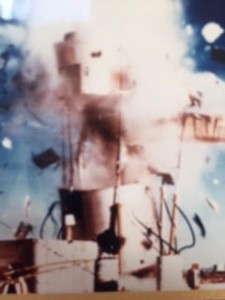
In order to achieve an effective defense against an all-out ICBM attack from the Soviet Union, the Fletcher Study, that in 1983 created the plan for the SDI, reported that Boost Phase Intercept would be needed. I explore this in great detail in my new book “Death Rays and Delusions” available now at Amazon.com. We believed the midcourse and terminal phases could overwhelm the defense with countermeasures if a large fraction of the boosters were not destroyed. Burning boosters provided a bright target that was easy to find and the thin missile skin made them relatively easy to kill. Missile vulnerability was demonstrated with a high power laser directed at a mock-up of a booster subjected to its acceleration and pressure stresses. The test was described by one of the technical skeptics as a “strapped down chicken test.”

Laser destruction of liquid fueled booster

Although the booster was very vulnerable to attack, intercepting the booster required deployment of either space based missiles or lasers. The lasers were far off in the future, and the numbers of missiles appeared to require a prohibitively large launch capability, unless the missiles were miniaturized, eventually resulting in the “Brilliant Pebbles” concept. This concept was seriously pursued for five years and then canceled when the Soviet threat disappeared in the ‘90s. Small interceptor missiles, however, did appear to provide a realistic path to BPI based on advancing missile technology.

The preferred approach in 1985, however, was the ground based laser (GBL) with only relay mirrors in space, and substantial efforts were begun to develop enormous free electron lasers to produce beams of the required power and wave length. A significant development was the invention of optics that could correct for sources of beam distortion. A remaining problem was the need for multiple high altitude locations to deal with clouds. In addition, the laser technology and physics did not cooperate, and for want of a laser, the GBL was dropped, but development of aircraft based lasers continued.

laser relay
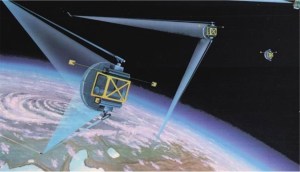
Artists concept of space based laser relay mirrors http://spie.org/newsroom/4853-did-adaptive-optics-end-the-cold-war?SSO=1

Chemical lasers on 747s enjoyed $5 billion of support for dealing with the evolving North Korean ICBM threat, but the concept was dropped by the Secretary of Defense as impractical, expensive and easily defeated. So the quest for a laser remained until recently with the development of short wave length, efficient, rugged, light weight, fiber lasers. Such lasers could be based on aircraft and be used to directly intercept boosters or relayed from space or possibly drone based mirrors to their targets. Nevertheless, this development is still many years away. So what about the near future? With the recent North Korea tests of a very high yield nuclear device and an  ICBM, the threat demands that we get very serious about deployment of an effective missile defense.

For short range defeat of boosters launched from North Korea, it is possible to utilize aircraft based very fast small missiles, and drone platforms have been proposed, as outlined in this column: http://www.sandiegouniontribune.com/military/guest-voices/sd-me-herman-northkorea-defense-20170816-story.html. So BPI, which was from the beginning of the SDI thought to be desirable or even necessary, seems to be emerging based on drone based fast missiles,  and could evolve eventually to laser weapons. To learn more, check out “Death Rays and Delusions” now available on Amazon.com.

Star Wars Sinks Summit

Time magazine For decades, the Soviet military lagged behind us technologically, and by dominating one half of the budget it fatally weakened their economy. The military was stuck in the quagmire of Afghanistan yet they remained committed to compete with us and maintain their control of Soviet society. A key element of their approach was stealing our secrets. We had discovered how they were shop lifting our technology, and we cooperated by “enhancing” the ingredients of their shopping bag. The chief Soviet thief was actually working for us, and he wanted to get even with his KGB bosses. Farwell Dossier

According to Thomas Reed, former Secretary of  the Air Force, we were “blowing up Soviet pipelines, infiltrating Soviet computers, bollixing  their software, …electronics infected with bugs, viruses, and Trojan horses placed there by the US intelligence community.”

Gorbachev wanted to terminate the arms race and turn his economy around, but in the fateful 1986, everything seemed to go from bad to worse: Gorbachev was planning an anti vodka campaign to deal with what he thought was contributing to his country’s mental and financial depression. His faulty governing plan was based on a commitment to a contradictory strategy of both entrepreneurial and communist economies that would become a worsening financial decline. Then the Chernobyl reactor explosion destroyed his confidence in Soviet technology, followed by the sinking in clear weather of their only luxury cruise ship Adm. Nakhimov. These accidents caused wide spread distrust of incompetent leadership and a growing level of anxiety in his country. Then just before the Reykjavik summit — one more stunning disaster. A critical component of their nuclear deterrent,  a rocket on the  k219 nuclear submarine with 30 nuclear warheads aboard caught fire and the sub sank with a trailing American sub watching the entire debacle.

With all of the Soviet catastrophes in mind, his military advisors told him we really had substantial advances in missile defense, yet his military industrial complex was on the verge of launching a space weapons race. He was convinced his country could not simultaneously compete and also salvage their disintegrating economy.

He was ready to make a deal and Reykjavik was the place to agree to end the arms race, but he could not close the deal with Reagan.  Above everything else he was determined to stop his own military industrial complex from launching their giant  Polyus space laser, and that meant he needed the leverage from persuading Reagan to keep SDI in the laboratory and not in space. He told Reagan after three days of back and forth arguing “It’s the laboratory or goodbye”.  Reagan, with his totally unrealistic confidence in near term SDI deployment, said no deal. The world leaders acting on their own walked away from changing the course of history.

Our own military and our allies breathed a sigh of relief since they were totally committed to a nuclear deterrent based on mutually assured destruction, and at the same time the press argued that Reagan had screwed up.

The deal was off, but their space laser experiment Polyus was not deployed because of a software problem. Negotiations continued in 1987 as both sides realized missile defense was not ready for any sort of deployment, and slowing the arms race was beneficial to both countries. An agreement was reached, by two politically weakening leaders, to eliminate intermediate range missiles. For a few years the Soviet Union continued to implode without our help, and then Gorbachev was removed by a coup, followed by the coup plotters jailed by the new Soviet leader Yeltsin.

Did Star Wars sink the deal? Will Star Wars ever become real? And what about the North Korea’s ICBM?