Liar, liar, pants on fire

The presidential impeachment hearings are a good example of one aspect of human behavior that I studied recently, when I was involved in a science and technology advisory panel. The question we addressed was: What methods can an observer use to determine if a witness; or if there are two opinions, which side; is credible when they give contradictory answers? It would be wonderful if we really had some method as we watch what is going on in Washington.

In the hearings, the Republicans accused the Democrats of “making false allegations.” The Democrats similarly accused the Republicans of “making statements that ranged from incomplete renditions to outright falsehoods.” Trump tweeted that “the Democrats are liars” and a senator called Schiff “the worst liar in politics.”

The purpose of the panel I served on was to determine if there were technical methods to determine if a subject was telling the truth. Our panel determined that the gold standard of deception detection was the polygraph that measured blood pressure, pulse, respiration and skin conductivity while the subject answered a series of questions. What we discovered from interviewing many experts in the field was that the test really determined a psychological stress response that could be characteristic of a guilty answer, or a response from an innocent person who feels intimidated or even no response at all. In other words, the results were not reliable.

There were also examples in the press of use by the CIA on Guantanamo detainees of sleep deprivation and water boarding to elicit confessions, but they were also found to be not useful and deemed a form of torture. Acute stress induced by torture was also found to destroy memory. From our discussions with professional interrogators, the one approach that seemed to work was to have extensive prior knowledge and then intimidate the subject in order to induce a confession. An expert at interrogation knew how to use psychological methods to condition a person to “spill the beans” with no gadgets at all.

So what does this have to do with my supposed knowledge about missile defense? One of the most controversial and contradictory aspects of my more than 50 years of participation in the technical community  was the response to President Reagan’s request in his national security speech March 23, 1983. Reagan asked the “scientific community…to turn their great talents …to give us the means of rendering these nuclear weapons impotent and obsolete” … to “intercept and destroy strategic ballistic missiles before they reached our own soil or that of our allies.” His speech was the starting point of my several years involved in trying to satisfy his request by first helping to make a plan for, and then participating in, the Strategic Defense Initiative (SDI) as its first Chief Scientist.

Many years later, L. Wood, a primary representative of the Lawrence Livermore National Laboratories’ proposed X-ray laser program, told science writer J. Hecht, “SDI (AKA Star Wars) was a brilliantly successful bluff…illusion of an awesome technological capability.” Wood said, “I got the results I wanted. The Soviet Union collapsed.”

If there was an intentional hoax, Wood and others sure had me fooled since I was convinced nobody was bluffing. In my opinion, Reagan hated nuclear weapons as much as he hated Soviet Communism, and he believed we could find a way to defend ourselves, that is if we jointly managed a transition to eliminate nukes and then share a defense system. I became convinced that in fact SDI had little impact on the Soviet Union that went bankrupt on their own without our help through their society riddled with deception, mismanagement and moral confusion.

But what about the truth of the SDI? Gorbachev told the Politburo, “Our main goal now is to prevent another new stage in the arms race from taking place. If we do not do that, the danger for us will grow … an arms race that is beyond our strength. We will lose, because now for us that race is already at the limit of our possibilities.” There is no question that Gorbachev was a believer, even though his advisers, such as Evgeny Velikhov, the principal Soviet scientific leader, claimed it was a delusion.

At the same time, Gorbachev’s Military-Industrial Commission advisers told him, “Americans think that a multi echelon missile defense system should allow, at most 0.1 percent of the attacking missiles to get through” and their belief was that the key for missile defense would be “a new type of nuclear weapons consist of transforming part of the energy from a nuclear explosion into powerful streams of directed x-rays or electromagnetic radiation or stream of high energy particles…capable of striking in space or from space ballistic missiles, their warheads, satellites and the targets …at distances of several thousand kilometers.” The advisers added, “Full scale of these weapons is expected to occur in the second half of the 1990s.”

The head of their nuclear programs, Victor Mikhailov, was so convinced that nuclear directed energy was a realistic future possibility that he argued to stop such work that he called the “Evil Jinn.” There was no lack of conviction in the Soviet Union that directed nuclear weapons were critical to the success of the SDI program, even though at the time, Donald Kerr, the head of Los Alamos argued it was an exaggeration, Bud McFarlane, Reagan’s National Security Advisor, said the program was a “sting,” and much latter Reagan’s scientific adviser, Jay Keyworth, even called the work at LLNL “unadulterated lies.”

So what about the lying liars, whether it be in Congress, among scientists, weapons developers and politicians? In my opinion, the best expert on the subject is George Constanza from the television series “Seinfeld.” His memorable quote was, “It is not a lie if you believe it,” and I believe he is right.

Trust me.

A simple, low cost, really nasty new weapon system

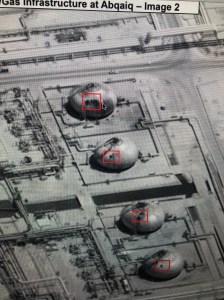
Precision drone attack damage of Saudi Oil facility

Could low cost, fairly low tech aircraft defeat the very expensive missile defense system of Saudi Arabia?  Of course not! No way, I thought, since the Saudis rely on our technology and we have spent billions and billions on missile defense since we began the SDI program in 1984.

I never gave this possible threat much thought until the Saudis’ giant oil facility was attacked with high precision on Sept. 14, causing enough damage to measurably reduce the global oil supply.

Yes there was a fairly modern missile defense system in place, but the attack came from tens of small low-flying drones and cruise missiles proving that the best defense against the wrong attack is useless. It looks like I was not the only one surprised since Israel, who should have been the most alert to such threats, has just announced they are reacting to this event. (“Netanyahu seeks billions to fund Israeli defense against Iranian cruise missiles,” Haaretz, Oct. 07, 2019.) Even before that, the Russians announced in Izvestia that their small multi rotor drones “will perform not only reconnaissance missions, but also strike targets with miniature bombs.”

I recall that when the SDI was created, the secretary of state raised the issue of cruise missile defense, but his question was never seriously answered and we focused on the Soviets’ huge investment in intercontinental ballistic missiles. So this new threat is not so new, but I hope the new aspect of swarms of low-cost drones is now being taken seriously.

This wake-up call up call should now be loud and clear, but even worse than we expected, since even though the cost of cruise missiles is very high, the technology and cost of swarms of drones has become very attractive worldwide to even capable individuals. It is now realistic that many of the world’s soft targets, such as cities, are vulnerable to attack. But certainly we could use electromagnetic weapons to jam, confuse, take over or destroy the guidance and communications of drones, high power lasers to destroy their delicate components or just plain old intercept missiles and anti-aircraft guns to blow them out of the sky, so not to worry.  We could even deploy our own swarms of defense drones to attack their offense swarms.

Well, it is not that simple since the real issue is the cost exchange, and the low cost and tactics available to giant swarms of drones could reduce the effectiveness of most of tomorrow’s technologically available defenses.

In addition, there is the element of surprise, demanding an early warning detection and tracking system, as well as the reality of exhaustion of the defense against fake or real repeated attacks. But we know that each low-cost drone could only deliver a pound or so to a target, so what is the big deal? Well, maybe the drones could target critical parts of our exposed electric grid, or maybe disperse biological agents along major streets, or target large sports events with hundreds of grenades or just go after parking lots at crowded shopping centers? The implication of such terror weapons are frightening to say the least.

Certainly Israel has some not so friendly neighbors, and their enemies must be preparing such killer drone swarm attacks, but we don’t have such problems from our neighbors .…  unless the drones are delivered from ships near the big cities near our coasts.

So what to do about all of these new concerns about a threat that might be more likely than intercontinental missile attack that attracted our defense community for decades?  I am sure the Pentagon, the labs and the defense industry are working to figure out our response. Of course, the threat will evolve as well as the defenses, and we need to also prepare for simultaneous info and space attacks, so we may look on the simplicity of the good old days with nostalgia.


It’s not a lie if you believe it

One of the most famous lines from the TV show “Seinfeld” was, “It’s not a lie…if you It's not a lie if you believe itbelieve it.” This concept also applies to intersection between science and politics. My last post discussed a commonly believed fallacy in the world of military technology development. The engineers and scientists who believe their latest invention will lead to certain victory and when they market that idea with the certainty of their faith, they are not lying.



One of the strongly marketed ideas currently for missile defense is the concept called “Brilliant Pebbles.” This idea has a long history going back to the 1958 Bambi

Brilliant Pebbles
This image shows a Brilliant Pebble anti-ballistic missile interceptor emerging from its protective “life jacket”, the white shell. It shows an earlier model of the interceptor design with three fuel tanks, later designs had four much larger tanks wrapped around the missile body. A second Pebble remains inside its life jacket in the background. Several Soviet missiles are shown in the lower right, but these would be too close for the Pebbles to intercept.

concept of hundreds of space based missiles that would detect the launch of attacking missiles and destroy them early in their flight. The technology of the time was far from adequate, and the concept reappeared in 1979 as the High Frontier concept, advocated by General Daniel Graham who claimed the technology was off the shelf. The advocates believed they had the certain path to an effective missile defense, but the dream of the ultimate space based defense weapon in the form of giant spaced based lasers captured the imagination and funding of the Pentagon. The laser weapon funding grew rapidly after Reagan’s Star Wars speech in 1983, and the laser advocates believed they finally had the answer, but again technology was wanting and the funding drifted down after a few years.

The enthusiasm for small space based missiles was reborn as “smart rocks.” This

Pebbles presentation
In March 1988, Teller and Wood (on the left) present the original Pebbles concept to Reagan, Bush, Abrahamson and members of the SDIO. The model of the pebble was theatrically draped in black cloth to hide it from the reporters.

approach achieved enhanced support when Lowell Wood’s LLNL concept became “brilliant pebbles” that would be so small and inexpensive that they could be permanently deployed in space and do the job of boost phase intercept. That idea gained support for a while and then it died in the early 90s, but the true believers never lost faith, and the idea is back again, and is being touted, by Henry Cooper of the new High Frontier organization as a possible component of Donald Trump’s Space Force proposal.

The technology has advanced to the point that the new system concepts are focusing on cost effective approaches to actual deployment using the industrial adaptations of the new ideas for small satellites. With enough space based missile interceptors, there could be a multilayer defense all the way from boost phase, to midcourse, to early re-entry. So this is the new last move that will finally and certainly solve the problem of missile defense, and the Pentagon is showing interest. And the advocates believe it … so it is not a lie.deception

I believe that this “last move” is one more fallacy, and there are certain to be reactions to this latest “last move.” These reactions, called counter measures, can come in the form of physical attacks on the space based hardware including jamming of the communications, dazzling and blinding of the sensors and hacking of the software. The reaction to these countermeasures will be “hardening” to achieve a robust and resilient system to counter the countermeasures, and the advocates will claim they have the final answer this time, as modifications and enhancements will lead to program extensions and cost growth that were not anticipated, but everybody involved will honestly claim that nobody was lying when they provided the initial cost estimates.

Is there any way out of what will become a new escalating space race? Is there no way out? How will this new space arms race end? There could be negotiated agreements that we used to call “arms control,” but today’s global strategic environment is more complex than it used to be. Today Russia and the U.S. are facing space competitors from China and before too long India. But what about Europe, Japan and Israel? Here we go again with the warning of President Eisenhower to beware of the growing power of the military industrial complex. It is too late for agreements – so fasten your seat belts and get ready for a fast and very expensive ride toward an unknown outcome.


Hawaii missile mistake alert

What if the missile attacks were real?

In January, an early-morning emergency alert mistakenly warned people in Hawaii of an incoming ballistic missile attack. Less than an hour later the warning was revoked, but the mistake started a panic. More importantly, what if the missile attack were real?

Several commentators have dealt with the question of what if the missile attack on Hawaii had been real. Our military would have known almost immediately that a real missile was launched and on its way. The flight time from North Korea would have been 18 minutes and in that time we could activate our responses and send our interceptors on their way. But does that mean that the probability of stopping the attack was so high that there was no reason for fear? One commentator, without even mentioning defense, suggested that people should duck and cover. That was the “method” for surviving nuclear attack that we practiced when I was in junior high school. kids ducking under desks

Others in the military have written that our missile defenses would be activated and interceptors would be launched and could destroy a single attacking missile.  This assumes that our deployments are effective, the right decisions could be made in time, and that the response would be to launch enough interceptors to increase the probability of successful defense. But what if the first missile was really only one more test and the missile landed harmlessly in the ocean? Or maybe this was part of a strategy of seeing how fast and how well we could respond? And what if the intercept really was successful? Would we then retaliate or just send a warning?

But such issues have always been on the table during the decades of deterrence-Reagan on Time Magazinebased strategy. That is until Ronald Reagan questioned the entire basis for our survival. He asked if we could develop a high-tech defense based on assured survival instead of assured destruction. His idea was totally out of favor with all of his strategic weapons advisors who believed that the threat of total mutual guaranteed annihilation would be the only way to achieve deterrence.

Now all of that seems to be no longer acceptable and nuclear weapons proliferation is a growth industry. Our new nuclear posture review is calling for more modern low-yield nuclear weapons to strengthen deterrence since Russia and China have adopted this approach. The argument against assured destruction is that deterrence is no longer credible if the other side has developed more usable low-yield nukes and is increasingly relying on them for deterrence. So the argument is that by making our ability to wage nuclear war more credible, our deterrence is more credible. No more talk of irrevocable destruction of society.

But what about Reagan’s 1983 concept of reducing the nuclear stockpiles and creating more credible defense? As I explain in my book “Death Rays and Delusions,” the needed technology was way off in the future and we were not ready to move in this revolutionary direction. But now 35 years later we have made dramatic progress in sensors, platforms and interceptor missiles so effective defense should be taken more seriously than crawling under desks.