


In my last post, I described a disturbing possible future involving a space version of the shoot-out at the OK Corral. The instability of the situation could be driven by speed of light weapons and swarms of small missiles ready to fire at each other. Obviously the quick draw and precise aim could win the day. With the recent realization of the North Korean development of intercontinental ballistic missiles (see https://mobile.nytimes.com/2017/07/28/world/asia/north-korea-ballistic-missile.html), the possibility of a preemptive terrestrial strike to disarm the missiles before a launch, is being considered. Thus, the instability of a shoot-out is even closer to becoming a reality than anyone could have imagined.
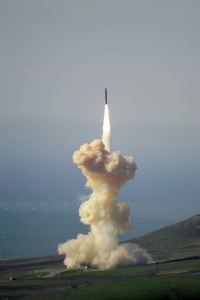
The North Korean threat is undoubtedly an exaggeration right now, since delivering a payload to a long range target area is only part of the technical challenge. Successfully surviving the stresses of reentry into the atmosphere, and then precisely detonation the weapon are formidable problems, but North Korea is making rapid progress, probably with assistance from others. So it is necessary that we get even more serious about missile defense. Unfortunately, we have already spent almost $200 billion during the last thirty years, and there is no guarantee even with enormous increases that we can ever have 100% protection against missile attack. I used to say there is no 100% guarantee in any complex system. There is no way to test a defensive system under a totally realistic war scenario. An actual missile strike could be preceded by deceptive tactics, conventional ground and cyber-attacks that would cloud rapid decision making with the thick fog of war.
I’ll discuss America’s missile defense options further in my next post and you can learn more about strategic defense in my soon-to-be-published book “Death Rays and Delusions.”
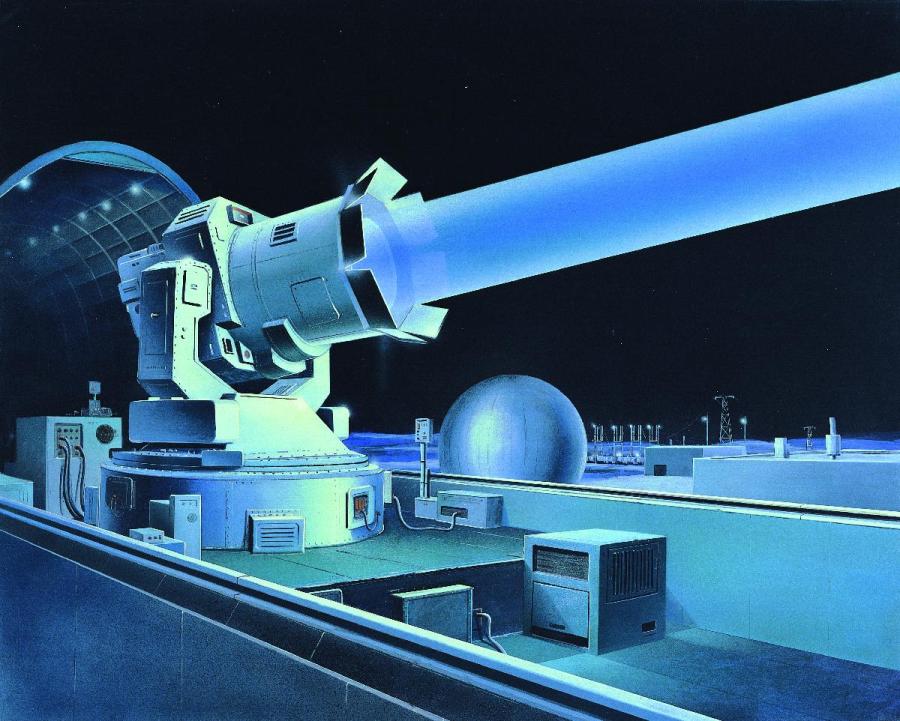
 This “fake news” headline appeared on a May 1985 article in the Los Angeles Times:
  a mirror on the space shuttle, so I was not to be believed. Well, technically he was correct about what we did, but he neglected to say that our laser was on top of a cloud free mountain. So the real story should have mentioned that several laser locations would be needed in high altitude relatively cloud free areas, like in Arizona, or even a more futuristic concept would require a high power laser on an aircraft, which is not unrealistic in the near future. But these recent advancements in the GBL could pose a problem. What if the GBL, whose technical basis has advanced rapidly, is used by a future adversary to attack our defense satellites as the first or second step of an escalating global conflict?
 According to Chinese general, military strategist, and philosopher Sun Tzu, “All warfare is based on deception.” The classic shell game uses three walnut shells and a pea to deceive the victim of the scam. The crook uses slight of hand to disguise the rapid moves. In mid course missile defense the reentry vehicle (RV) is the pea and the walnut shells are lightweight balloons. The slight of hand is to make each of the balloons look slightly different from all of the others. The game gets more challenging by spreading out the balloons so the observer can’t attack all of them. So one approach to defeat the balloons is to wait until the threat cloud reenters the atmosphere so the light weight objects slow down leaving only the RV to be attacked with an atmospheric interceptor like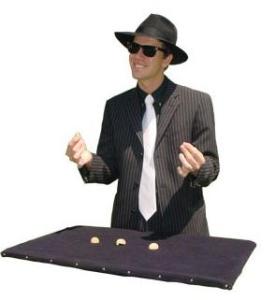
 battle management software. Does the street smart trickster win the shell game? We can only answer with tests of the defense system in the face of a credible “red team” of attackers….using realistic computer simulations. But how do we test the software against accidental faults or determined hackers who hide their moves under more shells?
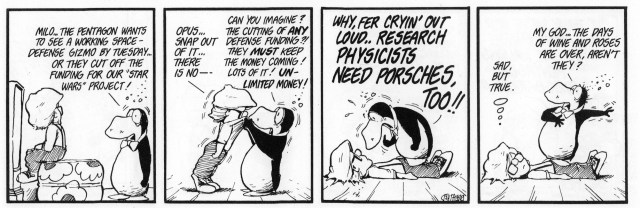 Many politicians including Ronald Reagan and Jack Kennedy knew how to express reality through humor in order to communicate real news hidden behind quips. I believe their style would be useful today.
 SDI Guy