

Last year, Russian President Vladimir Putin  announced that Russia had developed the Avangard hypersonic vehicle that would soon be deployed and he claimed could defeat any sort of missile defense. The concept is a re-entry vehicle that would be launched on a ballistic missile and instead of continuing to its target on a predictable ballistic trajectory through space, it would dive down into the top of the atmosphere and glide to its target. It would glide along without propulsion and could maneuver over large distances so that interception would only be possible in the short time close to its eventual target. Such a maneuvering re-entry vehicle is not entirely new idea, but presumably the Avangard has solved the problems of targeting, maneuvering and high temperature materials.
If this technology is successful, then the warhead could be a nuke, or a high explosive or even a basket full of high density rods. The notion of hypervelocity rods is also not a new idea, and we used to call them ‘Rods From God’ (RFG) that could potentially strike any target on the earth with high precision and extreme lethality to any relative soft target such as an aircraft carrier or even somebody standing on the corner. 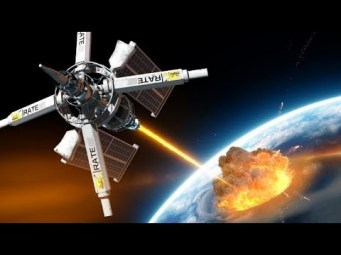 Another application would be to strike a stationary high value target, say in a building, but with no collateral damage to the building next door. We used to call this a conventional precision strike on a time urgent target. The problem of getting to a target in a hurry is probably not the least of the limitations of such a weapon, since a precision strike would have to be accompanied by time-urgent precision decision making. The precision targeting would require time-urgent knowledge and might have to involve a close-in sensor that could perch and search before the weapon lurch. The aspect of very fast and very precise decisions probably requires that the entire process of reconnaissance of the area, surveillance of the specific target, target acquisition, target kill and kill assessment be automated. All of that seems very difficult, but certainly possible, and could mean that targets anywhere in the world would be vulnerable … unless they were underground.
Very impressive tunnel boring machines have been developed over the years, and a future of RFG weapons and societies hiding in tunnels is not entirely crazy. But wait there is more. If the only defense is the threat of a retaliatory strike, there would be no way to know if the warhead is a nuke or a conventional warhead. So a “relatively” limited attempt to bump off that bad guy on the corner could be misunderstood as a nuclear strike and lead to instant nuclear retaliation. A predictable response to the Russian development would be our version of the same thing, and our similar programs are moving ahead with some urgency to catch up, so a future of unstable decision making on both sides is possible.
But what about the claim that no missile defense is possible? Back in the good old SDI days, we were concerned that ballistic missile countermeasures, such as decoys, could make defense against a large scale very competent attack ineffective, so we advocated boost phase defense to intercept the booster before it deployed re-entry vehicles and the inevitable countermeasures. I discuss this in great detail in my book “Death Rays and Delusions” available at https://www.amazon.com/Death-Delusions-Gerold-Yonas-Ph-D/dp/0692919554/ref=sr_1_1?crid=10EBJNPO83JNY&keywords=death+rays+and+delusions&qid=1560807394&s=gateway&sprefix=death+rays+and+%2Caps%2C182&sr=8-1. As I point out in the book, one approach to intercepting boosters would be fleets of small missiles permanently deployed in space and ready to be launched based on launch detection using space based sensors. This concept is being considered again, but my own preference to BPI is high power laser beams relayed by space based mirrors directed to the target, and projected from high power lasers on aircraft.
All of this discussion sounds a bit like the “fallacy of the last move” that I discussed in my Dec. 24, 2018, blog post (https://sdiguy.blog/2017/09/18/boost-phase-intercept-bpi-with-high-power-lasers-could-defeat-north-korean-missiles/), and the alternate path would be an arms control regime based on agreements and mutual trust that seems to be in short  supply, so the weapons racing will likely just go on. I offered an alternate approach in my post based on my belief that we face the impending cash flow dilemma that I called the “Geezer Threat” caused, not by the much feared global warming, but what I think is more likely, global aging. The Soviet Union provided us with a good illustration that cash flow problems can destroy one of the most powerful empires in the history of the world.
 SDI Guy