
Time flies, but technology has its own schedule.

The Zenith Star mockup was marketed in 1987 to Ronald Reagan as a near term deployable space based laser.

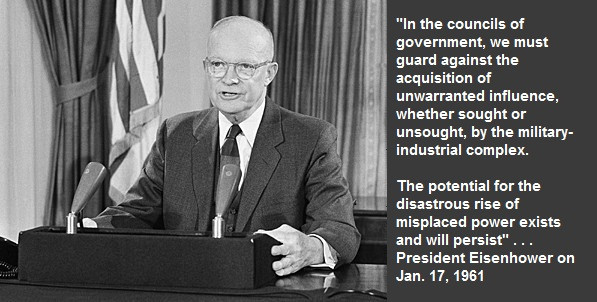
The purpose of this blog post is to consider the evolution of military technology and explore what has happened in the last 80 years, and what might the future hold. Before World War II, technology was rather primitive by today’s standards, but it was on the verge of dramatic changes driven by the necessities of the war. Nuclear weapons, long distance rockets, and computers were about to appear, and global conflict was the catalyst to create dramatic advances. But then the deployment of new weapons followed a slower schedule with decreased military requirements and with funding competition from non-military investments. Even though technology budgets were somewhat restrained, Eisenhower still warned against “the establishment of a ‘military industrial complex,’” and he worried about the size of the defense industry that had grown in the 1950s,
Within a few decades, however, new technologies began to appear driven by the threats emerging from the Cold War and with the emergence of new weapon concepts, new aircraft, advanced materials, directed energy weapons, and ever-increasing speed and memory storage of computers.  By the 1980s, there were lots of new weapons investments: deployment of intercontinental ballistic missiles carrying multiple warheads, a reuseable space shuttle, directed nuclear weapons, particle beam weapons, high power chemical lasers, and space-based sensors. Many enthusiastic aerospace engineers in the United States and the Soviet Union prowled the halls of their military organizations marketing new missiles as well as space and laser weapons to no avail. In the United States, budgets were tight, and national debt was feared more than the Soviet Union. But then, the announcement by Reagan in 1983 of his goal to eliminate the threat from nuclear weapons rapidly accelerated a new nationwide technology development program that started to receive slowly increasing funding in 1985.
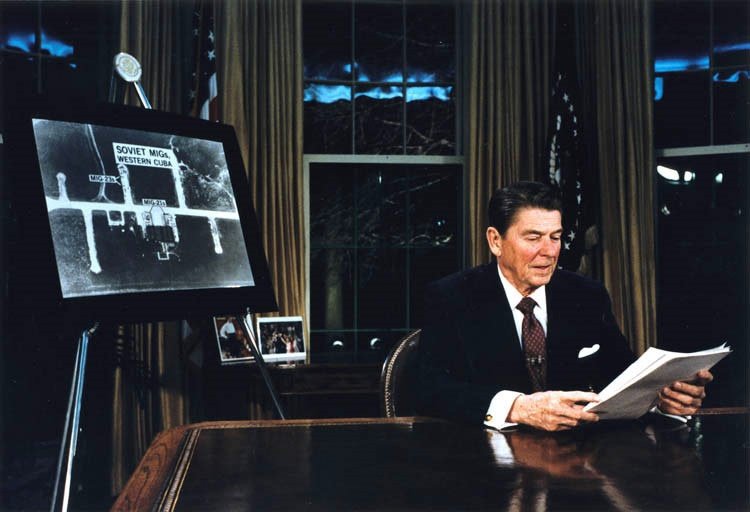
In 1983, Ronald Reagan announced the plan to develop the Strategic Defense Initiative.

Technology advocates soon had some political and technical setbacks. Congress passed the 1985 Balanced Budget Act, and the Pentagon faced many competing investments. Even though the Pentagon had been investing in many new concepts such as space-based lasers, Congress was not enthusiastic about giant programs. Even with the likely suspects, such as Edward Teller, who was selling his nuclear pumped x-ray lasers, the majority of the scientific community was skeptical. Then the Shuttle Challenger that the SDI program planned to use for early deployment of space weapons exploded shortly after liftoff. Nevertheless, many new programs were getting started slowly and Reagan was reelected with support for continuing emphasis on increasing defense budgets, The U.S. technology advances were just getting started but with very slow advances in high power lasers, but with real progress, primarily in the evolution of ground launched defensive missile systems, when the Soviet Union began to fall apart.

One year later, they signed an arms control agreement to ban intermediate range nuclear missiles that represented a serious strategic stability problem because of the short flight times of such missiles to and from Europe. The treaty remained in force for 10 years until Russia violated the treaty. Recently, the technology competition heated up again when Russia attacked Ukraine with such a missile carrying six non-nuclear warheads, each carrying six submunitions and fully capable of delivering nuclear weapons and attacking Europe in minutes. Now the need for missile defense has been made obvious to even the most dedicated advocates of arms control. And even more troublesome is the fact that the Russians have a well-developed capability to deploy methods, called penetration aids, to defeat any ground-based missile defense.

In April, 1986, a reactor at the Chernobyl nuclear power plant exploded contaminating Europe with radioactive material. That event was bad enough, but for the Soviet Union, the bad news just got worse and then even worse. They were already in a rather bad mood with their crumbling economy and had to deal with our active secret programs to blow up their pipelines and mess with their computers and software. At the same time, Gorbachev feared that with the United States increasing funding for our missile defense research, a space arms race would be the final blow in his attempts to save the Soviet economy. Then one of their ballistic missiles carrying submarines sank, and a Russian cruise ship carrying dignitaries collided in clear weather with a freighter in the Black Sea.

Gorbachev’s military experts convinced him that the United States would deploy space weapons in only a few years. Meanwhile, his own military industrial complex was preparing their own giant space laser for initial deployment the next year. As it turned out, there were many feverish aerospace engineers in both countries ready to be rewarded with unlimited funds. They were disappointed when not only was the technology not ready, but Reagan and Gorbachev decided to get along.

I believe that strategic political environment and technology have evolved to the point that we need to reconsider one of our old ideas for defense against nuclear tipped ballistic missiles based on lasers in space. The most advanced laser weapon system at that time was called Zenith Star and Reagan thought we were only a few years from a real defense. In reality, the technology fixes involved were not even close. The laser was one problem, but our computers for battle management were inadequate and the shuttle was much too expensive for a giant space deployment. Today times have changed, and so has technology.

Twenty years ago, practical high-power lasers were just concepts on viewgraphs, but DARPA formulated an ambitious program to create multiple combined fiber lasers with “tens of kilowatts and capable to be scaled to hundreds of kilowatts. A 500 kilowatt laser will exist soon and we are on the way to 1000 kilowatts. Not only are electrically pumped fiber lasers real today, but they have been moved from the research labs and are being used in manufacturing operations. They are also being deployed on ground and sea vehicles to intercept slow missiles and swarms of drones. Those are only some of the advances that indicate we need to take another look at missile defense using high power lasers.

Back in the 1980s, in spite of Reagan’s enthusiasm, the technology for large scale deployment of weapons into space was not a realistic possibility. Even if we had not suffered the loss of the Shuttle, we had no way to afford deployment with the cost of lift close to tens of thousands of dollars per pound. But now Space X is realistically offering lift at thousands of dollars per pound, and predicting 100 times less if everything but the rocket fuel is reuseable. In addition, Space X has launched thousands of Starlink satellites and changed the way people work and play. Elon Musk has certainly revolutionized access to space, and the entire missile defense system concept needs to be rethought without restrictions on deployment cost.

But what about the problem I thought would be the real show stopper, and that was the trusted computer hardware and software needed to allow the decision maker to instantly respond to a warning? When I worked at Sandia National Labs, our fastest computer had a computational speed of one trillion operations per second.  Today the fastest computers are one million times faster, and the practical applications of modern computers and the decision support software is so real that modern industry is investing in technology that has driven the leading supplier to become more than a 3 trillion-dollar capitalization corporation.

So now what?  With many extremely impressive advances in technology, I believe now is the time to ask again if Ronald Reagan’s dream of March 23, 1983 can become a reality. And as usual, even if the technology is enormously successful, there will be unintended strategic consequences that should be carefully explored.


It’s not a lie if you believe it

One of the most famous lines from the TV show “Seinfeld” was, “It’s not a lie…if you It's not a lie if you believe itbelieve it.” This concept also applies to intersection between science and politics. My last post discussed a commonly believed fallacy in the world of military technology development. The engineers and scientists who believe their latest invention will lead to certain victory and when they market that idea with the certainty of their faith, they are not lying.


One of the strongly marketed ideas currently for missile defense is the concept called “Brilliant Pebbles.” This idea has a long history going back to the 1958 Bambi

Brilliant Pebbles
This image shows a Brilliant Pebble anti-ballistic missile interceptor emerging from its protective “life jacket”, the white shell. It shows an earlier model of the interceptor design with three fuel tanks, later designs had four much larger tanks wrapped around the missile body. A second Pebble remains inside its life jacket in the background. Several Soviet missiles are shown in the lower right, but these would be too close for the Pebbles to intercept.

concept of hundreds of space based missiles that would detect the launch of attacking missiles and destroy them early in their flight. The technology of the time was far from adequate, and the concept reappeared in 1979 as the High Frontier concept, advocated by General Daniel Graham who claimed the technology was off the shelf. The advocates believed they had the certain path to an effective missile defense, but the dream of the ultimate space based defense weapon in the form of giant spaced based lasers captured the imagination and funding of the Pentagon. The laser weapon funding grew rapidly after Reagan’s Star Wars speech in 1983, and the laser advocates believed they finally had the answer, but again technology was wanting and the funding drifted down after a few years.

The enthusiasm for small space based missiles was reborn as “smart rocks.” This

Pebbles presentation
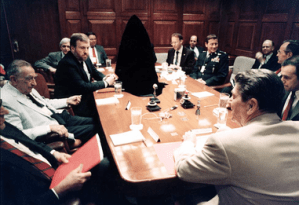
In March 1988, Teller and Wood (on the left) present the original Pebbles concept to Reagan, Bush, Abrahamson and members of the SDIO. The model of the pebble was theatrically draped in black cloth to hide it from the reporters.

approach achieved enhanced support when Lowell Wood’s LLNL concept became “brilliant pebbles” that would be so small and inexpensive that they could be permanently deployed in space and do the job of boost phase intercept. That idea gained support for a while and then it died in the early 90s, but the true believers never lost faith, and the idea is back again, and is being touted, by Henry Cooper of the new High Frontier organization as a possible component of Donald Trump’s Space Force proposal.

The technology has advanced to the point that the new system concepts are focusing on cost effective approaches to actual deployment using the industrial adaptations of the new ideas for small satellites. With enough space based missile interceptors, there could be a multilayer defense all the way from boost phase, to midcourse, to early re-entry. So this is the new last move that will finally and certainly solve the problem of missile defense, and the Pentagon is showing interest. And the advocates believe it … so it is not a lie.deception

I believe that this “last move” is one more fallacy, and there are certain to be reactions to this latest “last move.” These reactions, called counter measures, can come in the form of physical attacks on the space based hardware including jamming of the communications, dazzling and blinding of the sensors and hacking of the software. The reaction to these countermeasures will be “hardening” to achieve a robust and resilient system to counter the countermeasures, and the advocates will claim they have the final answer this time, as modifications and enhancements will lead to program extensions and cost growth that were not anticipated, but everybody involved will honestly claim that nobody was lying when they provided the initial cost estimates.

Is there any way out of what will become a new escalating space race? Is there no way out? How will this new space arms race end? There could be negotiated agreements that we used to call “arms control,” but today’s global strategic environment is more complex than it used to be. Today Russia and the U.S. are facing space competitors from China and before too long India. But what about Europe, Japan and Israel? Here we go again with the warning of President Eisenhower to beware of the growing power of the military industrial complex. It is too late for agreements – so fasten your seat belts and get ready for a fast and very expensive ride toward an unknown outcome.


Remembering the legacy of George H.W. Bush

“It would not be prudent at this juncture.”

On “Saturday Night Live,” comedian Dana Carvey, impersonated President George Herbert Walker Bush with the memorable line, “it would not be prudent at this juncture.” It was not only humorous, but an accurate description of the thoughtful approach, as well as the personality and character of the man who I had interacted with when I was the Chief Scientist of the SDI.

Reflecting on the man after his recent death, I recall the way he acted with prudence after the implosion of the Soviet Union. On Sept. 28, 1991, Bush announced his strategic nuclear weapons plans. He wanted to curtail further deployment of all nuclear tipped nuclear weapons. He wanted to limit all of our ICBMs to single warheads in order to avoid any perceived benefit from a first strike and to negotiate a posture of convincing deterrence. Part of this strategy was that there not be any sort of global missile defense as proposed by Ronald Reagan. He did recognize the growing proliferation of short-range ballistic missiles, and he called for developing and deploying limited defenses that would still be effective against the growing threat from rogue states.

His approach in 1991 was to maintain deterrence based on threat of mutual assured destruction while assuring the Russians that we had no intention of defending ourselves against their ability to retaliate. He had not changed his point of view from that when I met with him six years earlier. He had been asked by President Reagan to visit our allies and negotiate agreements with them to join us in a giant R&D program. Secretary of Defense Caspar Weinberger offered the allies prospects of lucrative contracts and technology sharing if they would sign on to supporting our SDI program.

I was asked to go along on the trip and provide low key technical back up to the negotiations. Bush invited me to visit him in his office and give him a one-on-one briefing on the program. He was cordial, informal and a good listener, but he obviously was not interested in details. We sat in overstuffed leather chairs next to a coffee table that had a signed picture of his previous vice-presidential opponent Gerry Ferraro. I noticed his plaid watch band that struck me as what would be expected of a prep school high school student and we chatted back and forth as if we were old friends.

After we talked, he asked me to come on over for dinner and continue the discussion with some of his friends. The old friends were all distinguished members of the political strategic weapons community and after dinner we went around the table and shared thoughts with the vice president.  All of the comments about SDI ranged from mild disagreement to outright opposition.

Harold Brown, former secretary of defense under Jimmy Carter, said “SDI is not a very good idea…it is a mistaken commitment to a real gamble.” Other comments basically argued that this program would mess up our relations with the allies that Bush would face on the trip. After listening to all of the opinions without comment, he closed the discussion by saying, ‘This is a listening trip…. not an SDI trip…this is a prudent step.”

I still thought the trip was on and even bought a new suit for the trip, rather than the threadbare one I had worn to dinner, but I soon learned that Reagan had decided to focus the trip on counter terrorism, not SDI, and my services were no longer needed. I should have realized that Bush believed that the trip was “not prudent at this juncture.”

With his calm, careful and thoughtful approach, Bush never sought nor received much attention in the Reagan administration, so it was not obvious at that the time that he was destined for greatness. When he was elected as President, he provided honest and clear-thinking leadership that served our nation well. He will be recognized as one of our greatest Presidents and we sure could benefit from a George Herbert Walker Bush in the White House today.

North Korean anthrax threat leaves U.S. with six options

As the new year dawns, the United States faces the issue of what to do about North Korea. Although North Korean leaders have denied charges of building facilities to produce deadly microbes and labs that specialize in genetic modification, the discovery that a North Korean defector tested positive for anthrax antibodies has raised fears that Kim Jong Un’s regime is developing lethal biological weapons. So how should the U.S. respond?

Getty imagesAs I see it, our country has at least six options and 2018 is likely to be the year we decide what road to take. The options consist of the six Ds: deterrence, defense, deals, destruction, deceit and delay. We faced a similar decision at the height of the Cold War when I was in the middle of the muddle of what to do about the Soviet Union, as I describe in my recently published book, “Death Rays and Delusions.”

During the early 1980s, President Ronald Reagan had charged my team with the goal of creating ballistic missile defense. At the time, none of us knew that the Soviet Union had not only aggressive programs in both offensive missiles and missile defense, but also had a very secret manufacturing and deployment program in biological weapons including warheads for their giant SS 18 missile.

While we debated the six Ds, the Soviets pursued strategies for spreading anthrax along with a nuclear strike. I had assumed that we had already made a deal with the Soviets to ban biological weapons, and I only became aware of the biological weapon threat when a letter containing a few grams of anthrax spores arrived at the Hart Senate Office Building.

In 2001, I walked out of a long meeting in the Hart Senate Office building and ran into yellow police tape in the corridors. Waiting police hurriedly ushered me and my colleagues out of the building and informed us that the building had been contaminated by a small envelope containing a few grams of anthrax spores.  Several days later, when I had already returned to Albuquerque, I received a message to get a nasal swab and start an extended treatment of Cipro, which turns one’s tongue black. The treatment was supposed to be effective if started immediately after exposure, but if delayed by a few days, death was certain. Of course, several days had already passed when I received the message. Fortunately, I was not infected but five people died from inhalation and infection. Another 17 became infected but survived. There was wide spread disruption and the cleanup cost was $27 million.

Caution Bio Warfare

This encounter with biological weapons clearly demonstrated the extent of this danger. I can’t imagine what a surprise attack spreading tons of anthrax spread over our major cities would do. The combination of a biological and nuclear strikes could only have one purpose–to kill us all.

In retrospect, during my time working with the Strategic Defense Initiative, we mostly engaged in delay in decision making, coupled with a certain amount of deception. Right now, the most likely D may not be one the big six. Instead the U.S. may turn to another D… denial.