
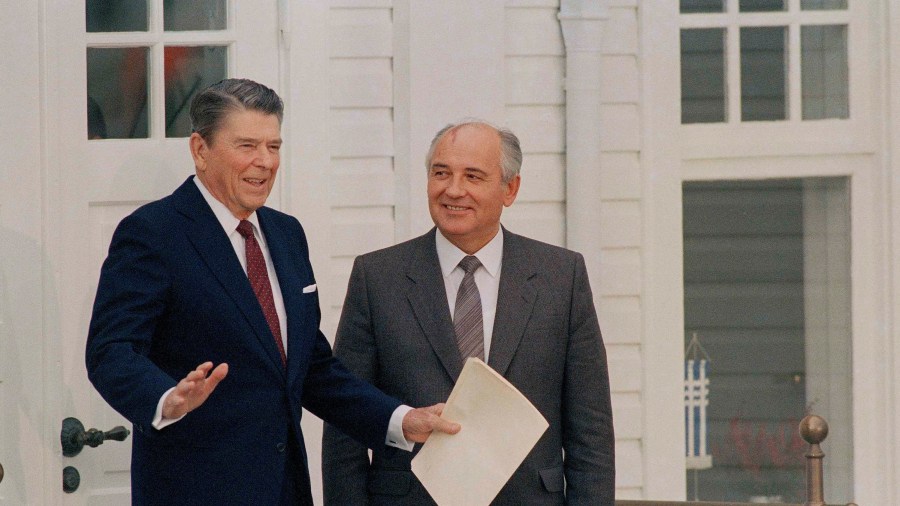
When I joined the SDIO in 1984, the president gave us clear instructions to figure out how to share missile defense technology as part of his strategy to eliminate all nuclear weapons. At the same time, we were aware that the Soviets would love to benefit from our investments and we were serious about protecting our secrets. I responded with a proposal to share early warning data–not technology–as part of an agreement preventing any surprise missile launches, and, as I expected, my suggestion was rejected as coming from an engineer. Reagan continued to insist that we share SDI, and he wanted to make a deal with Soviet leadership, but they kept on dying before he could sit down with them. Then came a totally new and revolutionary Soviet leader Mikhail Gorbachev.

In 1985 at the Geneva summit, Gorbachev and Reagan stated, “A nuclear war cannot be won and must never be fought.” This was not just propaganda but a deeply felt conviction on both of their parts.
After the latest dust up over North Korean missile tests had passed, our current secretary of state indicated a willingness to consider negotiations with North Korea. It seems to be unlikely to happen, or even less likely to be productive, but maybe we can learn from the history of the one of the most surprising negotiations in history. During three days of one-on-one arguments, the result was almost an agreement to eliminate all nuclear weapons.
President Reagan went to the Reykjavik summit in the fall of 1986 with a spirit of  cooperation and a conviction to abolish nuclear weapons. He wanted to move ahead with SDI that he thought was close to deployment, and share SDI with the Soviets. Secretary of State George Schultz, his principal adviser, had recommended that “we trade the sleeves of our vest and make them think they got an overcoat.”
The young and vigorous new leader of the Soviet Union, Gorbachev also wanted to eliminate nuclear weapons, but his military industrial complex wanted to compete not cooperate. He was told that his industry was only five years behind us in missile defense and could catch up if he could slow us down for 10 years. He was more worried about his own SDI that was preparing to launch its giant space laser and was terrified of a space weapon race in the face of his country’s imploding economy. He had been on the job only since March 1985, but his confidence had already been shattered by a rapidly declining situation that left him desperate to make a deal.
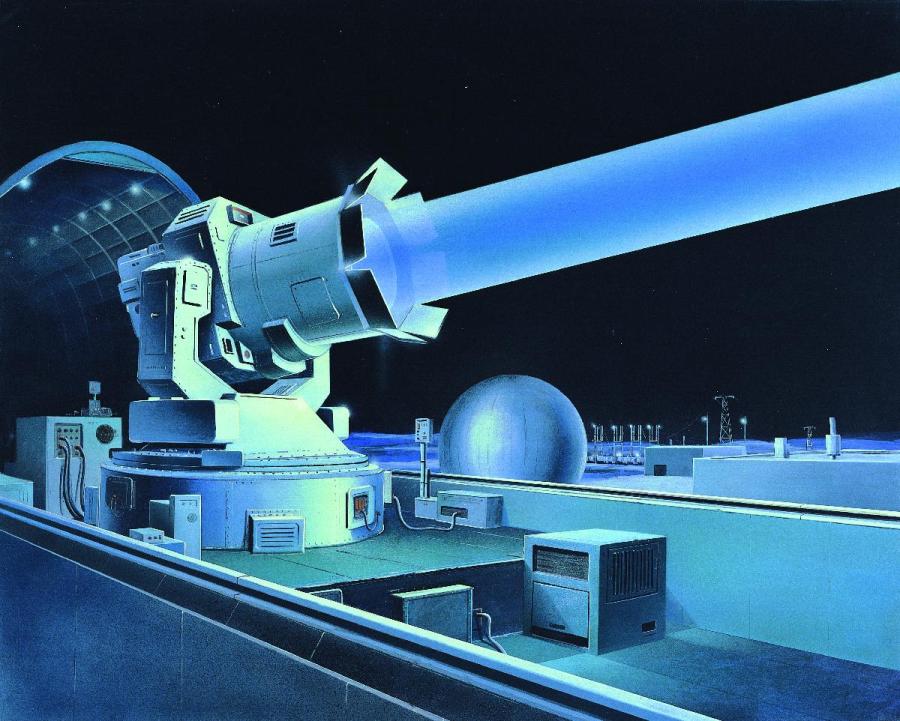
 This “fake news” headline appeared on a May 1985 article in the Los Angeles Times:
  a mirror on the space shuttle, so I was not to be believed. Well, technically he was correct about what we did, but he neglected to say that our laser was on top of a cloud free mountain. So the real story should have mentioned that several laser locations would be needed in high altitude relatively cloud free areas, like in Arizona, or even a more futuristic concept would require a high power laser on an aircraft, which is not unrealistic in the near future. But these recent advancements in the GBL could pose a problem. What if the GBL, whose technical basis has advanced rapidly, is used by a future adversary to attack our defense satellites as the first or second step of an escalating global conflict?
 According to Chinese general, military strategist, and philosopher Sun Tzu, “All warfare is based on deception.” The classic shell game uses three walnut shells and a pea to deceive the victim of the scam. The crook uses slight of hand to disguise the rapid moves. In mid course missile defense the reentry vehicle (RV) is the pea and the walnut shells are lightweight balloons. The slight of hand is to make each of the balloons look slightly different from all of the others. The game gets more challenging by spreading out the balloons so the observer can’t attack all of them. So one approach to defeat the balloons is to wait until the threat cloud reenters the atmosphere so the light weight objects slow down leaving only the RV to be attacked with an atmospheric interceptor like
 battle management software. Does the street smart trickster win the shell game? We can only answer with tests of the defense system in the face of a credible “red team” of attackers….using realistic computer simulations. But how do we test the software against accidental faults or determined hackers who hide their moves under more shells?
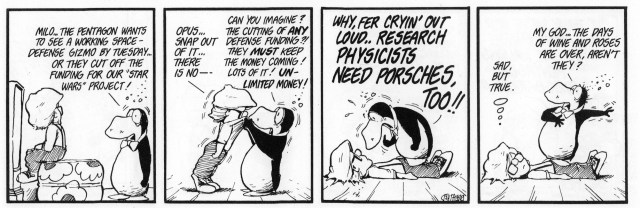 Many politicians including Ronald Reagan and Jack Kennedy knew how to express reality through humor in order to communicate real news hidden behind quips. I believe their style would be useful today.
 SDI Guy