A simple, low cost, really nasty new weapon system

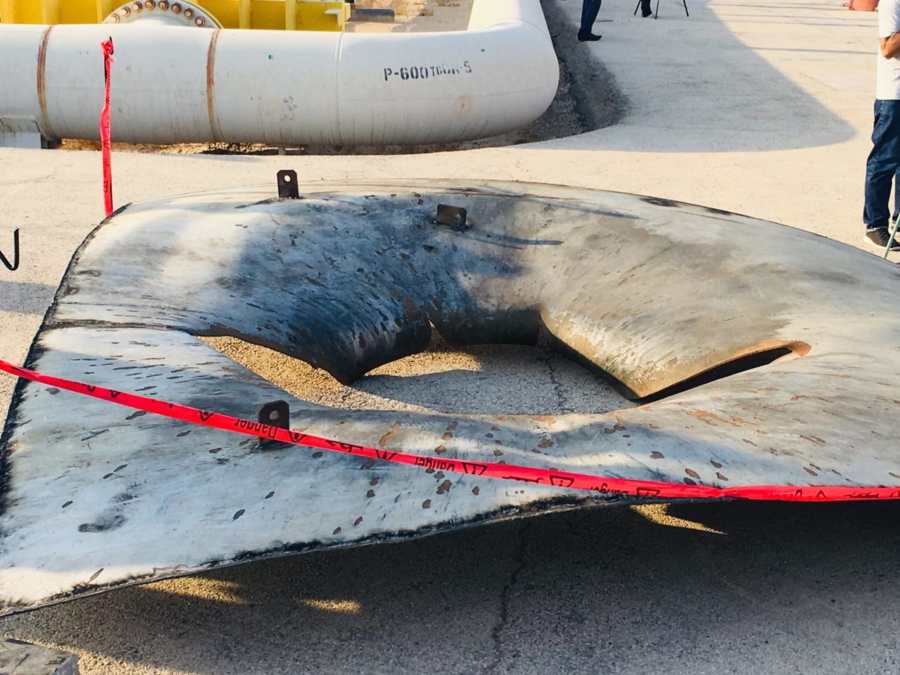
Precision drone attack damage of Saudi Oil facility

Could low cost, fairly low tech aircraft defeat the very expensive missile defense system of Saudi Arabia?  Of course not! No way, I thought, since the Saudis rely on our technology and we have spent billions and billions on missile defense since we began the SDI program in 1984.

I never gave this possible threat much thought until the Saudis’ giant oil facility was attacked with high precision on Sept. 14, causing enough damage to measurably reduce the global oil supply.

Yes there was a fairly modern missile defense system in place, but the attack came from tens of small low-flying drones and cruise missiles proving that the best defense against the wrong attack is useless. It looks like I was not the only one surprised since Israel, who should have been the most alert to such threats, has just announced they are reacting to this event. (“Netanyahu seeks billions to fund Israeli defense against Iranian cruise missiles,” Haaretz, Oct. 07, 2019.) Even before that, the Russians announced in Izvestia that their small multi rotor drones “will perform not only reconnaissance missions, but also strike targets with miniature bombs.”

I recall that when the SDI was created, the secretary of state raised the issue of cruise missile defense, but his question was never seriously answered and we focused on the Soviets’ huge investment in intercontinental ballistic missiles. So this new threat is not so new, but I hope the new aspect of swarms of low-cost drones is now being taken seriously.

This wake-up call up call should now be loud and clear, but even worse than we expected, since even though the cost of cruise missiles is very high, the technology and cost of swarms of drones has become very attractive worldwide to even capable individuals. It is now realistic that many of the world’s soft targets, such as cities, are vulnerable to attack. But certainly we could use electromagnetic weapons to jam, confuse, take over or destroy the guidance and communications of drones, high power lasers to destroy their delicate components or just plain old intercept missiles and anti-aircraft guns to blow them out of the sky, so not to worry.  We could even deploy our own swarms of defense drones to attack their offense swarms.

Well, it is not that simple since the real issue is the cost exchange, and the low cost and tactics available to giant swarms of drones could reduce the effectiveness of most of tomorrow’s technologically available defenses.

In addition, there is the element of surprise, demanding an early warning detection and tracking system, as well as the reality of exhaustion of the defense against fake or real repeated attacks. But we know that each low-cost drone could only deliver a pound or so to a target, so what is the big deal? Well, maybe the drones could target critical parts of our exposed electric grid, or maybe disperse biological agents along major streets, or target large sports events with hundreds of grenades or just go after parking lots at crowded shopping centers? The implication of such terror weapons are frightening to say the least.

Certainly Israel has some not so friendly neighbors, and their enemies must be preparing such killer drone swarm attacks, but we don’t have such problems from our neighbors .…  unless the drones are delivered from ships near the big cities near our coasts.

So what to do about all of these new concerns about a threat that might be more likely than intercontinental missile attack that attracted our defense community for decades?  I am sure the Pentagon, the labs and the defense industry are working to figure out our response. Of course, the threat will evolve as well as the defenses, and we need to also prepare for simultaneous info and space attacks, so we may look on the simplicity of the good old days with nostalgia.

 

Brilliant pebbles

Space is a dangerous place.

The trouble with good ideas…

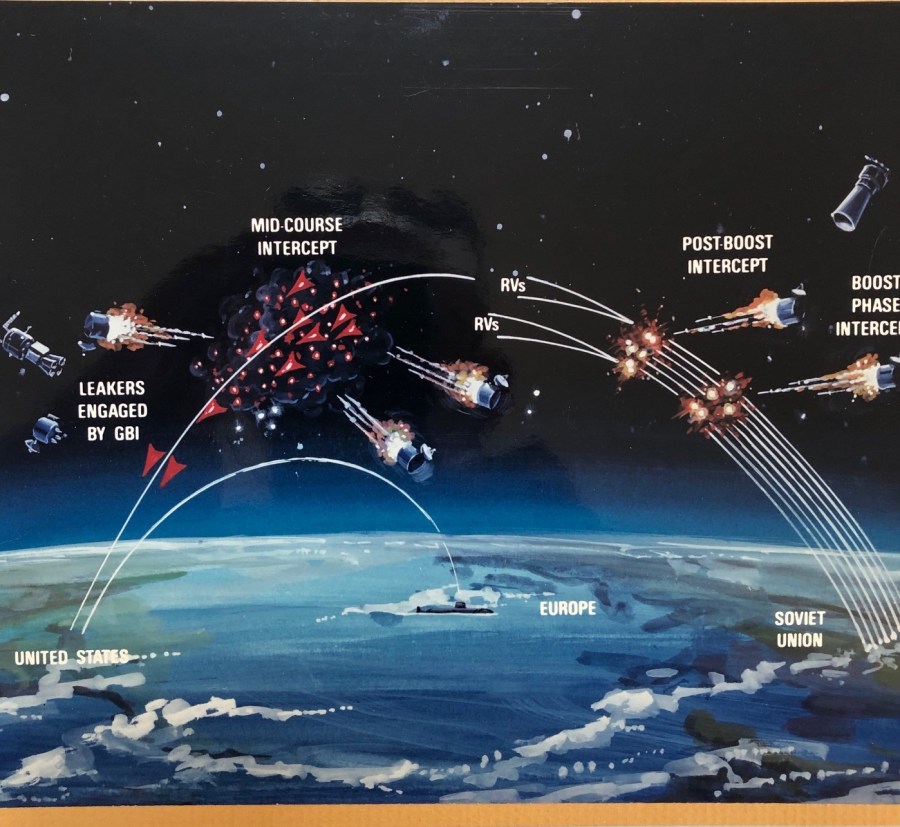
Brilliant pebbles are a really good idea, at least some scientists think so. No one doubts that the technology exists now to deploy thousands of small missiles (called brilliant pebbles) permanently orbiting the planet. These missiles coupled to an extensive space based satellite sensor constellation could automatically go after and intercept intercontinental ballistic missiles shortly after they lift off in their very visible boost phase. Burning boosters are very vulnerable to a high velocity collision with even a light object, and the boosters would come crashing down together with their lethal payloads possibly not even far from their launch area. Assuming that the sensors are operational and not spoofed, the automated decision process is reliable and most of the so called pebbles are in good working order, this low earth orbiting cloud of defensive missiles would greatly contribute to our defense against the ever greater proliferation of ballistic missiles and some of these might even have nuke payloads.

Some cost estimates of this defense investment do not seem unreasonable … but wait for the rest of the story. Any competent adversary who had counted on achieving a convincing threat would not be so happy with our deployment and would know far in advance about our plans and observe our deployment process. They might complain about our “militarization of space” and even threaten to put a stop to our bad behavior before we got too far into our plan. They might even do something nasty just to get our attention, and they might even use anti-satellite methods to harass and even destroy our early deployments. They might even start deploying their own missile constellation to tag along closely with our defensive missiles, and we might tell them to stop that and ask them to back off.  If we hurry up and get going before they can do too much, we could get our convincing defensive capability in place and declare our ownership of space and not allow further deployments of means to attack our purely defensive missiles. They might then turn their military investments to high power lasers on the ground that could over a period of time harass, blind and destroy our missiles and sensors. It turns out that low earth space orbits can be a very dangerous place if ground based high power lasers exist, but wait there are clouds that could get in the way, so they might not have the freedom of action they desire.

Another approach to laser deployment could be on high altitude aircraft that could operate above the clouds and conveniently track and shoot up at satellites. The laser power supplies would be chemicals that would have to be replenished, but there could be multiple aircraft, and the adversary could take their time to mess up our deployment. But wait there would be more to this story since we could attack the large, slow and vulnerable aircraft with our advanced fighter planes and their lasers that shoot toward satellites would provide them with no protection, so they might use their own advanced fighter planes to attack ours. By then we might have our own high power lasers on our fighter planes and we could defeat their lower power lasers, while they try to use their anti-satellite missiles against our purely defensive pebbles.

But wait, they might not be ready to start a space/air shooting war and instead attack our extensive but very vulnerable electric grid using their cyber weapons, which would trigger our own cyber-attack on their command, control, communications, intelligence (c3i). They might then try to destroy our c3i so we would no longer be able to manage the rapidly deteriorating chaos of our purely defensive pebbles. Somebody might even try to nuke somebody, or maybe their terrorist buddies could dump biological agents in a few of our cities, since nobody is managing the chaos, and things might get really messy real fast. Oh well, brilliant pebbles seemed like a good idea.

It’s not a lie if you believe it

One of the most famous lines from the TV show “Seinfeld” was, “It’s not a lie…if you It's not a lie if you believe itbelieve it.” This concept also applies to intersection between science and politics. My last post discussed a commonly believed fallacy in the world of military technology development. The engineers and scientists who believe their latest invention will lead to certain victory and when they market that idea with the certainty of their faith, they are not lying.



One of the strongly marketed ideas currently for missile defense is the concept called “Brilliant Pebbles.” This idea has a long history going back to the 1958 Bambi

Brilliant Pebbles
This image shows a Brilliant Pebble anti-ballistic missile interceptor emerging from its protective “life jacket”, the white shell. It shows an earlier model of the interceptor design with three fuel tanks, later designs had four much larger tanks wrapped around the missile body. A second Pebble remains inside its life jacket in the background. Several Soviet missiles are shown in the lower right, but these would be too close for the Pebbles to intercept.

concept of hundreds of space based missiles that would detect the launch of attacking missiles and destroy them early in their flight. The technology of the time was far from adequate, and the concept reappeared in 1979 as the High Frontier concept, advocated by General Daniel Graham who claimed the technology was off the shelf. The advocates believed they had the certain path to an effective missile defense, but the dream of the ultimate space based defense weapon in the form of giant spaced based lasers captured the imagination and funding of the Pentagon. The laser weapon funding grew rapidly after Reagan’s Star Wars speech in 1983, and the laser advocates believed they finally had the answer, but again technology was wanting and the funding drifted down after a few years.

The enthusiasm for small space based missiles was reborn as “smart rocks.” This

Pebbles presentation
In March 1988, Teller and Wood (on the left) present the original Pebbles concept to Reagan, Bush, Abrahamson and members of the SDIO. The model of the pebble was theatrically draped in black cloth to hide it from the reporters.

approach achieved enhanced support when Lowell Wood’s LLNL concept became “brilliant pebbles” that would be so small and inexpensive that they could be permanently deployed in space and do the job of boost phase intercept. That idea gained support for a while and then it died in the early 90s, but the true believers never lost faith, and the idea is back again, and is being touted, by Henry Cooper of the new High Frontier organization as a possible component of Donald Trump’s Space Force proposal.

The technology has advanced to the point that the new system concepts are focusing on cost effective approaches to actual deployment using the industrial adaptations of the new ideas for small satellites. With enough space based missile interceptors, there could be a multilayer defense all the way from boost phase, to midcourse, to early re-entry. So this is the new last move that will finally and certainly solve the problem of missile defense, and the Pentagon is showing interest. And the advocates believe it … so it is not a lie.deception

I believe that this “last move” is one more fallacy, and there are certain to be reactions to this latest “last move.” These reactions, called counter measures, can come in the form of physical attacks on the space based hardware including jamming of the communications, dazzling and blinding of the sensors and hacking of the software. The reaction to these countermeasures will be “hardening” to achieve a robust and resilient system to counter the countermeasures, and the advocates will claim they have the final answer this time, as modifications and enhancements will lead to program extensions and cost growth that were not anticipated, but everybody involved will honestly claim that nobody was lying when they provided the initial cost estimates.

Is there any way out of what will become a new escalating space race? Is there no way out? How will this new space arms race end? There could be negotiated agreements that we used to call “arms control,” but today’s global strategic environment is more complex than it used to be. Today Russia and the U.S. are facing space competitors from China and before too long India. But what about Europe, Japan and Israel? Here we go again with the warning of President Eisenhower to beware of the growing power of the military industrial complex. It is too late for agreements – so fasten your seat belts and get ready for a fast and very expensive ride toward an unknown outcome.


Herbert_York

“The Fallacy of the Last Move”

One of the military technology as well as arms control leaders at the end of the last century was Herb York. He always argued for weapons technology development based on good physics, and at the same time emphasized arms control based on mutual understanding between the U.S. and our adversaries. He made it clear in his 1995 book, “Arms and the Physicist,” that arms control agreements were hampered by the “fallacy of the last move.” He wrote, “We are confronted by the dilemma of steadily decreasing national security … this dilemma has no technology solution.”

I had reached a similar conclusion ten years before that.  After Reagan called for the initiation of the missile defense “Star Wars” program, the Fletcher panel was organized in the summer of 1983 to create and document a plan of action. I was asked to put together a sub panel on directed energy weapons that were thought to be the source of the next “technology miracle,” and after we completed our effort, I was asked by Fletcher to write a conclusion of the study. I wrote: “We concluded that a robust BMD system can be made to work eventually. The ultimate effectiveness, complexity, and degree of technical risk in this system will depend not only on the technology itself, but also on the extent to which the Soviet Union either agrees to mutual defense arrangements and offense limitations, or embarks on new and more desirable strategic directions in response to our initiatives. Since the outcome of the initiation of an evolutionary shift in our strategic direction will hinge on as yet unresolved policy as well as technical issues…no definitive predictions of the outcome can be made.” The end of the last sentence was not published. Instead, what was advertised was that “a robust BMD system can be made to work eventually.” The notion that the outcome was not only uncertain, but depended on the next move of our adversary did not see the light of day.

The history of military technology has taught us that the development of weapons is always followed by the development of counter weapons. We can learn from the history of the army’s battlefields that the infantry changes, from the machine gun to barbed wire and trenches, to tanks, to anti-tank weapons, to hardened armor, to defensive shields… and on and on. Space weapons will be no different, and will be dominated by sensors and anti-sensor weapons, be they blinding lasers or command and control hackers, and hyper-sonic missiles. The game will go on and on, but the predictability of the outcome will be obscured by the complexity of the actions and the reactions.

The technology marketers will improve their methods to persuade the poorly informed decisions makers that their latest inventions will provide certain victory. The end game, however, will be elusive and will be dependent on not just technical, but social, political, economic and psychological factors.

Will our future consist of an endless arms race or are there more beneficial ways to invest our nation’s increasingly limited financial resources? I believe we should take our guidance from history. Some of the scholars of the end of the Soviet Union argue that the SDI technology advances allowed us to win the arms race with the Soviet Union; however, as I wrote in my book, “Death Rays and Delusions,” the collapse of the Soviet empire was caused by its “moral decay and mismanaged political institutions rather than economic collapse or even scientific and technology competition.” We should learn from history to warn of us of our own social/political and impending cash flow problems as our population ages demanding more and more of available funds, compounded by the return to normal interest rates. I call this the “geezer threat,” and I believe we urgently need to figure out how to deal with the inevitability of “global aging.”