Boost Phase Intercept (BPI) with high power lasers could defeat North Korean missiles

In order to achieve an effective defense against an all-out ICBM attack from the Soviet Union, the Fletcher Study, that in 1983 created the plan for the SDI, reported that Boost Phase Intercept would be needed. I explore this in great detail in my new book “Death Rays and Delusions” available now at Amazon.com. We believed the midcourse and terminal phases could overwhelm the defense with countermeasures if a large fraction of the boosters were not destroyed. Burning boosters provided a bright target that was easy to find and the thin missile skin made them relatively easy to kill. Missile vulnerability was demonstrated with a high power laser directed at a mock-up of a booster subjected to its acceleration and pressure stresses. The test was described by one of the technical skeptics as a “strapped down chicken test.”
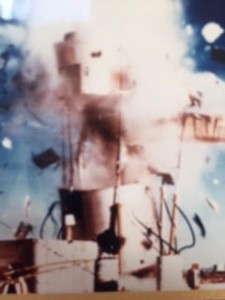
Laser destruction of liquid fueled booster

Although the booster was very vulnerable to attack, intercepting the booster required deployment of either space based missiles or lasers. The lasers were far off in the future, and the numbers of missiles appeared to require a prohibitively large launch capability, unless the missiles were miniaturized, eventually resulting in the “Brilliant Pebbles” concept. This concept was seriously pursued for five years and then canceled when the Soviet threat disappeared in the ‘90s. Small interceptor missiles, however, did appear to provide a realistic path to BPI based on advancing missile technology.

The preferred approach in 1985, however, was the ground based laser (GBL) with only relay mirrors in space, and substantial efforts were begun to develop enormous free electron lasers to produce beams of the required power and wave length. A significant development was the invention of optics that could correct for sources of beam distortion. A remaining problem was the need for multiple high altitude locations to deal with clouds. In addition, the laser technology and physics did not cooperate, and for want of a laser, the GBL was dropped, but development of aircraft based lasers continued.
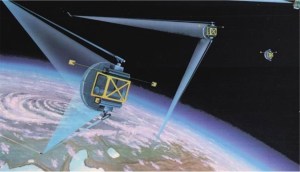
laser relay
Artists concept of space based laser relay mirrors http://spie.org/newsroom/4853-did-adaptive-optics-end-the-cold-war?SSO=1

Chemical lasers on 747s enjoyed $5 billion of support for dealing with the evolving North Korean ICBM threat, but the concept was dropped by the Secretary of Defense as impractical, expensive and easily defeated. So the quest for a laser remained until recently with the development of short wave length, efficient, rugged, light weight, fiber lasers. Such lasers could be based on aircraft and be used to directly intercept boosters or relayed from space or possibly drone based mirrors to their targets. Nevertheless, this development is still many years away. So what about the near future? With the recent North Korea tests of a very high yield nuclear device and an  ICBM, the threat demands that we get very serious about deployment of an effective missile defense.

For short range defeat of boosters launched from North Korea, it is possible to utilize aircraft based very fast small missiles, and drone platforms have been proposed, as outlined in this column: http://www.sandiegouniontribune.com/military/guest-voices/sd-me-herman-northkorea-defense-20170816-story.html. So BPI, which was from the beginning of the SDI thought to be desirable or even necessary, seems to be emerging based on drone based fast missiles,  and could evolve eventually to laser weapons. To learn more, check out “Death Rays and Delusions” now available on Amazon.com.


Star Wars Sinks Summit

Time magazine For decades, the Soviet military lagged behind us technologically, and by dominating one half of the budget it fatally weakened their economy. The military was stuck in the quagmire of Afghanistan yet they remained committed to compete with us and maintain their control of Soviet society. A key element of their approach was stealing our secrets. We had discovered how they were shop lifting our technology, and we cooperated by “enhancing” the ingredients of their shopping bag. The chief Soviet thief was actually working for us, and he wanted to get even with his KGB bosses. Farwell Dossier

According to Thomas Reed, former Secretary of  the Air Force, we were “blowing up Soviet pipelines, infiltrating Soviet computers, bollixing  their software, …electronics infected with bugs, viruses, and Trojan horses placed there by the US intelligence community.”

Gorbachev wanted to terminate the arms race and turn his economy around, but in the fateful 1986, everything seemed to go from bad to worse: Gorbachev was planning an anti vodka campaign to deal with what he thought was contributing to his country’s mental and financial depression. His faulty governing plan was based on a commitment to a contradictory strategy of both entrepreneurial and communist economies that would become a worsening financial decline. Then the Chernobyl reactor explosion destroyed his confidence in Soviet technology, followed by the sinking in clear weather of their only luxury cruise ship Adm. Nakhimov. These accidents caused wide spread distrust of incompetent leadership and a growing level of anxiety in his country. Then just before the Reykjavik summit — one more stunning disaster. A critical component of their nuclear deterrent,  a rocket on the  k219 nuclear submarine with 30 nuclear warheads aboard caught fire and the sub sank with a trailing American sub watching the entire debacle.

With all of the Soviet catastrophes in mind, his military advisors told him we really had substantial advances in missile defense, yet his military industrial complex was on the verge of launching a space weapons race. He was convinced his country could not simultaneously compete and also salvage their disintegrating economy.

He was ready to make a deal and Reykjavik was the place to agree to end the arms race, but he could not close the deal with Reagan.  Above everything else he was determined to stop his own military industrial complex from launching their giant  Polyus space laser, and that meant he needed the leverage from persuading Reagan to keep SDI in the laboratory and not in space. He told Reagan after three days of back and forth arguing “It’s the laboratory or goodbye”.  Reagan, with his totally unrealistic confidence in near term SDI deployment, said no deal. The world leaders acting on their own walked away from changing the course of history.

Our own military and our allies breathed a sigh of relief since they were totally committed to a nuclear deterrent based on mutually assured destruction, and at the same time the press argued that Reagan had screwed up.

The deal was off, but their space laser experiment Polyus was not deployed because of a software problem. Negotiations continued in 1987 as both sides realized missile defense was not ready for any sort of deployment, and slowing the arms race was beneficial to both countries. An agreement was reached, by two politically weakening leaders, to eliminate intermediate range missiles. For a few years the Soviet Union continued to implode without our help, and then Gorbachev was removed by a coup, followed by the coup plotters jailed by the new Soviet leader Yeltsin.

Did Star Wars sink the deal? Will Star Wars ever become real? And what about the North Korea’s ICBM?

Sharing SDI

When I joined the SDIO in 1984, the president gave us clear instructions to figure out how to share missile defense technology as part of his strategy to eliminate all nuclear weapons. At the same time, we were aware that the Soviets would love to benefit from our investments and we were serious about protecting our secrets. I responded with a proposal to share early warning data–not technology–as part of an agreement preventing any surprise missile launches, and, as I expected, my suggestion was rejected as coming from an engineer. Reagan continued to insist that we share SDI, and he wanted to make a deal with Soviet leadership, but they kept on dying before he could sit down with them. Then came a totally new and revolutionary Soviet leader Mikhail Gorbachev.

Reagan and Gorbachev sharing a pen
In 1985 at the Geneva summit, Gorbachev and Reagan stated, “A nuclear war cannot be won and must never be fought.” This was not just propaganda but a deeply felt conviction on both of their parts.

After the latest dust up over North Korean missile tests had passed, our current secretary of state indicated a willingness to consider negotiations with North Korea. It seems to be unlikely to happen, or even less likely to be productive, but maybe we can learn from the history of the one of the most surprising negotiations in history. During three days of one-on-one arguments, the result was almost an agreement to eliminate all nuclear weapons.

President Reagan went to the Reykjavik summit in the fall of 1986 with a spirit of Reagan on Time magazinecooperation and a conviction to abolish nuclear weapons. He wanted to move ahead with SDI that he thought was close to deployment, and share SDI with the Soviets. Secretary of State George Schultz, his principal adviser, had recommended that “we trade the sleeves of our vest and make them think they got an overcoat.”


The young and vigorous new leader of the Soviet Union, Gorbachev also wanted to eliminate nuclear weapons, but his military industrial complex wanted to compete not cooperate. He was told that his industry was only five years behind us in missile defense and could catch up if he could slow us down for 10 years. He was more worried about his own SDI that was preparing to launch its giant space laser and was terrified of a space weapon race in the face of his country’s imploding economy. He had been on the job only since March 1985, but his confidence had already been shattered by a rapidly declining situation that left him desperate to make a deal.

Robot space laser weapons

Gort_Firing
Gort

Gort was a 1951 sci-fi movie robot armed with devastating laser weapons…. now a not too distant future reality. The movie was about an alien visitor who came to earth to save the global population from self-destruction using its newly developed nuclear weapons. The spread of nuclear weapons has become a frightening reality long before an alien visit or the development of laser weapons, but after many decades, high power laser weapons are now on the procurement lists of many global militaries (see https://www.google.com/amp/s/phys.org/news/2017-04-laser-weapons-edge-military.amp.) In the movie, “The Day the Earth Stood Still,” Gort, the robot, was totally controlled by the command “klaatu baruda nikto,” the control of space based lasers will be a lot more complex. Systems of military systems in an escalating scenario of increasing violence is likely to be chaotic with a totally unpredictable outcome. Is it possible for us to look to technology for some way out of this mess?

A space-based defense consisting of a constellation of high power lasers that could zap any booster to a frazzle in a matter of seconds is certainly an exciting option. Decades ago the dream of such technology was too far off for us, but the Soviets took this very seriously and developed and began to test their own giant space-based laser called Polyus.

Polyus
Polyus on Energia

On their first test in 1987, it failed to deploy and now sleeps with the fishes on the bottom of the Pacific. Nevertheless, the technology did result in the deployment of an aircraft based anti-satellite weapon (“China and Russia Advancing Anti Satellite Weapons, US Intel Chief Says”…Space.com, May, 2017.) Then the United States Air Force decided to develop their own powerful 747 based chemical laser called the Airborne Laser or ABL. After racking up a bill of $5 billion over 20 years, the ABL now rests peacefully in the Air Force bone yard in Arizona.

So what are the near term options for missile defense? We could rapidly deploy Terminal High Altitude Area Defense (THAAD) in South Korea. Defense against long range missiles was discussed in my second blog post.  As long as the attackers don’t employ complex countermeasures, another possible solution would be our Ground Based Mid-Course defense (GMD), which has recently demonstrated its effectiveness.

The dream of instantaneous space-based defense affords an attractive option for the future, but only if precision strike is accompanied by precision decisions. More than likely this would require autonomous command and control.

A much more desirable approach to missile defense would be to come to an agreement as proposed by President Reagan to Gorbachev at Reykjavik in 1986. Unfortunately, even though they came very close to agreement on abolishing all nukes, their negotiations broke down because of a lack of understanding and trust (as described in my soon-to-be-published book, “Death Rays and Delusions.”) It seems now that trust with North Korea is in even shorter supply, and the outcome of this rapidly changing scenario is very uncertain.

As the great American philosopher Woody Allen once put it, “”More than any other time in history, mankind faces a crossroads. One path leads to despair and hopelessness. The other, to total extinction. Let us pray we have the wisdom to choose correctly.”