The Russians are coming… or maybe the Chinese… or maybe Amazon?

On May 16, I will release my first novel, The Dragon’s C.L.A.W. The book is fiction, loosely based on my more than 50 years of my real-life experiences related to the quest for the ultimate energy source. The scientists in the novel are striving to create a clean, affordable, inexhaustible commercial energy source using a fictitious technology. In real life, I spent my career pursuing the dream of creating fusion energy through applications of high power particle beams and pulsed power technology.

I was first introduced to the concept of using a focused high-current electron beam to ignite fusion burn in 1967 when I started work a small company called Physics International in San Leandro, California. The company was a spin off from the Lawrence Livermore National Laboratory, a nuclear weapons lab. The small company had created a program to use advanced pulsed power technology to create radiation sources for weapons effects testing. During my interview, the Livermore scientists told me about their work on the Electron Lighted Thermonuclear Explosion, or ELITE, and their quest to create, control and focus a multimillion ampere relativistic electron beam.

In 1971, I attended an international conference on fusion and happened to meet a Russian scientist named Lyonid Rudakov. I soon learned that Lyonid seemed to know a lot about both beams and fusion.  His lab, the Kurchatov Institute in Russia, was a recognized leader in fusion research and scientists there were already engaged in electron beam applications.  Lyonid and I formed a working friendship as we shared a vision of creating fusion in the lab. 

The following year I joined Sandia National Laboratories with the goal of pursuing the ELITE concept. I started a small program taking advantage of Sandia’s existing pulsed power technology. Within a year, I was applying my electron beam experience to the challenge of beam focusing. With the foolishness of youth and the support of Sandia Vice President Al Narath, who became my long-term mentor and friend, I advocated for a $14 million investment in a Sandia fusion program facility. In my previous post I described the Sandia fusion program that began in 1972 and is ongoing; however, I neglected to describe the vital importance of the cooperation and competition with the Russians, and that must be included in any review of my Sandia work.

It looks now as though the Russians probably understood the real requirements for pulsed power-driven fusion all along, and I learned a lot about science and marketing from my Russian colleagues. My first introduction to their specific predictions was at a conference in Moscow in 1973, where Rudakov presented a concept for a high gain fusion explosion driven by a 10 million joule electron beam. At the time our estimates for fusion ignition were much lower, and we pressed on to get funding for our first big machine, the Electron Beam Fusion Accelerator, EBFA. 
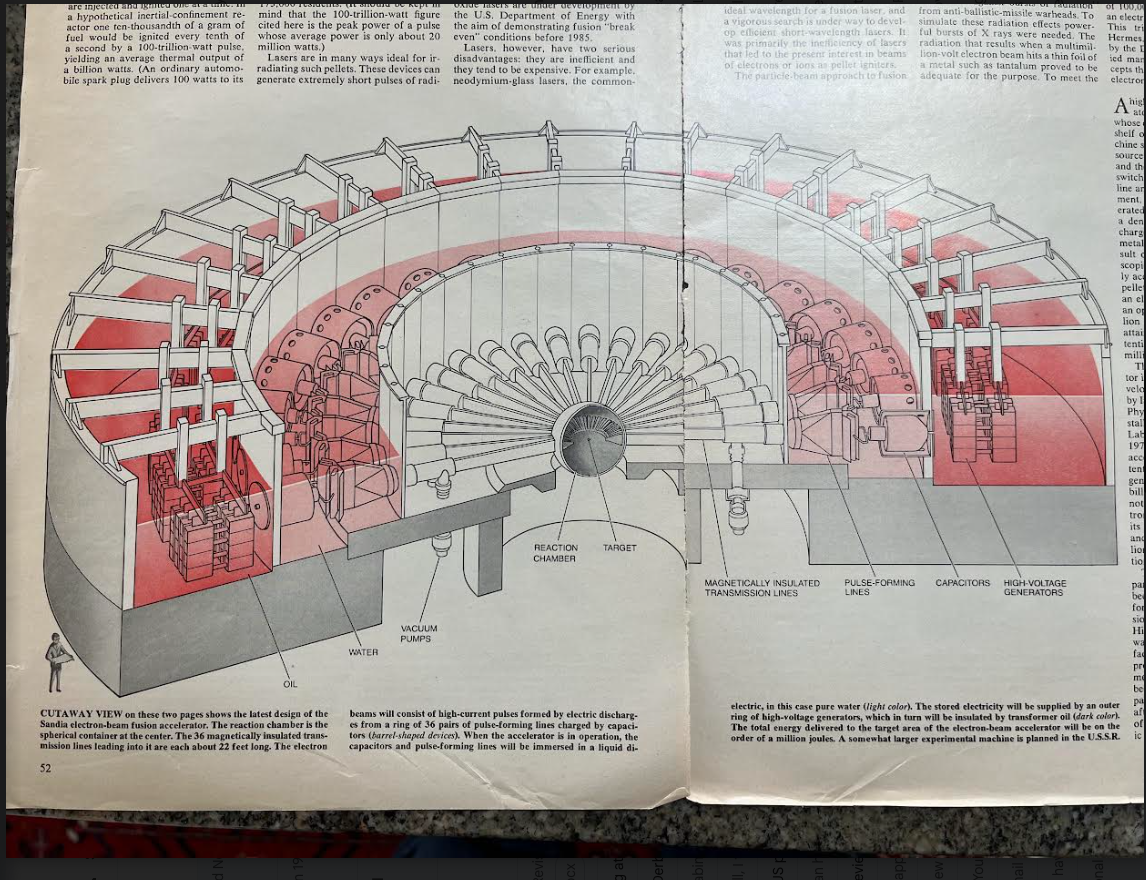
Scientific American article on EBFA.

My imagination was way ahead of real physics, and, in 1975, I even received a patent on an e beam fusion reactor concept. Since the patent expired in 1992, anybody is free to go ahead and use it to solve the world’s energy problems. In 1978, I published an article on particle beam fusion in Scientific American magazine.  I also invented an international electron beam conference that I hosted in Albuquerque and began a tradition of international cooperation and competition. I even had conference pins made up for all of the attendees following the tradition that the Russians followed in their conferences. Even though we had connections with many research groups including Japan, England, France and Israel, our strongest alliance in our fusion quest was from our technical colleagues and Cold War adversaries, the Russians.

With the help of Sandia management and funding from Congress, we broke ground for EBFA in 1977 and began operation in 1980. At the same time the Russians continued with their electron beam approach. In 1979, a New York Times front page article quoted Rudakov announcing that Russia’s new pulsed power machine, Angara 5, “would produce more energy than it consumes… and demonstrate that an industrial pilot plant can be built.”

Competition with the Russians helped me get funding for continued operation of EBFA and allowed our team to respond to new theoretical discoveries with ion driven rather than electron beam targets. As usual in the fusion funding business, getting funding consumed my attention, and we created support for the program by emphasizing use of ions and proposing a new machine, the particle beam fusion accelerator, PBFA. I predicted that PBFA would produce a 100TW output by 1984. I even got away with telling decision makers that I was negative on electrons and positive about ions. I recall the day when I took down the EBFA sign and put up the PBFA sign, abruptly switching from electrons to ions. This change turned out to be the key not just to getting continued funding, but to ensuring program survival.  There were many people, not just at Sandia but other labs around the world, who had invested their time and effort in electron beams who were upset with me. The head of the Soviet electron beam research at the Lebedev Institute began referring to me as “Lysenko,” an infamous Russian scientist known for his dangerous pseudoscience ideas. But the Russians were doing more than insulting my work, they were studying it and considering how they could compete with us and win.

I was a total amateur in the business of selling fusion funding to decision makers, but I learned that the Russians were already way ahead in this vital aspect of fusion research. On my first visit to the Kurchatov Institute in Moscow 50 years ago, was shown their world-famous fusion device, the Tokamak. Their experiment demonstrated real fusion output and became the world leader in fusion research as well as the first of hundreds of claims from all over the world of fusion breakthroughs since then.  I remember the comment from my guide, Lev Artsimovich, considered as a founder and leader of their Tokamak program.  I asked him what is the most serious problem with the Tokamak, and he replied that the “real problem with achieving fusion with my Tokamak, will be how to convince the bureaucrats to continue to spend so much money for me to satisfy my own curiosity.”   The Tokamak concept went well beyond Artsimovich’s curiosity when Reagan and Gorbachev agreed at their summit meeting in 1985 at Reykjavik to a cooperative international fusion reactor program that actually began construction in 2010 with a goal of beginning real fusion operation in 2035 and achieving practical energy gain possibly sometime after that. This method of creating a joint program to sustain investment in a long-term program was not a new idea and was employed in the funding of the 1975 U.S. /Russian Apollo-Soyuz program. This joint activity was part of the Cold War transition to a relationship of détente, which characterized my interactions with Rudakov and other Russians.
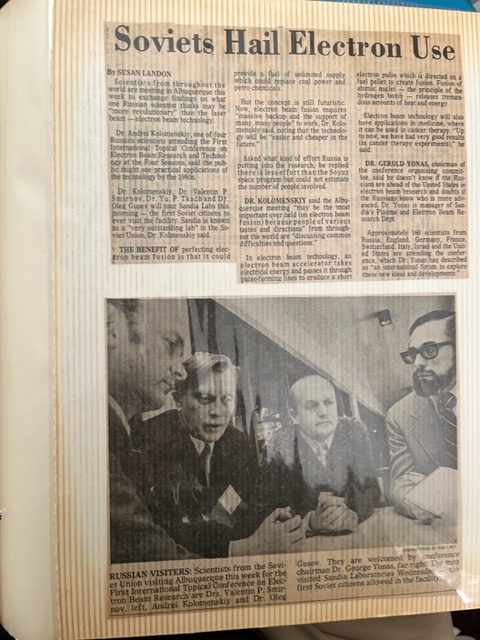
Albuquerque Journal reports on Soviets’ 1975 visit to Sandia.

At some point in the evolution of Tokamaks, some Russians, with I suppose weapon lab connections, began to think the way to achieve a large fusion gain in the lab was to use high power lasers as well as pulsed power. The Soviet scientists I knew played a great deal of attention to our research, and one of these was N.G. Basov, the 1964 Nobel Prize winner (shared with Townes and Prokhorov) winner for their original contributions to lasers.  Basov was the father of their giant but mysterious missile defense pulsed laser program called Terra 3.  We learned much later that in 1963 Basov had proposed a missile defense approach using a nuclear explosion pumped laser with an output of 10 million joules, and he was very aware of the United States’ work in our weapon labs.  Interestingly, he was way ahead of the U.S. program championed by Edward Teller in 1983 to use nuclear explosives to excite X-ray lasers. The Russians were building enigmatic, giant facilities and spending lots of rubles. Russia received lots of misguided attention for these efforts in Aviation Week magazine. Basov was also the first to admit that such efforts were futile. After he canceled their program he stated, “Well we made sure that nobody can shoot down a ballistic missile by a laser beam.”

I had many interactions with leading Russian scientists, including Valentin Smirnov, who I invited to attend our Albuquerque conference and to be the first Soviet to visit Sandia in 1975. I recall when I invited him to be the first, his reply, with a bit of a smirk on his face, was “that you know of.” Smirnov worked with Rudakov on their own version of PBFA called Angara, received awards for his pioneering pulsed power-driven z pinches and went on to head the Nuclear Fusion Institute at the Kurchatov Institute. My frequent contact in Moscow was his boss Evgeny Velikhov, who became the science adviser to Gorbachev during the 1980s arms control talks. He was an enthusiastic supporter of the application of pulsed power to fusion ignition, was anxious to stimulate the competition and cooperation with Rudakov and was my host when I attended conferences as a guest of the Soviet Union.  On one of these visits, he had been told we had made a secret fusion breakthrough with PBFA, and he met me at the door of my arriving flight and with a worried look on his face asked me if the rumor was true that we were first to achieve fusion ignition. I assured him that the race was still on and noted his immediate sense of relief.

I also vividly recall my conversation in Moscow after the end of the Cold War in the office of Viktor Mikhailov, Russia’s head of their nuclear weapons programs, and close follower of our work. In that meeting he offered to join with Sandia on the pulsed power approach to fusion ignition. He told me that ignition would require a 10 million joule pulse and 1000 trillion watts, and that would require a machine several times or maybe 10 times more powerful than what we had at Sandia. He offered to build that giant machine in a joint program, but with our money. He offered the use of an existing Russian facility, and he said our cost would “only be $30 million.” I gasped and gulped and almost spit out from my glass of tea, but made no other response. I soon found out that Department of Energy was almost instantly informed by the State Department representative who witnessed the offer, and to say the least, was greatly disturbed that I even listened to his proposed initiative.

The emergence of increasing international competition is accelerating every day. The parallel to the Sandia program, but this time with no cooperation, appeared a few years ago when the Chinese nuclear weapons lab announced they are building their version of Z that is “designed to produce about 60 million joules… 22 times that generated on the Z machine at Sandia.” They claim “it will dwarf the machine in Sandia.” The Chinese don’t seem to be short on cash. They have paid close attention to our publications and they really understand pulsed power technology. This is obvious from many of their publications, including the details on the operation of their electron beam accelerator called Dragon, the name I chose in my novel for the fictitious accelerator in the secret underground Chinese facility.
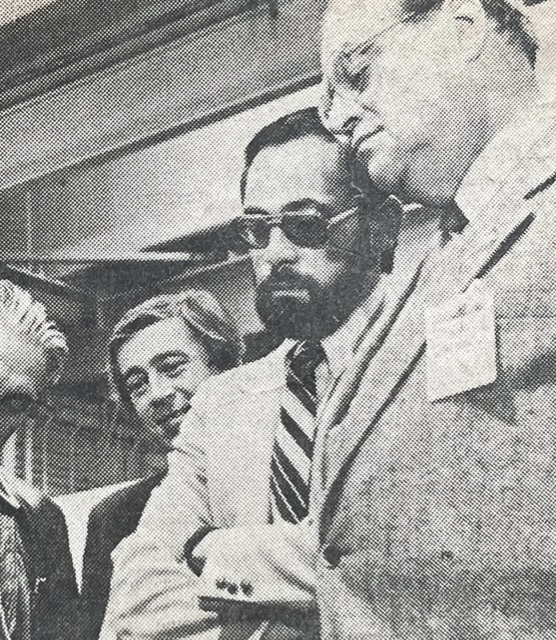
Basov scowls at EBFA

So, the competition for more funding and more fusion ideas continues and there are even now, not just governments, but also several fusion research entrepreneurs and private investments of several billion dollars. The media is filled with the ever-present announcements of yet another “fusion breakthrough” and certainly, this is just the beginning of increasing investments in fusion research with new ideas emerging every day. Recently, the Chinese announced a new world record with “plasma confinement of 403 seconds” and announced they are aiming to build the world’s first fusion demonstration reactor. They are probably not aware that Rudakov’s promises for a demo reactor preceded theirs by over 40 years.

Government funded programs may benefit from the increasing publicity, and should be able to sustain wide spread public interest in fusion research. For example, one privately funded company is building a “scalable Z-pinch energy system… a seriously cheap, compact, scalable fusion core with the shortest path to commercially viable fusion.”   With international competition as well as large private investments, we should see the rate of breakthrough announcements escalate rapidly and start a cycle of more and more private competition, but don’t count out the role of politics.  As usual, congressional leaders will be enthusiastically emphasizing the “safe and clean” fusion energy payoff, with a subtle inference that nuclear power based on fission does not have those attributes. They often emphasize the benefits of fusion based power plants since this appears to be a goal the public will support.

My soon to be published novel, The Dragon’s C.L.A.W. captures the behavior of decision makers, the politics and economics of fanciful science and the frequent exaggerated claims of one more fusion breakthrough.  Examples of recent not too specific but often hyperbolic government fusion statements are “a game changer” and “new ways to power our homes and offices in future decades.” When I read such announcements, I remember Reagan’s Star Wars speech in 1983 that the goal of his missile defense program would make “nuclear weapons obsolete.” As it turned out, one of the only other people who wanted to eliminate nuclear weapons was Mikhail Gorbachev, but the military industrial complex in both countries was totally opposed and the nuclear arms race continues and escalates every day.  My point is that exploration of science and technology and its application is not just a technical exercise, but also an activity that depends on politics driven by human imagination, fear, greed and belief in what can and should be accomplished.

Truth is stranger than fiction. You can preorder The Dragon’s C.L.A.W. now and purchase it starting May 16, 2023. https://projectzbooks.com/books/#preorder


Lessons from Soviet history: Could it happen here?

What if Trump had succeeded in overthrowing the election?

Former President Donald Trump apparently was totally dedicated to being declared the winner of the 2020 election, and he might have been successful if he had been able to persuade a number of members of our elected and appointed government organizations to go along with his plan. It is conceivable that the result would have been a rejection of the election results and the emergence of an unworkable form of government leading to political, social and economic chaos. The extreme forces on the liberal and conservative sides of the social and political spectrum might have launched a power struggle that could also involve military forces to enforce some sort of an interim government approach. It seems rather hard to believe that a world economic and military power with the ability to launch a nuclear war could totally lose control of its fundamental decision making and management abilities, but this would not have been the first time this has happened, and it would be useful to consider a little history lesson.

Some describe the Jan. 6, 2021 storming of the U.S. Capitol as an attempt to overthrow the government.

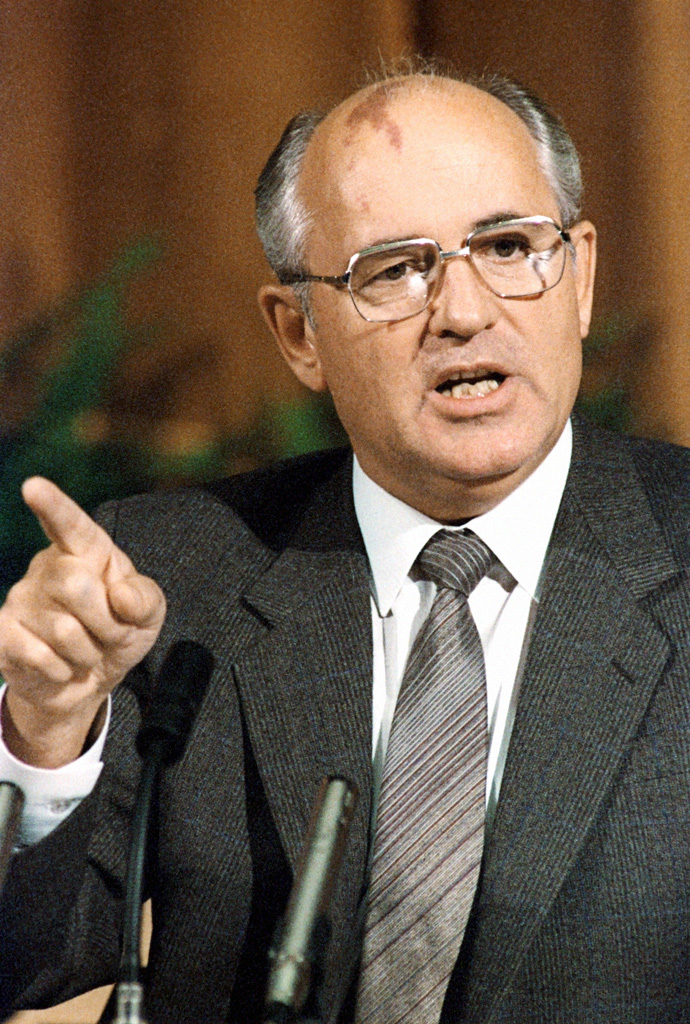
On Aug. 20, 1991, the Soviet government was preparing to sign a treaty that would have changed the relationship between the central government and the republics of the Soviet Union. The force behind this agreement was Mikhail Gorbachev, the man in charge, who along with a group of loyal followers wanted to change just about everything.  He was in the process of creating a new form of government that he had been working on since 1985, and his goal was an entirely new economic and military approach.

The 1991 Soviet coup d’état attempt, also known as the August Coup, was a failed attempt by hardliners of the Soviet Union’s Communist Party to forcibly seize control of the country from Mikhail Gorbachev, who was Soviet President and General Secretary of the Communist Party at the time.

Gorbachev envisioned a non-militaristic, non-autocratic, and globalistic liberal form of government driven by an entrepreneurial spirit like most of the rest of the world. He was convinced that the old Communist approach was doomed to failure. At the same time, he harbored the concept that he could preserve Communism in some form, but he was not too clear on that. He knew that the constant drain of funds to support all of the poor and gradually getting more poor republics would lead to inevitable failure of the government, and he was prepared to turn the dependent client states loose to fend for themselves. He had tried all sorts of approaches to turning around his country and one of his schemes was to end rampant alcoholism without considering that it was a major source of income to run the government, and this decision just added to the increasing economic woes.

The Soviet leader also was convinced that the military industrial complex was a major cause of economic disaster and he did everything he could do to derail attempts to spend increasing funds on defense in general and space weapons in particular. His goal was not only conventional disarmament, but also the elimination of all nuclear weapons. Strangely enough, there was at least one other person in the world that agreed with the nuclear part of his plan, and that was President Reagan, but that is a different story, so back to the overthrow.

A group of eight high-level Soviet officials put together a plan to take over the government and put a stop to any treaty that would lead to the end of the Soviet Union. They waited until it was almost too late and they did not really think through how exactly they would manage to run their new government. Nevertheless, with only two days to go, five of them showed up at Gorbachev’s vacation home in Crimea. Their plan was to convince him to sign an emergency declaration that put would put them in charge of the government.

One of the most important participants in this coup was Oleg Baklanov, the head of the military industrial complex and a man dedicated to restoring the global space leadership that they had demonstrated beginning with Sputknik in 1957. He believed that the Soviets had managed to let the Americans take over with the latest move being Reagan’s SDI that he believed could easily be handled if he were allowed to get on with running the show.  He was convinced that he knew how to win this latest form of technical competition and his approach was to develop and deploy their own death star, called Polyus, which would control space. The only issue was that Polyus had crashed into the Pacific after its launch in 1987, but only because of a minor software glitch, and Baklanov was not ready to give up on his engineer’s technology approach to problem-solving.

Baklanov had a running battle with Gorbachev and tried to persuade Gorbachev that he really had a better idea based on the superior scientific and engineering capabilities of the military R&D branches of the government. After many attempts to get his way, he concluded that Gorbachev cared little and barely understood the miracles of Soviet technology and was driven by his own political philosophy. Baklanov thought at least half of the military technical advantages were already devoted to the non-military needs and were best managed by stepping up military spending rather than somehow turning over the economy to a free and non-governmental form of big business.

When the coup plotters confronted Gorbachev, Baklanov later claimed in his oral history that Gorbachev “was dressed in a sweater although it was hot outside … to emphasize that he really was sick … became rather emotional and I saw a dull man thinking in a dull way about himself, rather than the matter at hand … and said he would sign the treaty even if they cut off my legs.”

The plotters left without any agreement and headed back to Moscow to “make arrangements” including getting Boris Yeltsin to go along with their plan, but that was not to be.  When Gorbachev returned to Moscow few days later still wearing that same sweater, he found that the coup plotters had ordered tanks and military to take over and enforce their coup.  Yeltsin then called on the public to strike and protest the coup. Yeltsin climbed on a tank, and with a megaphone and demanded the coup be defeated, and when the military refused to fire on the crowds, the coup was essentially over in three days and the plotters were arrested. Some spent time in prison but were released after an amnesty was declared in 1994. Gorbachev’s chief military adviser who had signed up with the coup committed suicide when it failed. An active coup plotter, Boris Pugo, along with his wife also took their own lives.

Gorbachev agreed with Yeltsin to abolish the Communist party, and in December the hammer and sickle flag was lowered, but then what? What was the outcome of a new freedom with lots of influence from the West? It is reported that without the law and order of the old government, the mafia that had been created when Gorbachev got rid of vodka took over and a new approach to big business emerged with oligarchs in charge.

Russian President Vladimer Putin poses for photos riding on horseback while shirtless.

Violent uprisings were not uncommon, and the government went into a multiyear economic and social collapse. Then Putin, with his KGB backing, rode shirtless on his horse to the rescue in 1999 by restoring law and order and increasing autocratic control. Putin believed that the collapse of the Soviet Union was “the greatest geopolitical catastrophe of the century.” His attempt to regain control of the Soviet republics has resulted in today’s rapidly evolving war in the Ukraine, and a renewal of the conflict between the West and Russia with consequences yet to be determined.

So what did I conclude from all of this history story? Certainly we are not Russia, and we have resilient institutions that work well under stress.  Not surprisingly, I believe an orderly transition of power that reflects the will of the governed is a rather good idea. When the rule of law and reasonable people make the transition decisions in a cooperative manner, it is better than a disorderly overthrow of the government. Had it happened here, we might have seen the lessons of Soviet history revisited on our own shores.

Remembering the Russian scientist who revealed secret of H bomb

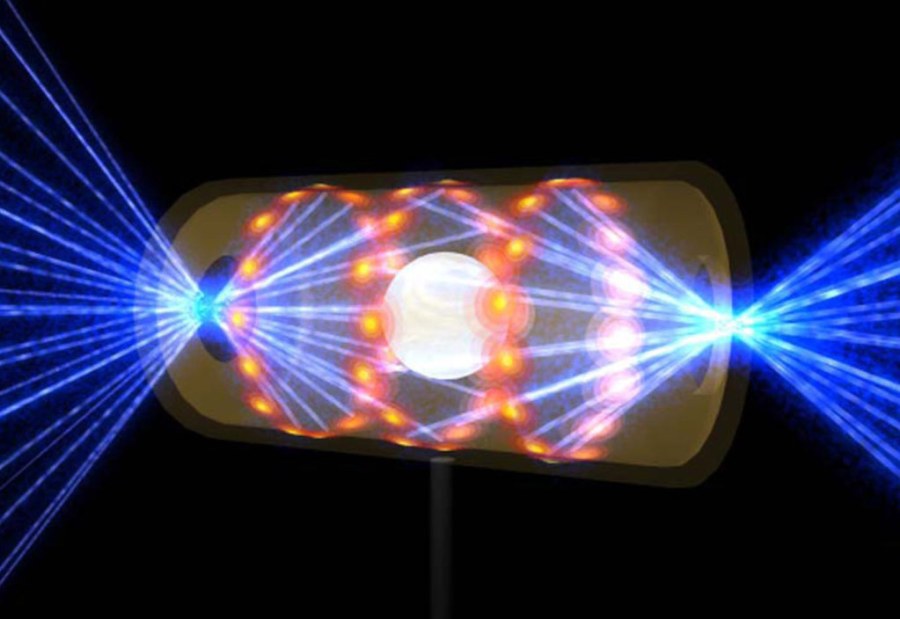
It is widely known that one promising way to create fusion in the laboratory is called inertial confinement fusion (ICF). It is based on the concept of spherically imploding, compressing and thus heating thermonuclear fuel. Indeed, the recent laser fusion breakthrough at the Livermore National Laboratories demonstrated efficient hot spot ignition and self-heating of cold fuel. There were many complex requirements in this outstanding technical achievement, but probably the most significant was spherically symmetric implosion of the fusion capsule. This was accomplished not by directing the 192 ultra high power laser beams at the target, but instead heating the inner walls of the tiny chamber containing the fusion pellet, and using the radiation trapped in the chamber to symmetrically heat the pellet. This chamber is called a hohlraum, which is a German word for a hollow volume of cavity in a structure. When I first became interested in fusion research, I had no notion of this vital ICF concept. In fact, just revealing the very idea of heating the target with indirect radiation rather than direct heating by the laser beams would have resulted in a severe penalty, or even jail time. Today, the hohlraum concept is totally unclassified.

In 1967, when I became interested in fusion, I knew that the physics worked well in the sun and in H bombs, but I knew little else about the subject. I was attracted to work for a small startup company that was pioneering work on pulsed power technology. This was a very new field of electro technology dedicated to creating machines that generated very short pulses of electric power levels of 1 trillion watts (TW).  The purpose of these machines was to create laboratory sources of pulsed radiation to test the vulnerability of reentry electronics faced with an H bomb tipped missile defense. The issue was to determine the exact vulnerability of the electronics to such a pulse. I was drawn to that company, Physics International, not because of the question of missile electronics vulnerability, but because the founders of the company had previously been H bomb development leaders at the Lawrence Livermore Lab, and they convinced me that such machines could be used to make a tiny H bomb explosion in the lab using the new pulsed power technology.

On a warm and clear day in June 1971, at the University of Wisconsin student union, I met with a well-known plasma physics theorist, Lyonid Rudakov, from the Kurchatov Institute in Moscow. He and I sat there in the sun like old friends drinking coffee and chatting about the subject of creating fusion with electron beams.  We were both in our thirties, and had just met and learned that we had a common interest in using high intensity electron beams to create fusion. I knew exactly what I could and could not discuss, and I had no idea about the connections of Rudakov to any Soviet secret information. Rudakov was very outgoing and obviously comfortable with people he did not know well, and from the first I recognized that we had one thing in common. We both were in the business of marketing our ideas on fusion to get funding.

As we talked, we shared a fantasy of building giant pulsed power machines, maybe hundreds of times bigger than anything in existence, and focusing relativistic electron beams onto BB size pellets. Rudakov already had an established program at a major Soviet research laboratory, and I, with no continuing government program support, was mostly concentrating on getting funding every year for my small program dedicated to simulation of nuclear weapons effects. I knew that I would never get very far with my vision unless I established a major program in a national laboratory.

One year later, I found that there were others who shared my fantasy, and I moved to Sandia National Labs in Albuquerque. After I received my clearance, the first question I asked was about the physics of the H bomb. I learned that the highly protected secret was the use of a fission device to produce radiation and it was the radiation trapped in a hohlraum that drove an implosion and fusion ignition. I thought that electrons, if they could be focused highly enough, could be used instead of radiation. I invented an imaginative, if not realistic, program based on my published very early experimental work with electron beam focusing but still with no real quantitative knowledge of the power level that would be needed for fusion ignition.

Rudakov had the backing of the most influential Soviet scientific/political engineer but I was unknown in the scientific community. I had a vision and motivation based on my experience at my first job after I completed my Ph.D. at Caltech. I received my Ph.D. in Engineering Science and Physics in 1967 and continued on at the Jet Propulsion Lab where I had done my research on magneto fluid dynamics since 1962. The lab had failed six times to take close-up photos of the surface of the moon and was faced with a major transition. The question that they were trying to resolve was if the proposed moon lander would sink into deep dust.  Unfortunately their payload, called Ranger, either was destroyed during the launch or crash landed time after time with no data. Although the lab went on to success, they had decided its job was exploring space and not basic research. My small fluid physics group was disbanded and they gave me the opportunity to move on, and that resulted in my first job as a new Ph.D. Married, with a 1-year-old daughter, I was highly motivated to succeed.

When I got to Sandia I found out that since the U.S. had agreed with the Soviet Union to prohibit anti-ballistic missiles, funding for development of nuclear weapons and lab funding had decreased. There would be a 10% reduction in force. I was a first level manager, but my quota for the layoff was to fire one person, and I was given freedom, as my boss said, “Go out for a pass.” The misfortunate layoff had a silver lining since I had the support to do something Sandia was not too experienced with, namely lobbying the Congress for funding.

After spending a lot of time getting to know our representatives from New Mexico and prowling the halls of Congress, I managed to influence Senator Joseph Montoya, who was primarily known for his somewhat inadequate but televised questions when he served on the Senate Watergate Committee. He was not a technically educated person, but he was sympathetic and told me he always rooted for the underdog. When he learned we were competing with a powerful lab in California that already had funding for laser fusion, he agreed to try to get minimal startup funding for my program. I also had support from the fusion research organization at the AEC because they also were happy to create competition with the laser program managed by the weapons division. This caused a negative reaction from the weapons program to my dealing with the “wrong organization.” I agreed to accept weapons program funding that was far more generous as long as I had no more dealings with those “research guys.”

Our plans were not advertised publicly until the July 1973 European Conference on Controlled Fusion and Plasma Physics in Moscow. At that meeting I together with my Sandia colleagues, who were as new to the game as I was, claimed that very high current electron beams could be self magnetically stopped in a thin shell driving the implosion, and could achieve fusion breakeven with “extensions of present day technology.” Rudakov, together with a well-known Soviet mathematician from the Institute of Applied Mathematics, carried out detailed calculation of the needed power for 1000 TW and they included the vital concept of self-heating of the fuel after ignition as demonstrated last year on NIF “only” 50 years later with 1000 times more energy than they had originally calculated in 1972.

After the meeting in Moscow, Rudakov and I became technical colleagues with reciprocal visits, and we continued to share information as both of us advertised the start of major competitive programs. Sandia began construction of prototype devices at power levels of a few TW, and advertised the development of a machine in the 100 TW class, but both of us were competing with the rapidly growing programs in the U.S. and Soviet Union that had much more funding for the use of high power lasers. I knew that electron beams created with low cost and efficient pulsed electrical power would be far more energetic than lasers. I guessed that even if millions of joules would be needed for ignition, it would be a more reasonable approach than the very expensive and inefficient lasers.

The LLNL results were achieved using the NIF laser to deliver 2 million joules to heat the walls of a hohlraum containing the fuel pellet and using the symmetric flow of energy in the hohlraum to heat the outer surface of the pellet. The physics of the hohlraum is based on the fact that the heated cavity walls come into thermal equilibrium with the energy in the cavity, delivering energy symmetrically to the fuel capsule. The reason for the closely held secret in the 70s was the idea of using the radiation in a hohlraum to implode and heat a fusion capsule. This is called the Teller/Ulam principle, the secret of the H bomb.  The H bomb concept relied on a two stage process with the radiation from a fission explosion to heat and compress a fusion device, but that was very secret in the 70s.  The reason for the high level of secrecy was not because we were afraid the Soviets would get the secret, which we knew they had, but for fear others would catch on and that would lead to proliferation of hydrogen bomb technology. So both programs progressed, but Rudakov knew something he was not sharing. In 1976, he announced with no details that his lab had produced the first fusion reaction using electron beams. The March 1976 “New York Times” reported, “Russians report fusion using electron beams,” but with no details. There is more to this story, to be continued in my next blog post.

Car accident

1986 and 2020, Part 1

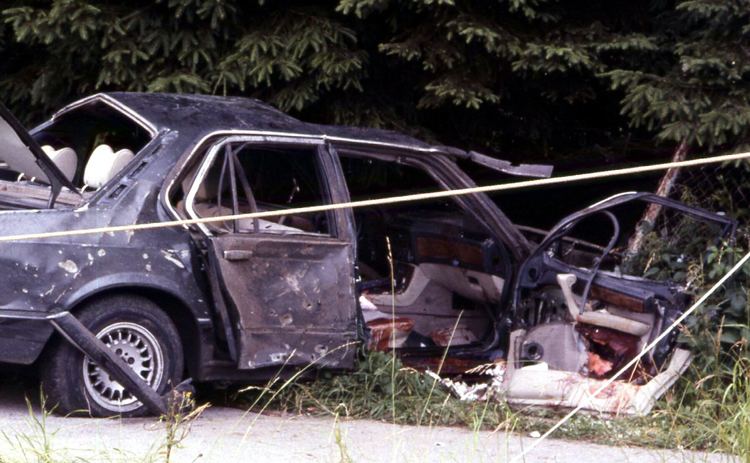
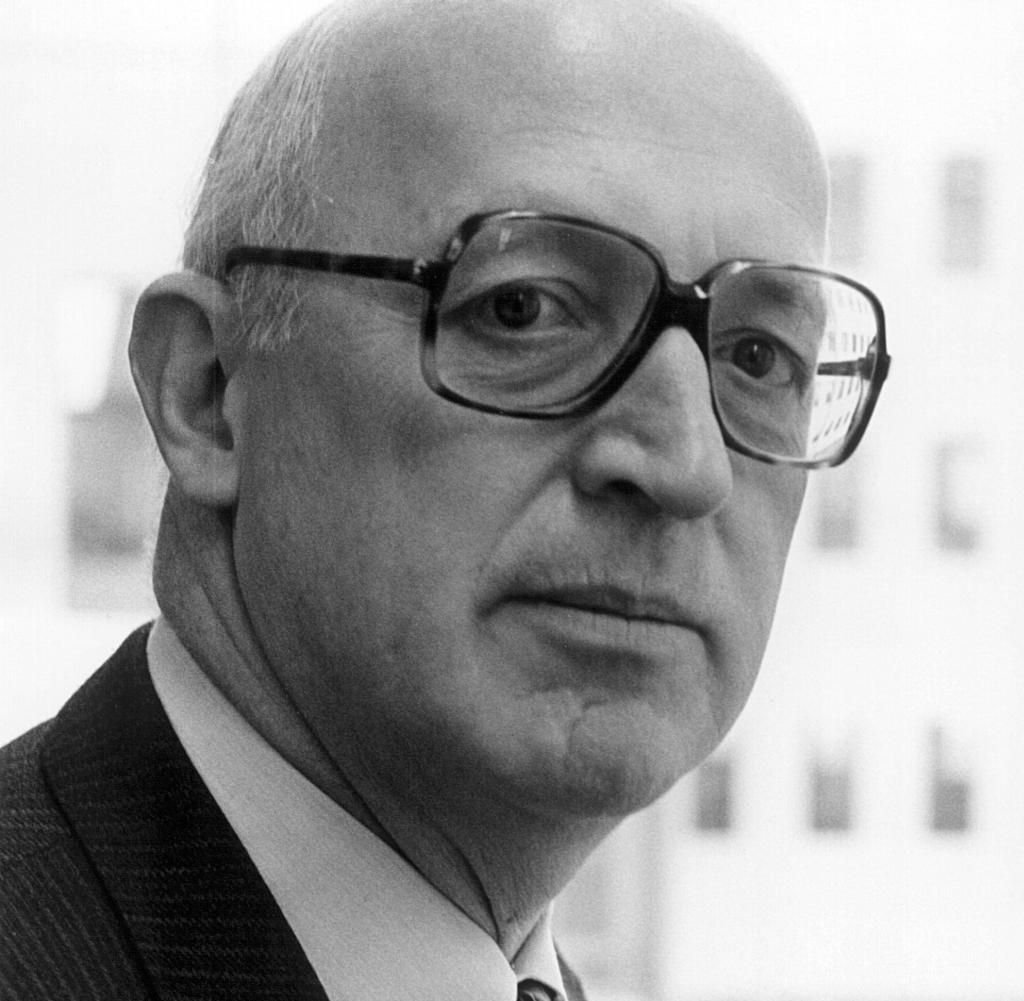
Karl Beckurts“High-tech research director and driver slain by bomb.”  Sound familiar? You probably think it just happened in Iran. Actually this happened in Bonn, and the headline was from the July 10, 1986, New York Times. You probably confused it with the very similar November 2020 New York Times headline that read, “Iran’s top nuclear scientist killed in ambush.” So, history repeats itself, but we really do not learn that much from history since we tend to forget. Let’s try to remember.

The 1986 story went on to explain that “a remote control bomb killed the research director, Karl Heinz Beckurts, of West Germany’s largest electronics company and his driver today.” The article reported that a “seven page letter found near the site of the bombing and signed by the Red Army Faction said he “had been killed because “he supported the U.S. space-based missile defense program.” This supposed setback to our program was one of many events that should be understood when trying to understand the real history of 1986 that, in my view, marked the beginning of the end of the Soviet Union.

At the same time that the KGB was trying to stop us, the Soviet Union’s military industrial complex was preparing to launch the world’s biggest booster, Energia, carrying a 100 ton demonstration test bed for components of the world’s first space based laser. This was a critical part of their plan for a battle station that would allow them to dominate space and prevent us from achieving any missile defense capability. This dramatic space experiment is in my opinion the best evidence that the Soviet military industrial complex took the strategy of competing with our SDI program seriously.

But why was Germany even involved in our SDI program? In March 1985, the president and the secretary of defense decided that we should make our program an international effort to involve and protect not just the U.S. but “everybody.” Some questioned this. Global defense against whom, the alien invaders? Vice President Bush was assigned the job of visiting each of our allied leaders and getting them to sign up to support our program. I was asked in May 1985 to go with Bush, in my role as the SDI Chief Scientist, to provide background technology advice and information. I met with him to prepare. I had dinner at his house, and even bought a new suit for the trip.

I could tell Bush, one of the most reasonable people I met in Washington, was not particularly enthusiastic about the SDI and he told me the whole allied involvement thing “would not be prudent,” but he was ready to go make deals anyway. He may have talked to Secretary of State George Shultz, who thought the whole thing was unrealistic. Nevertheless, Bush was always loyal to Reagan and he was ready to take me along. I was very excited about going for a ride with the vice president on Air Force II, and tagging along when he met with heads of state. I knew Bush wanted to make light of this whole thing, and was not that enthusiastic about my participation.

But it never happened. The next month, TWA 847 was high jacked, and the event made the cover of Time magazine. Reagan said forget about SDI for now, and told Bush to focus on terrorism instead of SDI. As a result, my big adventure was called off the week before we were about to leave. When I told my boss the bad news, he could barely hide his lack of sympathy for my disappointment. 

Secretary of Defense Weinberger still wanted to get foreign programs going, if for no other reason than to help persuade Congress to increase our budget for the next year to $3.7 billion instead of their plan that was for “only” $2.7 billion. At that time we were having considerable trouble with finding worthwhile ways to spend our funding, and the lower level of funding was plenty. Nevertheless this program was the proud invention of the president, and we had to do what we could to make it real. So I was tasked by the program director, General Abrahamson, to explore arrangements with technical leaders of our allies to join us in the program at our expense.

We knew that the Soviets were really unhappy about our getting political support from others in the controversial program and they wanted to drive a wedge between us and our friends. Although there were not many foreign leaders really interested in working on our program, particularly the French president, Francois Mitterrand, who was insulted that Reagan would consider treating them as “le subcontracteurs,” and he refused to go along. Instead, Mitterrand started his own multi nation high-tech program, Eureka. There was one country that did take us seriously because they wanted their own defense against the missiles from their neighbors. That country was Israel.

The Soviets did not want the Germans to get contracts from us and help us compete with them technically and politically. More importantly, they had their own SDI program, or to be more exact, their anti SDI program. We later found out that in 1985 the Soviets had embarked on a crash program of their own to get their laser weapon in space first. This was to be the crowning achievement of their space weapon program, to” Sputnik” us again like they did in 1957. They scraped together bits and pieces from other programs and made a desperate attempt to get a high power laser into space.

Meanwhile, back at the Pentagon, our program was not moving ahead aggressively toward any sort of space deployment since we would need an enormous lift capability for our admittedly early stage development of a chemical laser that we were testing in New Mexico. There were also many beam weapon approaches being pursued including deploying a free electron laser on the ground and bouncing beams around the world from mirrors in space. Unfortunately, our shuttle was not available after the explosion in January, and the entire shuttle fleet was to be grounded for the next three years. But wait, there’s more to this story of 1986 to be told in my next blog post.

past, present future signs