
The trouble with good ideas…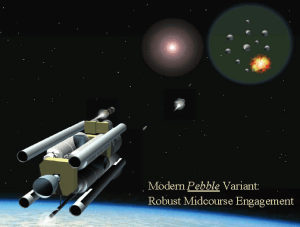
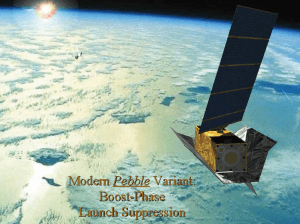
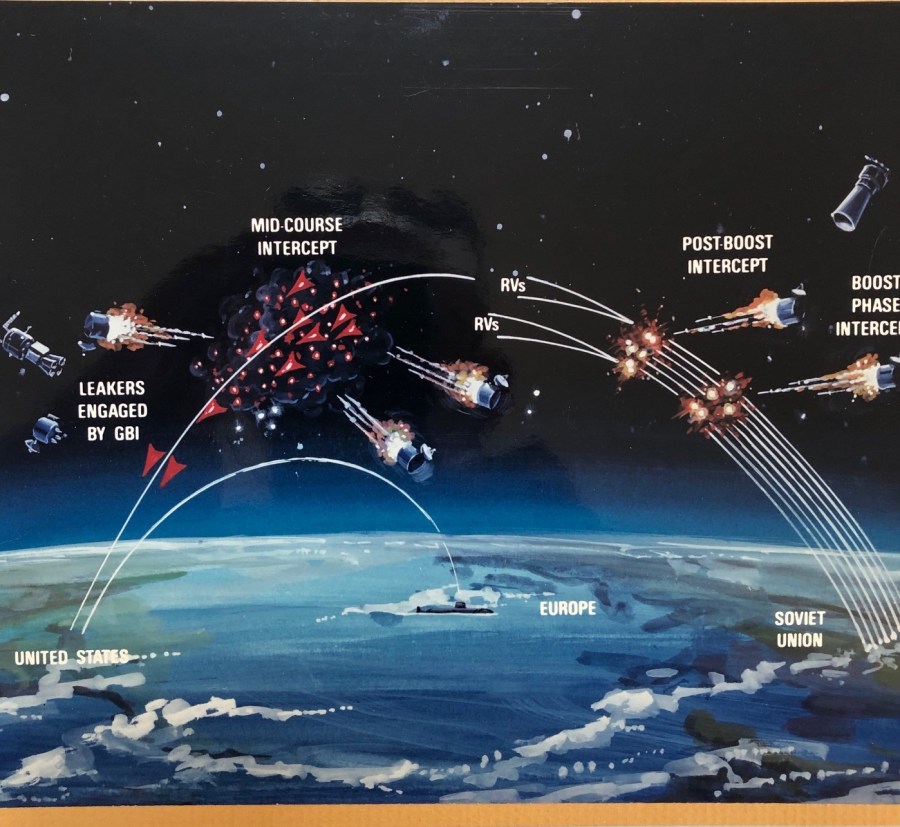
Brilliant pebbles are a really good idea, at least some scientists think so. No one doubts that the technology exists now to deploy thousands of small missiles (called brilliant pebbles) permanently orbiting the planet. These missiles coupled to an extensive space based satellite sensor constellation could automatically go after and intercept intercontinental ballistic missiles shortly after they lift off in their very visible boost phase. Burning boosters are very vulnerable to a high velocity collision with even a light object, and the boosters would come crashing down together with their lethal payloads possibly not even far from their launch area. Assuming that the sensors are operational and not spoofed, the automated decision process is reliable and most of the so called pebbles are in good working order, this low earth orbiting cloud of defensive missiles would greatly contribute to our defense against the ever greater proliferation of ballistic missiles and some of these might even have nuke payloads.
Some cost estimates of this defense investment do not seem unreasonable … but wait for the rest of the story. Any competent adversary who had counted on achieving a convincing threat would not be so happy with our deployment and would know far in advance about our plans and observe our deployment process. They might complain about our “militarization of space” and even threaten to put a stop to our bad behavior before we got too far into our plan. They might even do something nasty just to get our attention, and they might even use anti-satellite methods to harass and even destroy our early deployments. They might even start deploying their own missile constellation to tag along closely with our defensive missiles, and we might tell them to stop that and ask them to back off. If we hurry up and get going before they can do too much, we could get our convincing defensive capability in place and declare our ownership of space and not allow further deployments of means to attack our purely defensive missiles. They might then turn their military investments to high power lasers on the ground that could over a period of time harass, blind and destroy our missiles and sensors. It turns out that low earth space orbits can be a very dangerous place if ground based high power lasers exist, but wait there are clouds that could get in the way, so they might not have the freedom of action they desire.
Another approach to laser deployment could be on high altitude aircraft that could operate above the clouds and conveniently track and shoot up at satellites. The laser power supplies would be chemicals that would have to be replenished, but there could be multiple aircraft, and the adversary could take their time to mess up our deployment. But wait there would be more to this story since we could attack the large, slow and vulnerable aircraft with our advanced fighter planes and their lasers that shoot toward satellites would provide them with no protection, so they might use their own advanced fighter planes to attack ours. By then we might have our own high power lasers on our fighter planes and we could defeat their lower power lasers, while they try to use their anti-satellite missiles against our purely defensive pebbles.
But wait, they might not be ready to start a space/air shooting war and instead attack our extensive but very vulnerable electric grid using their cyber weapons, which would trigger our own cyber-attack on their command, control, communications, intelligence (c3i). They might then try to destroy our c3i so we would no longer be able to manage the rapidly deteriorating chaos of our purely defensive pebbles. Somebody might even try to nuke somebody, or maybe their terrorist buddies could dump biological agents in a few of our cities, since nobody is managing the chaos, and things might get really messy real fast. Oh well, brilliant pebbles seemed like a good idea.

 announced that Russia had developed the Avangard hypersonic vehicle that would soon be deployed and he claimed could defeat any sort of missile defense. The concept is a re-entry vehicle that would be launched on a ballistic missile and instead of continuing to its target on a predictable ballistic trajectory through space, it would dive down into the top of the atmosphere and glide to its target. It would glide along without propulsion and could maneuver over large distances so that interception would only be possible in the short time close to its eventual target. Such a maneuvering re-entry vehicle is not entirely new idea, but presumably the Avangard has solved the problems of targeting, maneuvering and high temperature materials.
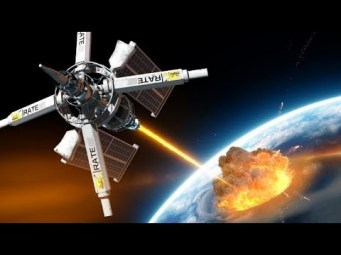 Another application would be to strike a stationary high value target, say in a building, but with no collateral damage to the building next door. We used to call this a conventional precision strike on a time urgent target. The problem of getting to a target in a hurry is probably not the least of the limitations of such a weapon, since a precision strike would have to be accompanied by time-urgent precision decision making. The precision targeting would require time-urgent knowledge and might have to involve a close-in sensor that could perch and search before the weapon lurch. The aspect of very fast and very precise decisions probably requires that the entire process of reconnaissance of the area, surveillance of the specific target, target acquisition, target kill and kill assessment be automated. All of that seems very difficult, but certainly possible, and could mean that targets anywhere in the world would be vulnerable … unless they were underground.
 supply, so the weapons racing will likely just go on. I offered an alternate approach in my post based on my belief that we face the impending cash flow dilemma that I called the “Geezer Threat” caused, not by the much feared global warming, but what I think is more likely, global aging. The Soviet Union provided us with a good illustration that cash flow problems can destroy one of the most powerful empires in the history of the world.
 believe it.” This concept also applies to intersection between science and politics. My last post discussed a commonly believed fallacy in the world of military technology development. The engineers and scientists who believe their latest invention will lead to certain victory and when they market that idea with the certainty of their faith, they are not lying.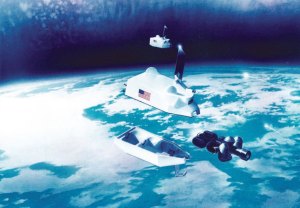



 SDI Guy