Are you kidding?

Are you kidding … nobody would believe that. You can’t be serious!

I am writing a sci/fi novel that tries to make a coherent fictional story somewhat based on the real history of death ray inventors and their inventions.  A portion of the true story is recounted in the book “Death Rays and Delusions” about my exploits as the chief scientist for Ronald Reagan’s SDI aka Star Wars program. My soon-to-be published novel, called “The Dragon’s CLAW” draws upon a real story that will cause the reader to exclaim, “Are you kidding… nobody would believe that. You can’t be serious.”

This totally true story begins with H G Wells’ 1897 “The War of the Worlds” that includes Martian invaders using infrared beams, or “the sword of heat,” that melt the metal weapons of the earth defenders. Hard to believe, but the primary space based laser weapon developed for the SDI program in the 1980s was a real sword of heat, an infrared laser called Miracle. It was going to be deployed in space and would have required miracles to ever be feasible. There is a famous picture of Ronald Reagan standing in front of a giant mock-up of the nonexistent laser weapon. But we were not alone in inventing miracles, and the Soviet Union developed their own version of a space based laser, and went far beyond a mock up. They even tried in 1986 to deploy parts of it on the world’s largest booster, Energia.

But let’s go back to the 1930s when the Serbian genius, Nikola Tesla, who probably should have, but did not receive the Nobel Prize for his electrical engineering inventions, designed a particle beam weapon that he claimed could defend the U.S. against “10000 enemy air planes at a distance of 250 miles.” It was not seriously pursued until after he died, and then after the start of WW II, the FBI seized his papers and asked MIT professor and Donald Trump’s uncle George to analyze them, but he saw nothing of value. As a footnote to this history, Donald claimed in 2020 that his uncle was a genius and “It’s in my blood. I’m smart.”

The idea of particle beam weapons, actually relativistic election beams, was resurrected in 1958 by ARPA, now called DARPA, to defend ships at sea and the entire U.S. against attacking reentry vehicles. The so called See Saw concept was to build giant electron beam accelerators that would generate beams that could bore a hole in the atmosphere and deliver a killing pulse to the attackers. The fatal flaw was that the beams whipped around like a giant high pressure fire hose, and sometimes even turned back and struck the accelerator.

The concept was dropped, but was replaced by an old Soviet idea from the 50s to use the electron beam to trap and accelerate ions to relativistic velocities. The collective forces of the electron beam would trap the ions that would reach billions of volt energies accelerated only over distances of meters. This Collective Ion Acceleration concept that we called the “CIA” would become a practical way to produce stable particle beams, and the intelligence community thought that the Soviets were up to their old tricks at an enigmatic facility at their nuclear test site in Kazakhstan.

The site was called a possible nuclear test site and its nickname was PNUTS. Satellite photos of the site became a mystery that attracted the attention of many U.S. physicists, some of whom thought it was a “CIA” facility, but most were sure that their own programs needed more funding because of what the Soviets were doing. The famous U.S. magazine “Aviation Week,” with the nickname Aviation Leak, because it often seemed to know real secrets, claimed it was a particle beam weapon facility. Indeed the head of the U.S. Air Force Intelligence organization went public in 1977 claiming the Soviets had made a breakthrough and their new weapon could neutralize our entire strategic deterrent.

The real CIA asked several accelerator physicists to stare at the somewhat blurry photos, to get help to solve the mystery, but eventually the intelligence community turned to remote viewers in a psychic phenomenon program called Stargate to visualize the goings on at this enigmatic facility. One of the viewers, who was given just the geographical coordinates, and without any help from any satellite photos, made a drawing of a giant crane that was moved on eight wheels over the facility. A friend of mine visited after the end of the Cold War, and sent me a photo of that crane.

Even though the use of PNUTS had nothing to do with beam weapons, its phony reputation allowed the Soviets to attract unknowing scientists to this god forsaken part of the world, only to be disappointed that it was only a nuclear rocket test facility. We also had such a program but canceled it because of environmental issues, but they continued for decades and just made the program invisible and a total enigma to us.

There was one very serious U.S. directed energy program and that was the development of a nuclear explosion driven X-ray laser, but we were not the first to consider such nuclear powered weapons. The Soviets claimed that a “nuclear explosion creates a stream of metallic fragments of small mass that travel at more than 10 kilometers per second, and are capable of string targets in space, including warheads, with a direct hit. One underground test showed the potential plausibility of accelerating a small mass to high speeds.”

The Soviets also claimed that we were far ahead of them in development of nuclear powered weapons, and they could catch up with us in 10 years if we were slowed by an arms control agreement, but even the early advocates of this approach became discouraged after initial experiments. One of the early strong supporters who was Reagan’s chief scientific adviser, later called the directed nuclear weapons “unadulterated lies,” but I recall Edward Teller requesting an acceleration of the test program, and claimed “the president has already promised these additional funds … and do you really want me to go back to the president and say the money is not available?”

There were other mysteries during my SDI career like the claim by the editor of the biggest Arizona newspaper that the SDI radar facility in the Pacific was really the location of the alien space craft that we were back engineering, and that I was in cahoots with the aliens based on my studies as an undergrad at Cornell University. The editor suddenly departed from the scene when it was discovered that he was a fraud and had no experience that matched his phony uniform, trophies, and medals and the story of my alleged treachery never appeared, although I have a copy.

The particle beam quest was not dead, however, and use of electrons to neutralize ion beams was supported for several years by SDI as a space weapon. That program was canceled when support for SDI energy weapons drastically declined. After the end of the Cold War, the U.S. then proposed to develop a neutral beam accelerator in a joint U.S./Russia nuclear reactor powered space NPB program for planetary geology research.  The Pentagon then decided it was really interested in starting up a new NPB space weapon program and in 2018 announced it was planning a development program leading to a test in space in 2023. Then in 2019 without a lot of notice, the Pentagon announced it was not that interested in the NPB after all because it was too far off, but lasers, the original sword of heat from 1897, was now mature enough to move forward aggressively, and real advances in solid state lasers have energized an accelerated program.

One should not discount the inventiveness of energy weapon advocates, and yet another new weapon that is being supported is based on powerful microwave generators.  Some even claim that such weapons are the cause of the “Havana Syndrome” that messes with the minds of diplomats. Now after many claims of fear of foreign attackers, the CIA says that of “2000 U.S, officials in diplomat posts worldwide” who have claimed symptoms, most are not really from foreign attackers but from some sort of a natural malady. But what about the rest? A CIA panel of “experts” concluded some “small number of the cases …a plausible explanation is a directed pulsed radio frequency energy.”

Can you believe any of this? Well, the true story goes on. Truth may be stranger than fiction, but stay tuned for the fictionalized version, coming soon.

Lies and liars

My most popular blog post during the past three years has been about lying. I wondered why there was so much interest in that subject. Upon reflection, I have concluded that our preoccupation with lying stems from our inability to access factual information and sift through the vast piles of alternative facts. We are increasingly faced with mass communication that is filled with lies, counter lies and even more lies. So I guess my readers would like to know more about lying… assuming I tell them the truth.

In 1984, in my job as Chief Scientist for President Reagan’s Star Wars program, I learned about the evolution of misinformation. I continually faced the dilemma of representing a program that lacked a fact-based and timely technical foundation, but I advertised it realistically as a research program to uncover the facts. Congress, of course, was not so happy to fund an enigma that Reagan said was a sure thing. Meanwhile, I expressed a desire to answer the myriad serious questions provided that we received the $25 billion we said we needed. I estimated that it would be at least five years before we could say whether or not Reagan’s promises to protect all of us were true. Reagan really hated both nuclear weapons and the Soviet Union’s communism based government, and his logic was to somehow eliminate both of those things.

I have learned that at first most public officials in the world of politics, science, technology and medicine capture the trust of their political allies. Their claims are thought to be truths. Then their political detractors accuse them of telling outright lies, followed by denials and more accusations. Even the widely respected Dr. Fauci has now been accused of lying about wearing masks and recently about funding the Wuhan lab and has had to defend his case.

What I found then and over the years was that the true believers were not interested in considering any facts. I eventually learned that the Soviet military industrial complex was selling their own SDI, and Gorbachev had no choice but to go along with their ill-fated attempt to launch their own SDI killing Death Star called Polyus.  Their chief engineer and program leader believed their space-based laser could dominate space. The United States’ advocate of space control, Edward Teller, made similar claims about his pet project, the X-ray laser. Secretary of State George Shultz and Reagan’s White House scientific adviser had serious doubts. Were both the U.S. and Soviet leaders lying to their citizens?

Today, the most widely accused purveyor of doubtful claims is Donald Trump, but many believe Trump’s statements and claims. A majority of Republicans believe Trump really won the election but widespread voter fraud stole the election from him. His lawyer, Rudy Giuliani, was apparently sincere in repeating Trump’s claims but he was disbarred from practicing law because the court said he was “knowingly making false statements.” A lawyer is not supposed to defend their client by misrepresenting the facts. Even as a technical adviser to the SDI program, I was warned by the legal staff at the SDI to never ever, ever lie to Congress under any circumstances, but also to not volunteer too much of the truth. My approach was to provide extensive technical information that the questioners would find confusing and dull.

When it comes to lying, it is also possible that the communicator actually may believe his claims are true. This may be the case with Giuliani. A person is not lying if that person believes their own claims. If the claim is a blatant factual falsehood and the audience is predisposed to believe it, then it will be repeated and embellished and become an even more outrageous lie that the true believers will repeat and often even invent nonexistent evidence to support the lie.

If the believer observes only the sources of information that are biased in one direction, then it is likely that the lie will get reinforced with no opportunity to consider contrary points of view. Once believers share the lie widely they will have their own self-images and reputations at stake and will ever more forcefully defend the lie, so that even doubters start to believe the blatant lie. The doubter can easily begin to wonder, “Well, maybe there could be something to this story after all, and maybe I was wrong to doubt the storyteller.” The key to convincing the doubters is to repeat the lie over and over again, and it seems that with enough repetition, the lie can become a belief.

My clarinet teacher once told me that the brain can be trained with enough repetition, and the only way to ever learn chromatic scales was to practice over and over again. She said this so often, I believed her, and accepted that it was only my lack of discipline that kept me from becoming the next Benny Goodman. So it seems that through forceful repetition, my brain was trained.

Big lies repeated frequently with no contradictory information have become widely accepted. This is damaging to our democracy—a form of government that demands free speech and informed decision making by an educated and intelligent population. Many of us make decisions without investigating the “rest of the story” as Paul Harvey, the radio commentator, used to say. The solution to this problem is to consider alternate points of view. Watch and read a variety of news sources from different perspectives. Give equal time to both CNN and Fox News. My wife argues that I do not practice what I am now preaching, and it will be really difficult, but I will try. Thomas Jefferson wrote that  a well-informed citizenry is a prerequisite to democracy. So, if you are worried about liars, lies and the people who believe them, stay informed, use your critical thinking skills and help expose falsehoods before they become accepted as facts.

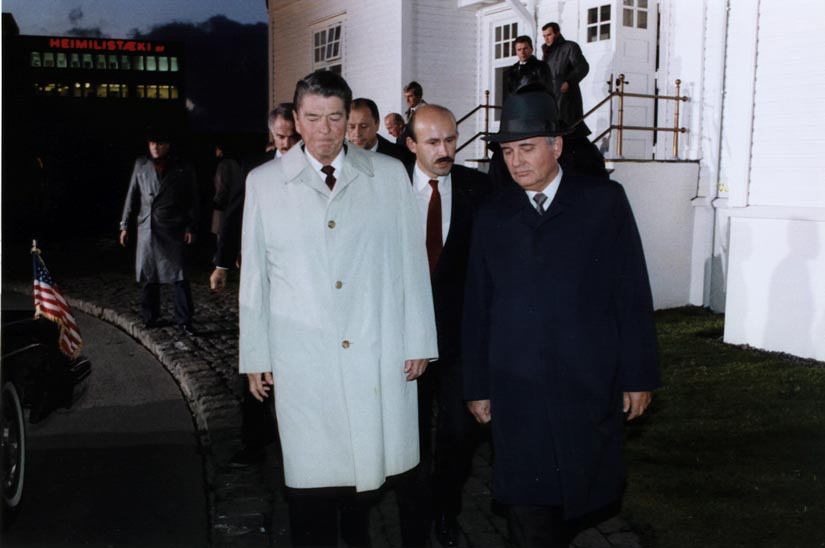
Reagan and Gorabchev leaving Reykjavik

1986 and 2020, Part Two

The new actor on the Soviet scene in 1986 was Mikhail Gorbachev. After the deaths of three Soviet leaders since 1982, Gorbachev became the new head of the Soviet Union in 1985. He immediately found that he was faced with managing total economic collapse and political chaos in competition with the most powerful Soviet force, their own military industrial complex. He seemed to be an idealist committed to open communication and restructuring and faced a never-ending collection of problems. He pressed on nevertheless with enthusiasm, optimism and charm.

One of Gorbachev’s first initiatives was to wage war against alcohol, which he believed was one of the reasons for the failure of the Soviet economy, but he only managed to cut off a major source of government income from the Soviet vodka monopoly. The alcohol kept coming, however, and the illegal vodka income then went instead to their own version of the Mafia. Soviet historian Vladimir Zubock described these events writing, “The Soviet socialist empire, perhaps the strangest empire in modern history committed suicide.”

Well, maybe Soviet suicide is a bit of an overstatement, but there really were enough serious troubles facing Gorbachev to cause at least a feeling of overwhelming depression. In April, the Chernobyl reactor disaster, the worst nuclear power plant accident in history, causing more than 300,000 people to be resettled, threw Gorbachev into a desperate lack of trust in Soviet technology. And there is more to this sad story. In September, the pride of the limited Soviet fleet of luxury cruise ships collided with a freighter in clear weather and hundreds of wealthy Soviet citizens died leading to a nation overcome by “pessimism and foreboding.”

Some people believe the superstition that bad things come in threes. The third blow struck in 1986 and it may have been the worst. The event was the sinking of a Soviet nuclear submarine, but that was not the first time that such a disaster happened. In 1968, the K129 nuclear missile carrying submarine sank to a depth of 5000 meters in the Pacific 2700 kilometers from Hawaii. After the Soviets failed to locate it, a U.S. ship found it, and an enormous, technically fantastic and very secret CIA program called Azorian tried to lift it, but it broke apart on the way up and it was never revealed publicly what we recovered. When remembering the history, it is easy to confuse 1968 with 1986 and K129 with K219, but let’s try to get it straight.

In October 1986, the K219, one of their ballistic missile submarine with 34 nuclear warheads, sank within 1000 kilometers of Bermuda, but this time there was no problem finding it since a trailing U.S. submarine was watching the disaster. At first, the Soviets blamed the disaster on a collision with our submarine Augusta, and I can imagine that Gorbachev, who was actively engaged in negotiating with Reagan to put a stop to any more high-tech competition with the U.S., was stunned when he got the message that the sub was on fire. I imagine he felt a sense of desperation and had given up on competing with the United States. In a bit of additional mystery, a Soviet deep water research probe found later that the sub was “sitting upright on the ocean floor with empty missile tubes dangling open.”

Gorbachev was in no mood to compete and was even prepared to give up all of the Soviet nuclear weapons. His only condition for mutual abolition of nukes was our agreement to “10 years of research in the laboratories within the treaty” and he made it clear ‘it’s laboratory or goodbye.” I think he did not want the Soviet “death star” to be launched and he knew he could not put a stop to his own aerospace industry enthusiasts creating a new weapons race unless we first agreed to keep our program out of space. So my argument not accepted by the real experts, is that he was more worried about the SDIsky than the SDI.

Maybe he thought he could turn around the course of economic and technological history in 10 years, but Reagan would not go along, even though he hated nukes. The problem was that he believed we were ready and able to deploy defenses, which of course was false. In my opinion, the Soviet Union was on the way out even without our “help” because of its moral decay and mismanaged economic and political institutions. A nuclear agreement might have helped us deal with the global spread of nuclear weapons and maybe even contributed to an economic turnaround for the failing Soviets. Instead, the world still has more than enough nukes to go around, including North Korea. In addition, there is the growing capability of Iranian program, even without their “top nuclear scientist.” Well, some things don’t change and space-based lasers are still far off in the future.

But maybe there are lessons to be learned from the events of 2020 and we won’t have to make the Soviet mistakes. The world has seen plenty of surprising and horrible recent catastrophes, but there is reason. I had hoped that our new United States president would not be faced with the same sort of economic, political and social mess that confronted Gorbachev only 34 years ago. Maybe, I thought, we can solve some of our own economic and public health problems, and figure out a way to just “learn to get along” both within our borders and with our adversaries in other countries. That is, before Jan. 6, 2021, in the words of FDR, “a day which will live in infamy” that has exposed our own socio-political frailty.

My view was even becoming optimistic after the presidential election, until I realized that many of the governance problems that Gorbachev faced, are looming in our own future. Possibly we cannot avoid the seemingly inevitable repeat of wide spread self-destructive decision making of nations under stress. It seems that a nation cannot easily avoid reacting poorly to its history of traumatic events, but I hope we have learned our lessons.

Oh, one more thing about history. And that is what happened a few months before Beckurts was murdered. He and I had a very nice meeting to talk about German involvement in the SDI. My goal was to get him to agree to a contract that would support our program. Over lunch in an elegant German restaurant, he explained to me in no uncertain terms that his company did not support the SDI and had no intention of participating.

Introducing the COVID Defense Initiative (CDI)

Gerry Yonas introduces COVID Defense Initiative
Illustration by Jenna Gibson

On March 23, 1983, President Ronald Reagan gave a televised address on national security that surprised everyone as he challenged “the scientific community who gave us nuclear weapons to turn their great talents now to the cause of mankind and world peace to give us the means of rendering these nuclear weapons impotent and obsolete.” His brief words led to the creation of the Strategic Defense Initiative (SDI) and initiated my involvement in a giant program that, although it did not lead to an effective missile defense, did effectively flummox the Soviet Union.

Now we face a global health, economic, political and social threat that could possibly be as risky for all of us as the strategic missile threat we faced in the 1980s. I think we need to approach this real threat from a systems engineering approach, starting with a presidential call for action not just to the bioscience community, but also to the nation’s engineering community.

What I am suggesting is a multilayer defense involving detection and response similar to the concepts we created in the 1983 Fletcher Study. I described this study in my book “Death Rays and Delusions” and the basic approach was an information-based layered system of systems. The needed technology did not exist at that time and is still not available, so the notion of applying this methodology to a very dangerous, contagious and asymptomatic virus may seem a bit unrealistic The biggest deficiencies at that time were the need for space deployed high sensitivity and high specificity sensors, directed energy and kinetic interceptors and the command and control for the entire system.

I may be overly optimistic, but I am suggesting that the COVID Defense Initiative can provide an extremely useful approach. The virus defense technology needed for this system is no more available today than the technology we needed 35 years ago for the SDI, but now is the time for the national commitment and investment to make it real.

I envision a future system beginning with a readily available real time virus detection system. The  reliable sensors would be coupled through the Centers for Disease Control and Prevention National Syndromic Surveillance Program to other symptomatic measurements and would provide the means to identify the threat and track it using millions of other simultaneous data sources.

Facility design would be required to prevent the infected person from entering an otherwise virus free location. A next step would be an immediate antiviral treatment  that might be provided using an inhaler. If the detection, reporting and treatment are included in a widely available system of systems, we could achieve a highly effective defense system that could be coupled with a vaccine to reduce the probability of infection. This multilayer approach would reduce the probability of spreading of the disease. As in our multilayer SDI system concept, there would still be a threat, but the probability of infection would become acceptably small .