

The presidential impeachment hearings are a good example of one aspect of human behavior that I studied recently, when I was involved in a science and technology advisory panel. The question we addressed was: What methods can an observer use to determine if a witness; or if there are two opinions, which side; is credible when they give contradictory answers? It would be wonderful if we really had some method as we watch what is going on in Washington.
In the hearings, the Republicans accused the Democrats of “making false allegations.” The Democrats similarly accused the Republicans of “making statements that ranged from incomplete renditions to outright falsehoods.” Trump tweeted that “the Democrats are liars” and a senator called Schiff “the worst liar in politics.”
The purpose of the panel I served on was to determine if there were technical methods to determine if a subject was telling the truth. Our panel determined that the gold standard of deception detection was the polygraph that measured blood pressure, pulse, respiration and skin conductivity while the subject answered a series of questions. What we discovered from interviewing many experts in the field was that the test really determined a psychological stress response that could be characteristic of a guilty answer, or a response from an innocent person who feels intimidated or even no response at all. In other words, the results were not reliable.
There were also examples in the press of use by the CIA on Guantanamo detainees of sleep deprivation and water boarding to elicit confessions, but they were also found to be not useful and deemed a form of torture. Acute stress induced by torture was also found to destroy memory. From our discussions with professional interrogators, the one approach that seemed to work was to have extensive prior knowledge and then intimidate the subject in order to induce a confession. An expert at interrogation knew how to use psychological methods to condition a person to “spill the beans” with no gadgets at all.
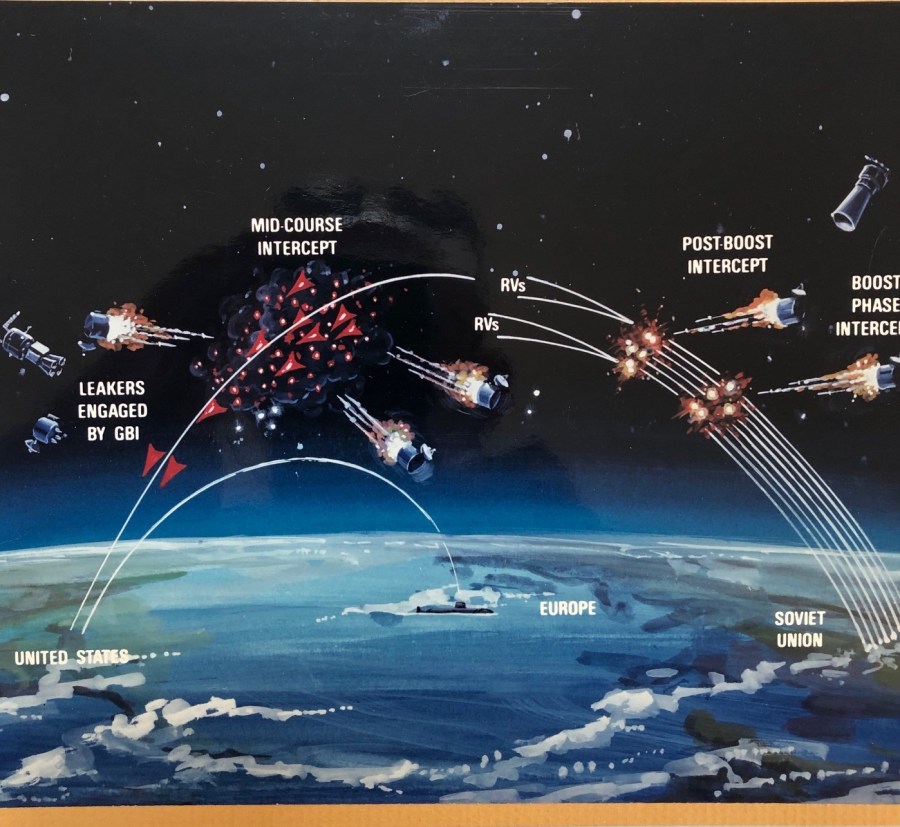
So what does this have to do with my supposed knowledge about missile defense? One of the most controversial and contradictory aspects of my more than 50 years of participation in the technical community was the response to President Reagan’s request in his national security speech March 23, 1983. Reagan asked the “scientific community…to turn their great talents …to give us the means of rendering these nuclear weapons impotent and obsolete” … to “intercept and destroy strategic ballistic missiles before they reached our own soil or that of our allies.” His speech was the starting point of my several years involved in trying to satisfy his request by first helping to make a plan for, and then participating in, the Strategic Defense Initiative (SDI) as its first Chief Scientist.
Many years later, L. Wood, a primary representative of the Lawrence Livermore National Laboratories’ proposed X-ray laser program, told science writer J. Hecht, “SDI (AKA Star Wars) was a brilliantly successful bluff…illusion of an awesome technological capability.” Wood said, “I got the results I wanted. The Soviet Union collapsed.”
If there was an intentional hoax, Wood and others sure had me fooled since I was convinced nobody was bluffing. In my opinion, Reagan hated nuclear weapons as much as he hated Soviet Communism, and he believed we could find a way to defend ourselves, that is if we jointly managed a transition to eliminate nukes and then share a defense system. I became convinced that in fact SDI had little impact on the Soviet Union that went bankrupt on their own without our help through their society riddled with deception, mismanagement and moral confusion.
But what about the truth of the SDI? Gorbachev told the Politburo, “Our main goal now is to prevent another new stage in the arms race from taking place. If we do not do that, the danger for us will grow … an arms race that is beyond our strength. We will lose, because now for us that race is already at the limit of our possibilities.” There is no question that Gorbachev was a believer, even though his advisers, such as Evgeny Velikhov, the principal Soviet scientific leader, claimed it was a delusion.
At the same time, Gorbachev’s Military-Industrial Commission advisers told him, “Americans think that a multi echelon missile defense system should allow, at most 0.1 percent of the attacking missiles to get through” and their belief was that the key for missile defense would be “a new type of nuclear weapons consist of transforming part of the energy from a nuclear explosion into powerful streams of directed x-rays or electromagnetic radiation or stream of high energy particles…capable of striking in space or from space ballistic missiles, their warheads, satellites and the targets …at distances of several thousand kilometers.” The advisers added, “Full scale of these weapons is expected to occur in the second half of the 1990s.”
The head of their nuclear programs, Victor Mikhailov, was so convinced that nuclear directed energy was a realistic future possibility that he argued to stop such work that he called the “Evil Jinn.” There was no lack of conviction in the Soviet Union that directed nuclear weapons were critical to the success of the SDI program, even though at the time, Donald Kerr, the head of Los Alamos argued it was an exaggeration, Bud McFarlane, Reagan’s National Security Advisor, said the program was a “sting,” and much latter Reagan’s scientific adviser, Jay Keyworth, even called the work at LLNL “unadulterated lies.”
So what about the lying liars, whether it be in Congress, among scientists, weapons developers and politicians? In my opinion, the best expert on the subject is George Constanza from the television series “Seinfeld.” His memorable quote was, “It is not a lie if you believe it,” and I believe he is right.
Trust me.



 announced that Russia had developed the Avangard hypersonic vehicle that would soon be deployed and he claimed could defeat any sort of missile defense. The concept is a re-entry vehicle that would be launched on a ballistic missile and instead of continuing to its target on a predictable ballistic trajectory through space, it would dive down into the top of the atmosphere and glide to its target. It would glide along without propulsion and could maneuver over large distances so that interception would only be possible in the short time close to its eventual target. Such a maneuvering re-entry vehicle is not entirely new idea, but presumably the Avangard has solved the problems of targeting, maneuvering and high temperature materials.
 Another application would be to strike a stationary high value target, say in a building, but with no collateral damage to the building next door. We used to call this a conventional precision strike on a time urgent target. The problem of getting to a target in a hurry is probably not the least of the limitations of such a weapon, since a precision strike would have to be accompanied by time-urgent precision decision making. The precision targeting would require time-urgent knowledge and might have to involve a close-in sensor that could perch and search before the weapon lurch. The aspect of very fast and very precise decisions probably requires that the entire process of reconnaissance of the area, surveillance of the specific target, target acquisition, target kill and kill assessment be automated. All of that seems very difficult, but certainly possible, and could mean that targets anywhere in the world would be vulnerable … unless they were underground.
 supply, so the weapons racing will likely just go on. I offered an alternate approach in my post based on my belief that we face the impending cash flow dilemma that I called the “Geezer Threat” caused, not by the much feared global warming, but what I think is more likely, global aging. The Soviet Union provided us with a good illustration that cash flow problems can destroy one of the most powerful empires in the history of the world.
 believe it.” This concept also applies to intersection between science and politics. My last post discussed a commonly believed fallacy in the world of military technology development. The engineers and scientists who believe their latest invention will lead to certain victory and when they market that idea with the certainty of their faith, they are not lying.


 SDI Guy