
“Cloudy Day Could Sink Star Wars, Scientist Cautions”
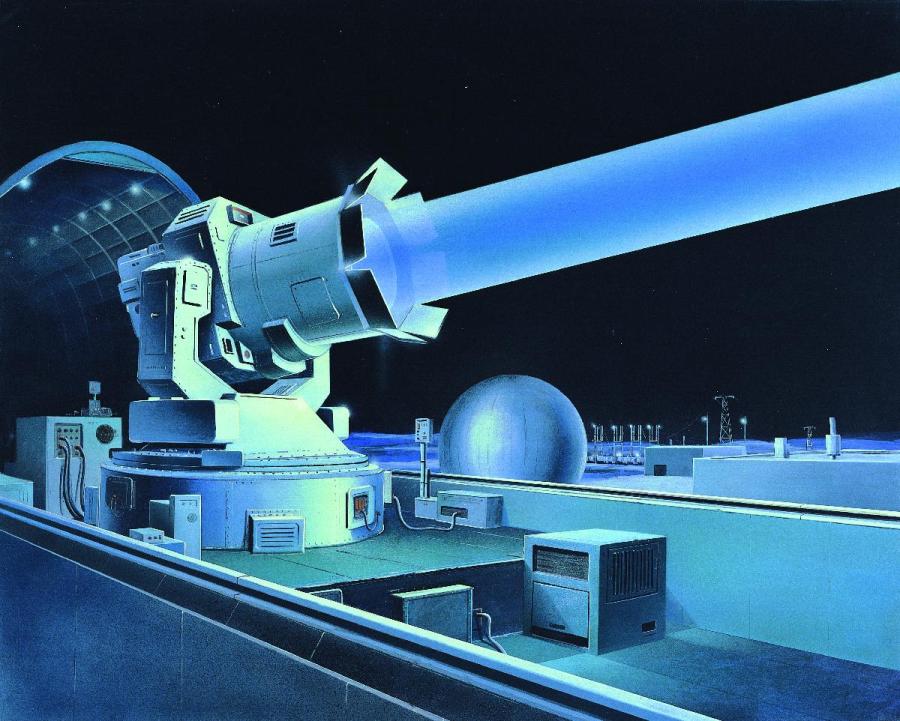
 This “fake news” headline appeared on a May 1985 article in the Los Angeles Times: http://articles.latimes.com/1985-05-28/news/mn-16287_1_star-wars. I was the scientist in the article responding to a reporter’s question about the ground based laser (GBL). At the time, using the GBL was our leading approach to energizing space mirrors to destroy attacking boosters. After seeing the negative article, the Secretary of Defense was not too pleased with my public relations gaff and I did not have time to get into the “I shoulda, coulda said” before he contacted the press to undo the damage that my remarks had caused.
Weinberger told the news media that the SDI had already bounced a GBL beam off  a mirror on the space shuttle, so I was not to be believed. Well, technically he was correct about what we did, but he neglected to say that our laser was on top of a cloud free mountain. So the real story should have mentioned that several laser locations would be needed in high altitude relatively cloud free areas, like in Arizona, or even a more futuristic concept would require a high power laser on an aircraft, which is not unrealistic in the near future. But these recent advancements in the GBL could pose a problem. What if the GBL, whose technical basis has advanced rapidly, is used by a future adversary to attack our defense satellites as the first or second step of an escalating global conflict?
Possibly such an attack would begin with a stealthy cyber attack against our satellite ground stations, communication links, and command structures. Once the fog of war is upon us, the lasers could then be used to dazzle, blind, disrupt, or even damage our defensive satellites used for detection and location of launches, and tracking of the threat cloud including a myriad of decoys, It is also realistic that enemy constellations of swarms of small missiles and directed energy weapons could be deployed in space even before we get there. This scenario sounds a bit like gunfight at the Space OK Corral. If attacked, do we dodge the bullets, or quick draw and shoot first. The space war could escalate in minutes and the outcome is likely to be chaotic at best. We might wish that the worst we have to deal with is a cloudy day.
Learn more about laser-based missile defense systems in my book Death Rays and Delusions, which will be available soon.

 According to Chinese general, military strategist, and philosopher Sun Tzu, “All warfare is based on deception.” The classic shell game uses three walnut shells and a pea to deceive the victim of the scam. The crook uses slight of hand to disguise the rapid moves. In mid course missile defense the reentry vehicle (RV) is the pea and the walnut shells are lightweight balloons. The slight of hand is to make each of the balloons look slightly different from all of the others. The game gets more challenging by spreading out the balloons so the observer can’t attack all of them. So one approach to defeat the balloons is to wait until the threat cloud reenters the atmosphere so the light weight objects slow down leaving only the RV to be attacked with an atmospheric interceptor like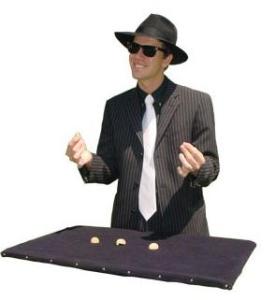
 battle management software. Does the street smart trickster win the shell game? We can only answer with tests of the defense system in the face of a credible “red team” of attackers….using realistic computer simulations. But how do we test the software against accidental faults or determined hackers who hide their moves under more shells?
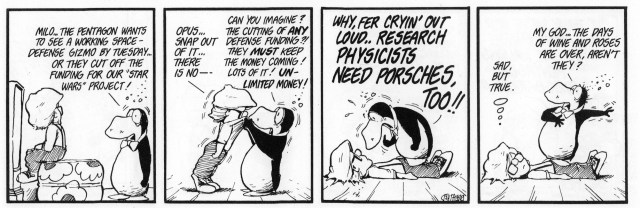 Many politicians including Ronald Reagan and Jack Kennedy knew how to express reality through humor in order to communicate real news hidden behind quips. I believe their style would be useful today.
 SDI Guy