Heraclitus, QMU, and Laser Fusion

Heraclitus had many famous quotes, but the one I often remember is, “No man ever steps in the same river twice. For it’s not the same river and he’s not the same man.” My take away from this is relevant to many of the complex problems I have worked with over my 50 odd years of dealing with various science and technology problems. Also, I can claim without contradiction that my career has never been blemished with even a single success.

For some reason, I always seemed to be interested in really challenging problems that were limited by not just engineering and physics, but also by constraints of politics, economics, and human decision making. I have written about this general class of problems that are best described as “wicked.” They are characterized as not having any closed form solution. Working on such problems provides the participants with alternating experiences of euphoria and utter depression. Maybe that is why poor Heraclitus had a problem crossing a river.

People in charge of maintaining the United States’ nuclear weapons stockpile are facing a particularly wicked problem. Their job is to assure that the weapons are safe, secure, and reliable… but without the ability to fully test them by detonating any of these weapons. This approach is called Quantification of Margins and Uncertainty (QMU).  It is a process of highly diagnosed but sub critical experiments and comprehensive computer simulations to allow decision making about the risk involved in the performance and reliability of the stockpile.

An extremely important and challenging aspect of this program is the use of lasers to ignite fusion ignition in the laboratory. The recent experiment at the National Ignition Facility (NIF) recently demonstrated fusion ignition with more energy output than delivered to the target by the lasers. This is the first time that actual “fusion ignition” has been achieved in a lab.

In my Feb.23 post “Fusion Fact or Fiction,” I explained the seemingly “miraculous” achievement involving many tradeoffs on nonlinear variables adjusted over years of complex experiments and calculations requiring continuing political support with ever-increasing budgets. I stated then (and as far as I know now) the achievement has yet to be repeated. The lab director explained recently, “We haven’t had the kind of perfect capsule that we had in December.” Perfect capsules will require a “perfect” budget.

An additional issue is the performance of the laser. Pushing the laser to its limits causes damage to the optical system that is expensive and time consuming to fix. There is also the political pressure created by the association of fusion research with the desire to develop the ultimate clean, cheap, unlimited source of energy.  

So, how can leaders deal with this wicked problem? I think the methodology that will be useful is QMU that focuses on establishing the needed margins of performance of all the components of NIF experiments that will have uncertain outcomes. Each experiment will be a different man stepping into a different river.  Heraclitus would certainly get his feet wet, but he might get swept away.

Truth versus Fiction

Truth may be stranger than fiction, but fiction is more fun.

At the end of 2022 when Lawrence Livermore Laboratory achieved a major fusion breakthrough, my novel, The Dragon’s C.L.A.W. was already at the printers.  This struck me as amusing, since the book tells the story of a fictional clean energy breakthrough. In the novel, scientists at Los Alamos National Laboratory create a compact clean low-cost energy source using electron beams to trigger a Low Energy Nuclear Reaction that generates electromagnetic energy and then directly convert that into electricity.

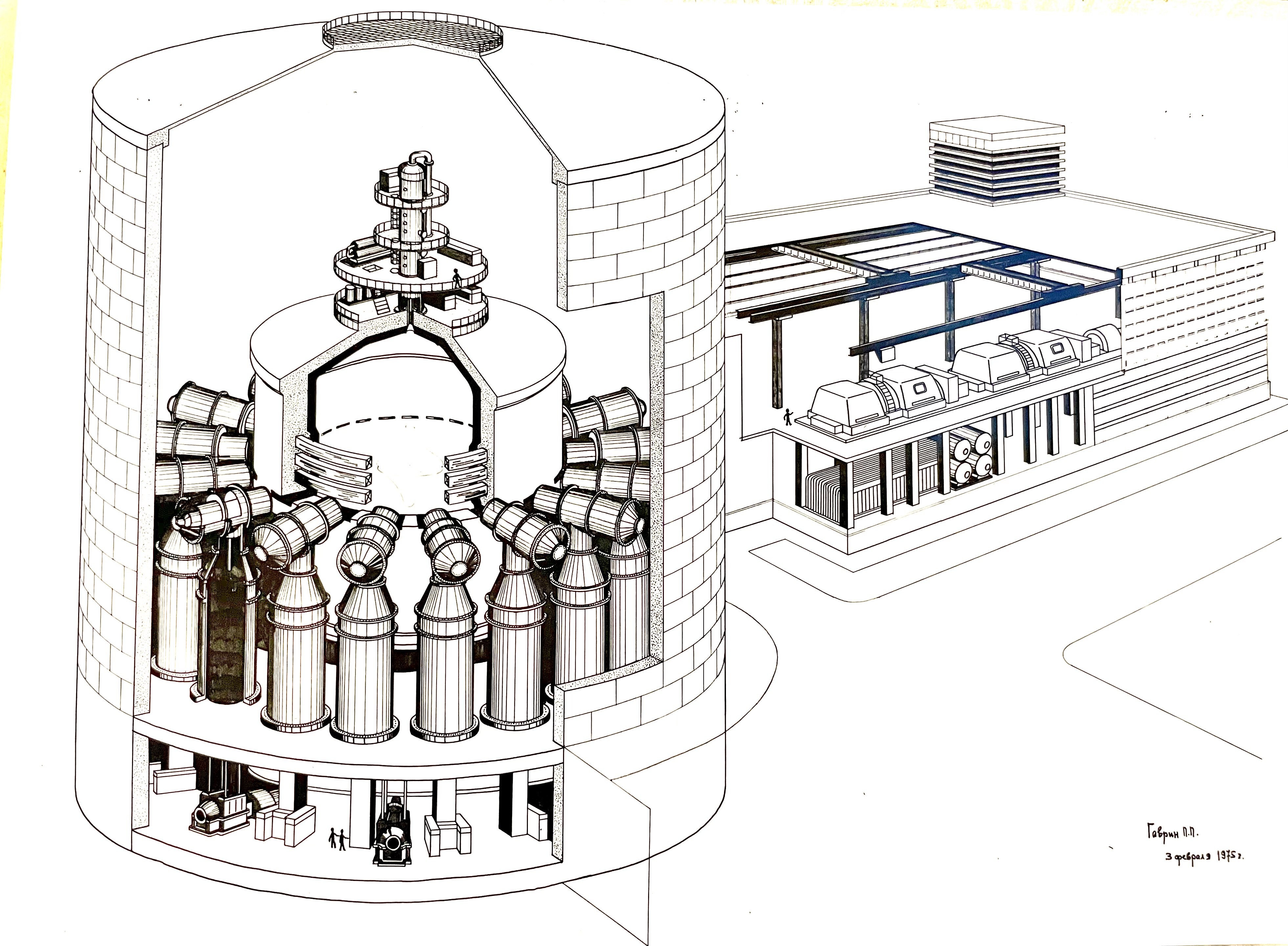
Russia’s 1975 electron beam fusion reactor

The fictional breakthrough discovery is an accident that generates one thousand times more energetic output.  In addition to intended entertainment, my book’s basic messages are first that surprises happen in research when one’s imagination, creativity and enthusiasm is as important as careful well-founded analysis. My second theme is that discovery of new science is like a knife. A knife can be used to butter your bread or slit someone’s throat. Technology is a literal double-edged sword. I believe that there will always be applications of scientific achievements that are both civilian and military—that can be used for peaceful innovation or for weapons of war. I also believe that there will always be people who can invent and stimulate ideas as well as people who know how to stand in the way of progress. The path to scientific innovation often involves the sort of characters that appear in the pages of The Dragon’s C.L.A.W. 

I spent much of my career striving to achieve a breakthrough that could lead to clean, unlimited energy. Now, as an author I have created a fictional breakthrough that reaches that goal. So, naturally that begs the question—will scientists achieve that fusion goal in real life? When it comes to recent fusion breakthroughs, the rhetoric is exciting and invigorating. Examples of recent not too specific government fusion statements are “a game changer for efforts to achieve President Biden’s goal of a net-zero carbon economy,” and “new ways to power our homes and offices in future decades.” When I read such announcements, I cannot but help remembering Reagan’s Star Wars speech in 1983 that the goal of his missile defense program would make “nuclear weapons obsolete.” The outcome of the Reagan initiative was not technical but a strategic/political event that took place at Reykjavik Iceland in 1986 as told in my Potomac Institute article, It’s Laboratory or Goodbye.

Another famous president’s call for action was Kennedy’s 1962 challenge to “land a man on the moon” by 1970. In my first year as a grad student, after I listened to a detailed Caltech colloquium after the Kennedy speech, I was convinced that the technology was already well developed, the achievement was not that far off and a race with the Soviets would provide plenty of political support for the program. Kennedy’s words shaped public enthusiasm for the space program. Words can change the way people think about science. Words can change the way governments fund science.

This approach to imagining and planning for a very distant future suggested to me a story that begins with “it was dark and stormy night.” The story is about two cave men who sat in the cold, dark, dampness of their cave when a bolt of lightning struck and ignited for the first time in the history of human development, a pile of wet branches at the mouth of their cave. The pile of wet wood was ignited into a growing fire rather than just a thin whisk of smoke they had previously experienced.  One cave man could hardly believe that a lightning bolt could create a roaring fire in wet wood. He was astonished, warm, happy, and started to roast a small rodent on a stick, but the other, probably one of the first human engineers spoke up, “What if the lightning bolt ignited a new reaction that transformed the wood into new materials and created a way to make cheap, clean, inexhaustible energy?”

If you want to spend more time thinking about the scientific process, the quest for inexhaustible energy and the unavoidable connection between peaceful innovation and military applications, pick up a copy of The Dragon’s C.L.A.W. at your local bookstore or order online:

Fiction may be the answer

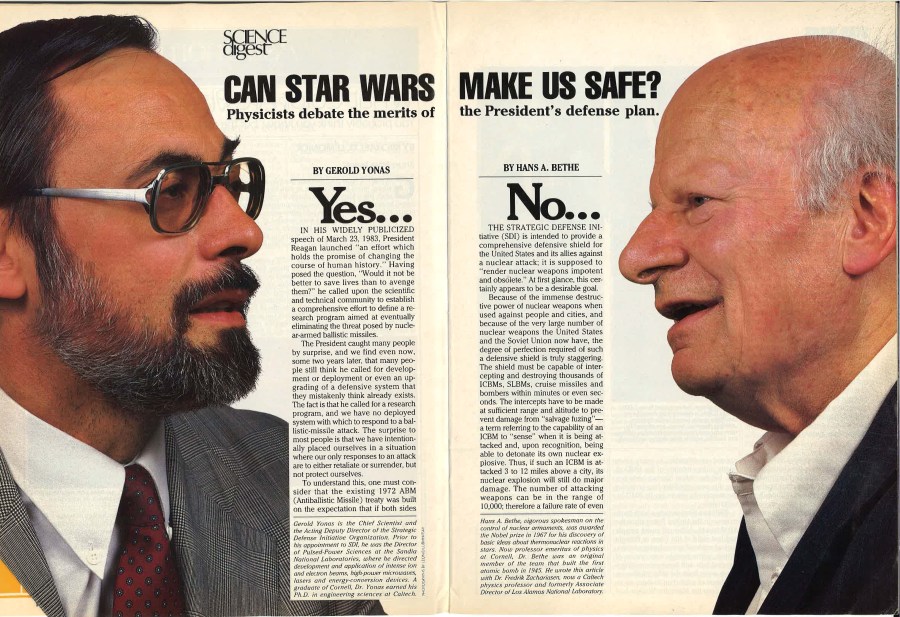
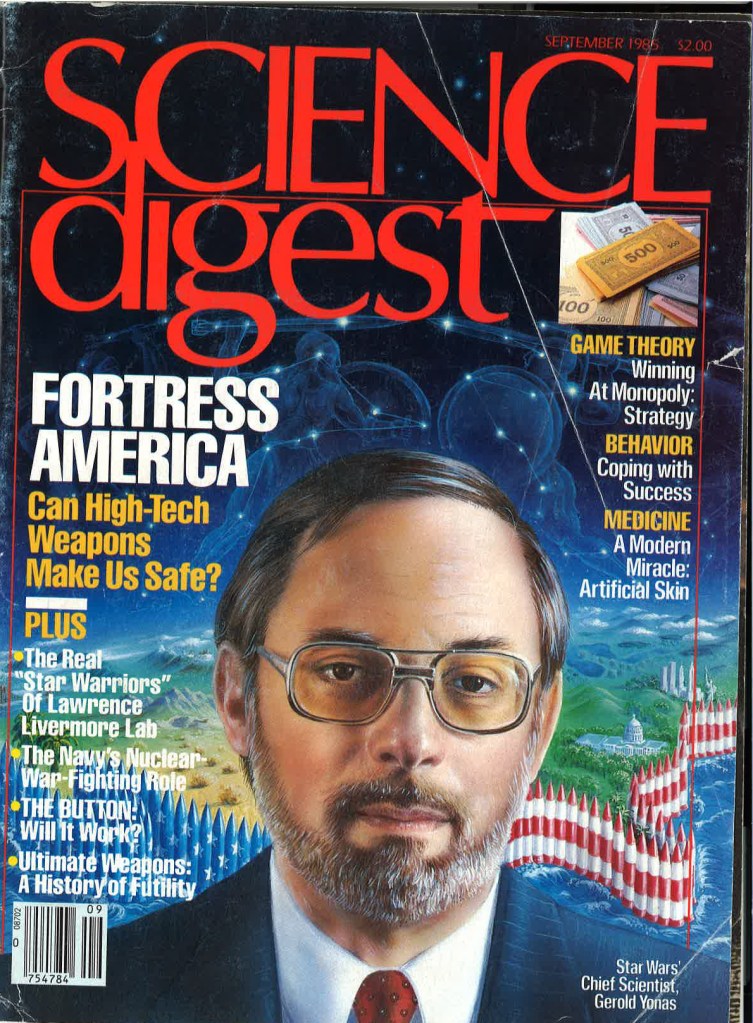
In 1985, the magazine “Science Digest” featured a debate between me and Hans Bethe, the 1967 Nobel Prize winner in physics and my former Cornell University undergraduate quantum mechanics physics professor. The question was whether President Reagan’s Strategic Defense Initiative, SDI, could be effective against nuclear tipped Soviet missiles. Bethe’s answer was a definite, “No.”

Bethe’s most persuasive argument was, “The entire system could never be tested under circumstances that were remotely realistic.” He did not wish to tackle the psychology of deterrence. He focused on the technical issues instead.

The United States was already living with the concept of mutually assured destruction, which I knew could not be tested either. I argued it was too soon to discuss the effectiveness of any hypothetical defense system. I believed a research program was justified and would be needed in order to influence the perception of a new and safer approach to strategic stability.

There was one area of technology development that concerned me––the requirement that the split-second events in a war would have to be managed by computer software. Back then I was basically Reagan’s Ray Gun Guy, and I did not know anything about testing software. Today, it looks like Bethe was right about the importance of testing. But there’s still something he missed.

Here’s where I think Bethe went astray: testing is all about technology, but deterrence is far more complicated. The vital issues in creating a credible deterrent are not just technology, but economics, social issues, political arrangements and psychology. I learned over the years that such problems really have no final solution, and continuing to pursue the answer often leads to alternating periods of hopeful optimism and depressing pessimism… and sometimes, but not always, real progress. My published opinion was that the outcome of the SDI program would “depend not only on the technology itself, but also on the extent to which the Soviet Union either agrees to mutual defense agreements and offense limitations…no definitive predictions of the outcome can be made.”

My feelings were ambivalent. I struggled to communicate the complexity of the issue to my scientific and political colleagues. I found it even more difficult to explain the questions surrounding SDI to the news media. But one person got it. He was a cartoonist.

In the 1980s, Berkeley Breathed, the cartoonist behind the series Bloom County, created a cartoon about me, the Chief Scientist of Reagan’s SDI, aka Star Wars program. He depicted me as a chubby penguin named Opus, who claimed that enormous sums of money would be needed to develop a “space defense gizmo.” When Opus learned that the unlimited money was not forthcoming, he screamed, “Physicists need Porsches too,” and then mused that maybe “the days of wines and roses are over.” Breathed understood the reality of my job.

I had been challenged with helping to put together a $25 billion, five-year plan for a research program to accomplish Reagan’s goal of “rendering nuclear weapons obsolete.” After the plan was finished and delivered to the Secretary of Defense, I wrote that even if the research was wildly successful, any workable missile defense would have to go along with a comprehensive arms control treaty that greatly reduced our own offensive capabilities as well as the threat. In spite of my published doubts, the following year I was asked by the newly chosen program’s manager, General James Abrahamson, to be his deputy and chief scientist. We brought together a distinguished advisory group including Edward Teller, the “father of the H bomb”, Bernard Schriever, retired four star general and the father of our nation’s first ballistic missiles that responded to the Soviet threat posed by Sputnik in 1957, Simon Ramo, the father of the engineering behind that first ballistic missile technology, Fred Seitz, former head of the National Academy of Sciences, and me.

During my two years in the Pentagon, I was faced not only with many serious detractors, but also with many incidents that could have been the source of high anxiety. I realized the contradictions, irony and exaggeration in the program were inescapable. I managed to approach the many stressful moments with humor that I often expressed in satirical memos and comments that were not always appreciated by my boss. But when dealing with complicated issues, there are no simple solutions. The best you can do is hang on to your sense of humor and keep trying to help other people understand your point of view.

As a cartoonist, Breathed understands that. His fictionalized depiction of the Star Wars dilemma summed up the situation succinctly. Reflecting on his cartoons years later, I wondered if perhaps Breathed had the answer to explaining the ambivalence that I faced during my time in the SDI program. In fact, the contradictory issues related to nuclear deterrence are something all scientists working in national defense face.

So, taking my inspiration from Breathed’s penguin, I have decided to try my hand at writing fiction. This spring, I will launch the first in a series of novels about the complex interaction between science and politics. Stay tuned for more information in future posts.

Beware of the swarm

Three years ago, I speculated in my blog that fairly low-tech unmanned aircraft, UAVs, or drones could defeat very expensive missile systems after a giant Saudi oil facility was attacked with high precision causing enough damage to reduce the global oil supply. Even though there was a missile defense system in place, the attack came from a swarm of small low-flying drones and cruise missiles that defeated the existing missile defense system.

I called for an increased emphasis on defense against this type of attack, and since then, there have been many worldwide new programs focused on developing this kind of threat as well as new defense systems. The recent Russian attacks on Ukraine’s infrastructure and the Ukraine attacks against Russian air bases appear to be a demonstration of what I expected, namely a fundamental change in offense and defense.

I pointed out in my post that swarms of such weapons to surprise and exhaust even the most competent defenses could mark a radical change in warfighting. I wrote that “drones could target critical parts of the exposed grid, disperse biological agents, target crowds at sports events, or even parking lots of shopping centers.” Unfortunately, my worst fears have come to pass with the Russians targeting the cities and critical infrastructure of Ukraine. Now Ukraine has struck back, and the nastiness is only going to be even nastier with more attacks from both sides. The balloon has gone up. But wait there’s more. The latest Ukraine innovation is drone killer boats backed up by flying drones to find and strike targets at sea. So the air, sea, and space application of killer drones is going to be the new way of war. But where there are new weapons, there are certain to be new counter-weapons.

With the development of fiber laser weapons with a power level of tens to hundreds of kilowatts, a realistic defense against drone swarms is possible if the tracking, pointing, and fire control system works reliably, and if the power supply is of an ample duration, and if enough of such defense system could become an affordable deployment … and of course, the weather cooperates. Boeing has created “an anti-drone death ray truck” that may defeat the ifs, but there are a lot of ifs and as usual, the offense is already a step ahead of the defense.

What about those new all-weather high-power microwave weapons such as the Ratheon Phaser to attack the controls and brains of the drones so that they become dumb rocks instead of brilliant pebbles?  High-power microwave weapons are being developed by many countries and they will be important.  This will be a story of brains versus beams, and the details will be written as the old game of offense versus defense is repeated again and again. In any case, there is no question that the game has begun and when new technology is created, people will find a way to apply that technology to warfighting.

An eventual development could be the proliferation of low-cost killer drones, and they could become the weapon of choice for ground forces, law enforcement, and maybe terrorists or even your neighborhood crazy guys who already are using weapons developed for the military. It is likely that such killer drones will initially be under the control of an operator, but quite possibly in a few years, they will be employed using artificial intelligence to search out and target predetermined targets when they are recognized by the smart sensor on the killer drones.

Survival of soldiers and military surface systems is possible if they can move, hide, defend, and shoot back, but there is not going to be a so-called “last move” in this contest of energy weapons versus drones. There may have to be an eventual change in the tactics of all surface warfare. It could be just too dangerous for high-value targets to try to survive above ground.  Maybe survival would be achieved by deploying in tunnels and caves. But what about drone swarms used by terrorists against civilian targets?  A logical step would be to ban such weapons, but we have not done this with assault rifles. Instead, children are trained to respond to an active shooter in their schools. I wonder if children will have to return to “duck and cover” when sensors detect a killer drone swarm approaching their playground?