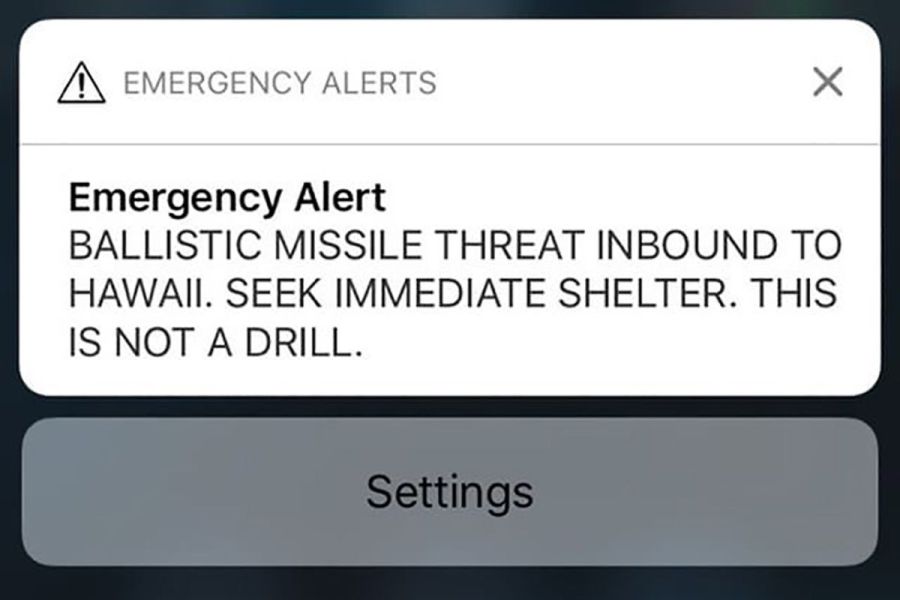
Hawaii missile mistake alert

What if the missile attacks were real?

In January, an early-morning emergency alert mistakenly warned people in Hawaii of an incoming ballistic missile attack. Less than an hour later the warning was revoked, but the mistake started a panic. More importantly, what if the missile attack were real?

Several commentators have dealt with the question of what if the missile attack on Hawaii had been real. Our military would have known almost immediately that a real missile was launched and on its way. The flight time from North Korea would have been 18 minutes and in that time we could activate our responses and send our interceptors on their way. But does that mean that the probability of stopping the attack was so high that there was no reason for fear? One commentator, without even mentioning defense, suggested that people should duck and cover. That was the “method” for surviving nuclear attack that we practiced when I was in junior high school. kids ducking under desks

Others in the military have written that our missile defenses would be activated and interceptors would be launched and could destroy a single attacking missile.  This assumes that our deployments are effective, the right decisions could be made in time, and that the response would be to launch enough interceptors to increase the probability of successful defense. But what if the first missile was really only one more test and the missile landed harmlessly in the ocean? Or maybe this was part of a strategy of seeing how fast and how well we could respond? And what if the intercept really was successful? Would we then retaliate or just send a warning?

But such issues have always been on the table during the decades of deterrence-Reagan on Time Magazinebased strategy. That is until Ronald Reagan questioned the entire basis for our survival. He asked if we could develop a high-tech defense based on assured survival instead of assured destruction. His idea was totally out of favor with all of his strategic weapons advisors who believed that the threat of total mutual guaranteed annihilation would be the only way to achieve deterrence.

Now all of that seems to be no longer acceptable and nuclear weapons proliferation is a growth industry. Our new nuclear posture review is calling for more modern low-yield nuclear weapons to strengthen deterrence since Russia and China have adopted this approach. The argument against assured destruction is that deterrence is no longer credible if the other side has developed more usable low-yield nukes and is increasingly relying on them for deterrence. So the argument is that by making our ability to wage nuclear war more credible, our deterrence is more credible. No more talk of irrevocable destruction of society.

But what about Reagan’s 1983 concept of reducing the nuclear stockpiles and creating more credible defense? As I explain in my book “Death Rays and Delusions,” the needed technology was way off in the future and we were not ready to move in this revolutionary direction. But now 35 years later we have made dramatic progress in sensors, platforms and interceptor missiles so effective defense should be taken more seriously than crawling under desks.

hacker

The ultimate missile defense problem

My previous blog posts have focused on lasers, missiles and physical counter measure evaluation. Complicated topics to tackle, however, those are easier to deal with than the fundamental question about making the split second decision to pull the trigger and launch the defense system. The decision would have be made in the unavoidable uncertainties of real war. There are estimates that multiple interceptors would be launched to stop a single attacker, but what if that first attack is a fake? Other analysis suggest a shoot, look, shoot approach to manage the rapidly changing battle or maybe the system is not fully operational or needs to adjust to surprises.

An obvious counter measure to missile defense would be the use of deception and the creation of doubt and confusion. If the attackers can exhaust the defense in an initial salvo, then the real attack could go ahead without any interruption. With the war unfolding in seconds and minutes, much of the process will have to be controlled by computers.

The first step in the attack could also focus on disruption of battle management decision-making software. How can we test that software to determine if it has not already been hacked? Is there a hidden virus ready to be triggered before or during the attack? Ultimately these issues are fundamental, and as I said in my book “Death Rays and Delusions,” software is hard, but at the time I had no idea how vulnerable our information technology would become.

It now appears that even with the most secure hardware and software, the insider, through sloppy procedures or malicious intent, can open the gates to our information systems or insert a virus that would not appear until the moment of attack. So the ultimate success of defense hinges on being able to trust the humans who create and manage the defense software.

Sharing SDI

When I joined the SDIO in 1984, the president gave us clear instructions to figure out how to share missile defense technology as part of his strategy to eliminate all nuclear weapons. At the same time, we were aware that the Soviets would love to benefit from our investments and we were serious about protecting our secrets. I responded with a proposal to share early warning data–not technology–as part of an agreement preventing any surprise missile launches, and, as I expected, my suggestion was rejected as coming from an engineer. Reagan continued to insist that we share SDI, and he wanted to make a deal with Soviet leadership, but they kept on dying before he could sit down with them. Then came a totally new and revolutionary Soviet leader Mikhail Gorbachev.

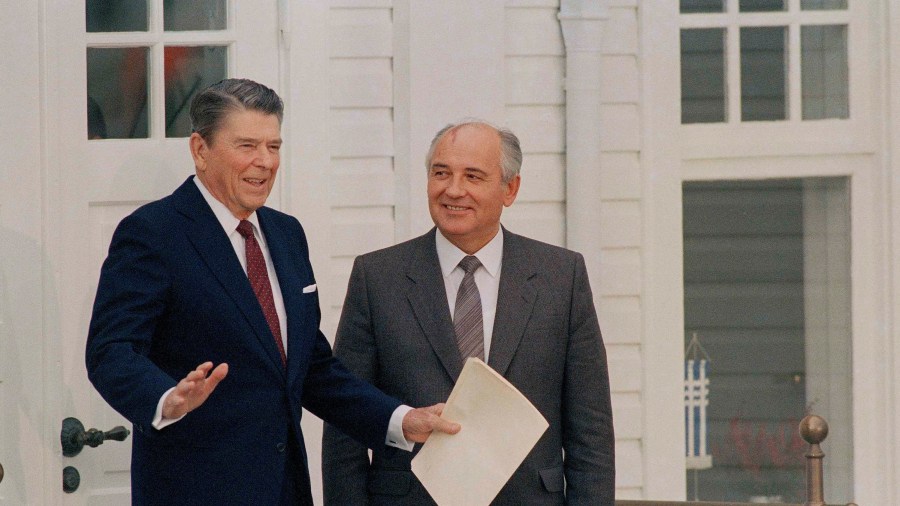
Reagan and Gorbachev sharing a pen
In 1985 at the Geneva summit, Gorbachev and Reagan stated, “A nuclear war cannot be won and must never be fought.” This was not just propaganda but a deeply felt conviction on both of their parts.

After the latest dust up over North Korean missile tests had passed, our current secretary of state indicated a willingness to consider negotiations with North Korea. It seems to be unlikely to happen, or even less likely to be productive, but maybe we can learn from the history of the one of the most surprising negotiations in history. During three days of one-on-one arguments, the result was almost an agreement to eliminate all nuclear weapons.

President Reagan went to the Reykjavik summit in the fall of 1986 with a spirit of Reagan on Time magazinecooperation and a conviction to abolish nuclear weapons. He wanted to move ahead with SDI that he thought was close to deployment, and share SDI with the Soviets. Secretary of State George Schultz, his principal adviser, had recommended that “we trade the sleeves of our vest and make them think they got an overcoat.”


The young and vigorous new leader of the Soviet Union, Gorbachev also wanted to eliminate nuclear weapons, but his military industrial complex wanted to compete not cooperate. He was told that his industry was only five years behind us in missile defense and could catch up if he could slow us down for 10 years. He was more worried about his own SDI that was preparing to launch its giant space laser and was terrified of a space weapon race in the face of his country’s imploding economy. He had been on the job only since March 1985, but his confidence had already been shattered by a rapidly declining situation that left him desperate to make a deal.

OK Corral

North Korean ICBM test raises specter of escalating instability

The shoot out at the OK Corral
An artist’s rendering of the shoot-out at the OK Corral

In my last post, I described a disturbing possible future involving a space version of the shoot-out at the OK Corral. The instability of the situation could be driven by speed of light weapons and swarms of small missiles ready to fire at each other. Obviously the quick draw and precise aim could win the day. With the recent realization of the North Korean development of intercontinental ballistic missiles (see https://mobile.nytimes.com/2017/07/28/world/asia/north-korea-ballistic-missile.html), the possibility of a preemptive terrestrial strike to disarm the missiles before a launch, is being considered. Thus, the instability of a shoot-out is even closer to becoming a reality than anyone could have imagined.

missile test
A long-range ground-based interceptor missile launches from Vandenberg Air Force Base.

The North Korean threat is undoubtedly an exaggeration right now, since delivering a payload to a long range target area is only part of the technical challenge. Successfully surviving the stresses of reentry into the atmosphere, and then precisely detonation the weapon are formidable problems, but North Korea is making rapid progress, probably with assistance from others.  So it is necessary that we get even more serious about missile defense. Unfortunately, we have already spent almost $200 billion during the last thirty years, and there is no guarantee even with enormous increases that we can ever have 100% protection against missile attack. I used to say there is no 100% guarantee in any complex system. There is no way to test a defensive system under a totally realistic war scenario. An actual missile strike could be preceded by deceptive tactics, conventional ground and cyber-attacks that would cloud rapid decision making with the thick fog of war.

I’ll discuss America’s missile defense options further in my next post and you can learn more about strategic defense in my soon-to-be-published book “Death Rays and Delusions.”