


Gort was a 1951 sci-fi movie robot armed with devastating laser weapons…. now a not too distant future reality. The movie was about an alien visitor who came to earth to save the global population from self-destruction using its newly developed nuclear weapons. The spread of nuclear weapons has become a frightening reality long before an alien visit or the development of laser weapons, but after many decades, high power laser weapons are now on the procurement lists of many global militaries (see https://www.google.com/amp/s/phys.org/news/2017-04-laser-weapons-edge-military.amp.) In the movie, “The Day the Earth Stood Still,” Gort, the robot, was totally controlled by the command “klaatu baruda nikto,” the control of space based lasers will be a lot more complex. Systems of military systems in an escalating scenario of increasing violence is likely to be chaotic with a totally unpredictable outcome. Is it possible for us to look to technology for some way out of this mess?
A space-based defense consisting of a constellation of high power lasers that could zap any booster to a frazzle in a matter of seconds is certainly an exciting option. Decades ago the dream of such technology was too far off for us, but the Soviets took this very seriously and developed and began to test their own giant space-based laser called Polyus.
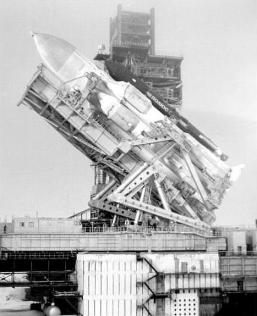
On their first test in 1987, it failed to deploy and now sleeps with the fishes on the bottom of the Pacific. Nevertheless, the technology did result in the deployment of an aircraft based anti-satellite weapon (“China and Russia Advancing Anti Satellite Weapons, US Intel Chief Says”…Space.com, May, 2017.) Then the United States Air Force decided to develop their own powerful 747 based chemical laser called the Airborne Laser or ABL. After racking up a bill of $5 billion over 20 years, the ABL now rests peacefully in the Air Force bone yard in Arizona.
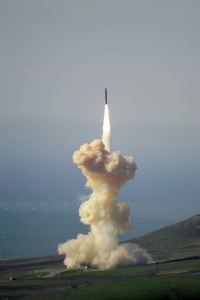
So what are the near term options for missile defense? We could rapidly deploy Terminal High Altitude Area Defense (THAAD) in South Korea. Defense against long range missiles was discussed in my second blog post. As long as the attackers don’t employ complex countermeasures, another possible solution would be our Ground Based Mid-Course defense (GMD), which has recently demonstrated its effectiveness.
The dream of instantaneous space-based defense affords an attractive option for the future, but only if precision strike is accompanied by precision decisions. More than likely this would require autonomous command and control.
A much more desirable approach to missile defense would be to come to an agreement as proposed by President Reagan to Gorbachev at Reykjavik in 1986. Unfortunately, even though they came very close to agreement on abolishing all nukes, their negotiations broke down because of a lack of understanding and trust (as described in my soon-to-be-published book, “Death Rays and Delusions.”) It seems now that trust with North Korea is in even shorter supply, and the outcome of this rapidly changing scenario is very uncertain.
As the great American philosopher Woody Allen once put it, “”More than any other time in history, mankind faces a crossroads. One path leads to despair and hopelessness. The other, to total extinction. Let us pray we have the wisdom to choose correctly.”



 According to Chinese general, military strategist, and philosopher Sun Tzu, “All warfare is based on deception.” The classic shell game uses three walnut shells and a pea to deceive the victim of the scam. The crook uses slight of hand to disguise the rapid moves. In mid course missile defense the reentry vehicle (RV) is the pea and the walnut shells are lightweight balloons. The slight of hand is to make each of the balloons look slightly different from all of the others. The game gets more challenging by spreading out the balloons so the observer can’t attack all of them. So one approach to defeat the balloons is to wait until the threat cloud reenters the atmosphere so the light weight objects slow down leaving only the RV to be attacked with an atmospheric interceptor like
 battle management software. Does the street smart trickster win the shell game? We can only answer with tests of the defense system in the face of a credible “red team” of attackers….using realistic computer simulations. But how do we test the software against accidental faults or determined hackers who hide their moves under more shells?
 SDI Guy