
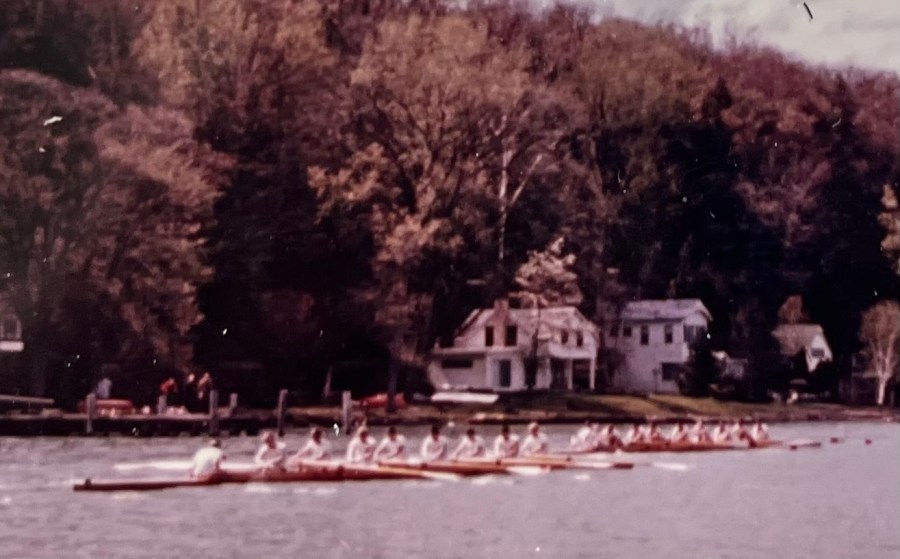
I first learned about the importance of the coach during my four years rowing an eight-oar competitive racing shell at Cornell University. This story began when I was fresh out of high school in Ohio and went off to Ithaca, New York to attend college. It was September 1957, and I was not sure I was in the right place as I looked around nervously in a long Cornell University freshman registration line. Somebody walked up to me, an obviously self-confident upper classman that I assumed wanted to help me, and he said, “Want to join the Cornell crew?”
The upper classman seemed to be an authority. He instructed me to show up at the boathouse that afternoon. I had no experience in the sport of competitive rowing, and my only activity even related to sports was playing the clarinet in the high school band at football games. Mostly out of curiosity, I showed up with several dozen others, many of whom (unlike me) appeared to know what they were doing. I soon learned that they had rowed in prep school. Cornell was recruiting rowers for the lightweight crew, where the average weight was 150 pounds with a max of 160 pounds, so they needed to have some to come in at 145 pounds or lower. Apparently, I looked like the skinny kid that might be able to teach how to row.
We spent the next few weeks getting lessons from the experienced coach, and rowing very slowly up and down the Ithaca inlet in what was called the barge with 16 rowers in the boat. Our numbers had been reduced. The preppies were off, and what remained was a group of scruffy inexperienced kids trying to fit it to a new environment. We were a bunch of exhausted freshmen getting used to new classes and fatigue. We struggled together in a rather undistinguished craft. Many of us were getting ready to give up, but there was something about the patient, forceful, and calm instructions from that the coach that encouraged me. This was the sport for me.
Then we were introduced to a magnificent eight-oared, thin-walled, cedar shell. We rowed on Lake Cayuga until the glorious fall weather turned into freezing rain and rapidly dropping temperatures. Winter arrived, and we were assigned to the “tanks” in the campus gym. We were sitting on slides with water flowing past on two sides. Our oars had large holes in the blades, so the water resistance was as if we were on the water.
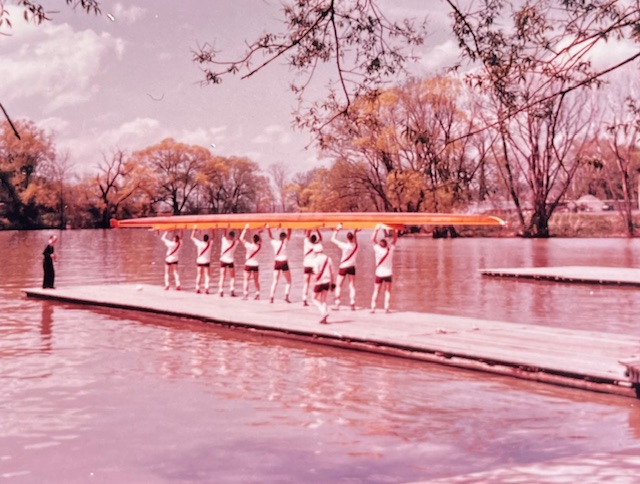
I had a lot to learn, and I was worried that I would not make the cut. Nevertheless, I was completely impressed by the coach who I believed wanted me to succeed. The coach often watched from within a foot away from my hands, carefully explaining the complex motions I had to repeat over and over again for what seemed like hours. One problem I experienced was that the skin of my hands was a bit too delicate for this sport. Before long, my hands were bloody pulp. I could barely hold a fork at the training table, but my coach never seemed to notice the blood stains on my old sweatshirt since. The mission was made clear, we had to learn to row, and learn to win. Racing would begin when the snow melted, and we would face competition on Lake Cayuga.
I had little time nor interest in anything but rowing. I had already decided that I was not happy with studying mechanical engineering, which seemed dull. One early morning I walked down the tree-lined street to the Physics building. One of my fellow rowers had told me about a new Cornell program called Engineering Physics that offered the challenge of a more exciting set of courses. The dean was my second experience with a respected coach. The dean told me the program would require be five years instead of four, but in addition to studying physics and engineering, the extra year would be a collection of the very best liberal arts courses at Cornell. I was instantly convinced by his description of the challenges ahead.
I got used to rowing, the training table, an early curfew, and limited time for studying. I learned how to use my time for studying efficiently, and I managed to get better grades than most of my friends in our fraternity. My grades were not fantastic, but they were up there with other crew members. I even made Dean’s list.
Eventually spring emerged and we went back on the lake with an occasional thin sheet of ice delicately cracking on the side of the shell. Then came spring vacation, where practically everybody left the campus, but the crews were told we would stay on campus and row for mile after mile in the morning and afternoon to harden up for competition.
As we first glided down the inlet toward the lake, my hands already toughened up from rowing in the tanks, I felt optimistic. Then, two weeks on the lake turned my hands back to the bloody pulps. I eventually got used to the pain in my hands because there was much more pain in the rest of my body. There was also the unbelievably mystical sweeping sound as we cut through the light waves. The soaring feeling of eight of us responding in unison to the yells of the coxswain, “up two in five” and pounding the side of the shell with wooden rods. Our coach followed in a small launch instructing all of us with a calm but convincing set of commands.
I was never particularly good at the sport, but I was totally dedicated. My coach really appreciated my total commitment and my competitive spirit. He even gave me a couple of awards, including, in my senior year, the Cornell C embroidered on a white wool crew neck sweater (that I could not put on today with a crowbar). I retired from crew after my senior year with a couple of trophy oars and a silver bowl that my coach called the “competitors cup.” When we did win some races, the losing crew would give us their shirts. (Although Yale somehow managed to avoid that custom.)
From rowing crew, I learned a lot that applied over the next several decades of working on mostly impossible challenges such as giant pulsed power machines, fusion, missile defense, death rays, and enhanced cognition, working with the government, laboratories, and industry. I believe that my most important lesson from crew was the importance of having a person I reported to that I respected and trusted. I never thought of that person as a boss but rather as my coach. We shared goals and a desire to win.
One of my favorite coaches during my career was Air Force General James Abrahamson who recruited me to be his depute and chief scientist when he was chosen to head the Strategic Defense Initiative Organization, also known as Reagan’s Star Wars program. He was as new to high powered lasers as I was to the military, but we learned from and trusted each other, and he tolerated my jokes.
Recently my coach at Sandia, Al Narath passed away, and I was fortunate to attend his 90th birthday party and was able to express my feelings about him at his memorial ceremony. I knew from four years on rowing, and for the rest of my career, what it was like to have that very special coach. My coaches always made the major difference in my work. As long as we shared goals, mutual respect, trust, and open communication, I was able to contribute to my fullest to a shared success that included the entire team. I learned that crew is successful when the only outstanding person on the team is no one, but also everyone. The result was a team that shared the same beliefs, feelings for each other, and dedication that resulted in open communication and trust, which the coach shared with us. Every day after practice we all experienced a combination of exhaustion and exhilaration. When we won, we sang the Cornell Crew song together as loudly as we could: “Onward like a swallow going…. rest was made for feebler folk….and for fame of Alma Mater. Stroke, stroke, stroke.”
 SDI Guy