Seventeen years ago, I was invited to give a presentation to a group of intelligence analysts at the Joint Military Intelligence College. At that time, I was managing the Advanced Concepts Group at Sandia National Labs, and my group was focusing much of our attention on emerging threats. A current issue was what was called “the global war on terrorism.” This war began in Afghanistan in 2001 after the Al-Qaeda attack and continued for 20 years. During that period, it expanded to include Iraq in 2003 with one justification being the belief that Iraq was linked to Al-Qaeda.
The threat of terrorism was very much a major national security issue, and my presentation attempted to address these issues based on my perceived needs for intelligence analysis. I had been increasingly interested in dealing with current complex challenges, and I studied the literature of systems engineering approach to solving relevant problems. What I learned was that most of my career as an engineer and physicist had been dominated by what were called tame problems, and the national security issues of the time were best described as wicked problems that would be long in duration.
I was convinced that the current military issues were best described by a timeline beginning with a long period of increasing threat, and short period of conflict, and a much longer post conflict period of managing the threat. I thought the key to success of this challenge would be in the hands of intelligence analysts that knew how to deal with wicked not tame problems.
Tame problems had been the focus of my training and career, and are the typical challenge for analysts, engineers, and convergent thinkers. Such problems have a well-defined problem statement. For example, a tame problem is figuring out how to build a bridge. A wicked problem includes planning for the bridge, obtaining permission from the community and elected officials to build it, acquiring funding and scheduling, and working with the various individuals and agencies required to build that bridge. The bridge builders know what, where, and how to proceed with a well-defined end point of the task. They can learn from the records of other similar bridges already built and can easily try out various paper designs and choose the one most appropriate approach. They have an orderly approach to analysis, design, and implementation, but do not have the divergent thinking approach that is actually needed to complete all of the tasks involved in building the bridge.
The typical tame approach can lead to disaster if the problem is really wicked. If the problem is defined incompletely, prematurely, or influenced by desperation, ambition, fear, greed, hatred, or other emotions. Being driven to a hurried solution can lead to oversimplified solution options and an early and false belief that the problem is solved. The different perspectives, backgrounds organizations, and prejudices can lead to escalating confusion, conflicts, and paralysis.
A symptom of a wicked problem that is treated as tame is when the leader says, “Let’s get organized, put the right person in charge, get on with the solution, and get it done.”
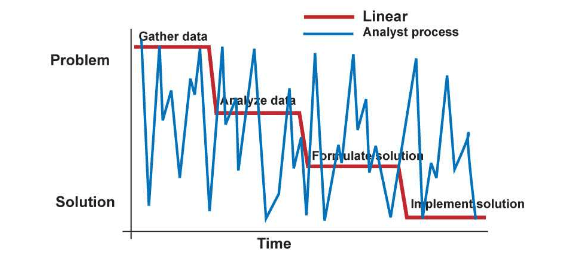
The tame problem approach is a satisfying and coherent method of increasing knowledge. Wicked problem solving, on the other hand, can often be characterized by frustrating alternating periods of euphoria and utter depression. So, are wicked problems just another worthless activity that is in the end a hopeless mess?
Well, maybe, but if you know the problem is truly wicked, a wicked engineering analyst can make real progress by spending a great deal of time and effort to comprehensively formulate the approach as a nonlinear spiral instead of a ladder of subsequent steps. The key is also to share the complexity with a group of creative thinkers and communicators that have a diversity of views. It’s important to share ideas frequently as the context of system issues changes and avoiding a focus on the detailed piece of the problems. Since premature belief in success will turn out to be the devil preventing group productive cooperation, the participants need to trust each other as the game changes.
I concluded that without active counterterrorism intervention, the level of terrorist violence will be low until a triggering threshold is passed, and, at some point, conflict will demand increased security emphasis. If successful, counterterrorism actions can be taken that will lead to a cessation of combat operations. This period will be followed by a long period of stabilization and reconstruction. During the active combat period, the adversary may apply such irregular methods as assassination of leaders; hostage taking; cyber, bio chem, and infrastructure attack. The adversary may also introduce social and psychological methods such as induced chaos, exponential migration, financial attack, and race wars. The symptom of terrorist success would be a disruption of societal stability and stimulation of self-destructive behaviors.
A strength of the wicked engineering group could be the application of ubiquitous information technology, but in the hands of the terrorist, could also accelerate instabilities, so it will be necessary to take advantage of advances in complex computer modeling and simulation as well as the application of neuroscience to enhance cognition and group problem solving.
By gaining a neuro advantage over the adversary, methods of deterrence and dissuasion will become apparent. The advances in the neuro science spectrum can enhance the psychological armor, accelerate learning, cognition, and memory. Use of such methods applied against the terrorist can create confusion, fear, and loss of understanding of the rapidly changing environment. The adversary’s use of such psychological and information warfighting tools can lead to our early failure in dealing with the threat. The positive and negative implications must be understood.
At the time of my presentation, I believed that neuroscience advances in the hands of the adversary (which won’t have the same legal and moral constraints that we have) would have an important impact on the outcome. I also believed that the challenge of dealing with terrorism was open ended and there would likely never be a last move in this contest, so the happy ending to the story was not obvious.
My new novel, The Dragon’s C.L.A.W., also tackles a wicked problem. The protagonist realizes that his breakthrough invention, which has the ability to transform the world by providing clean, affordable, unlimited energy, can also be used to create a deadly weapon. I called upon my understanding of how to wrestle with wicked problems as I described how the character dealt with the conflict the dual nature of his work. Wondering how he resolves the problem? You’ll have to read the book!
Have you ever dealt with a wicked problem? How did you approach it? Did you resolve it? Comment below.
Truth may be stranger than fiction, but fiction is more fun.
At the end of 2022 when Lawrence Livermore Laboratory achieved a major fusion breakthrough, my novel, The Dragon’s C.L.A.W. was already at the printers. This struck me as amusing, since the book tells the story of a fictional clean energy breakthrough. In the novel, scientists at Los Alamos National Laboratory create a compact clean low-cost energy source using electron beams to trigger a Low Energy Nuclear Reaction that generates electromagnetic energy and then directly convert that into electricity.
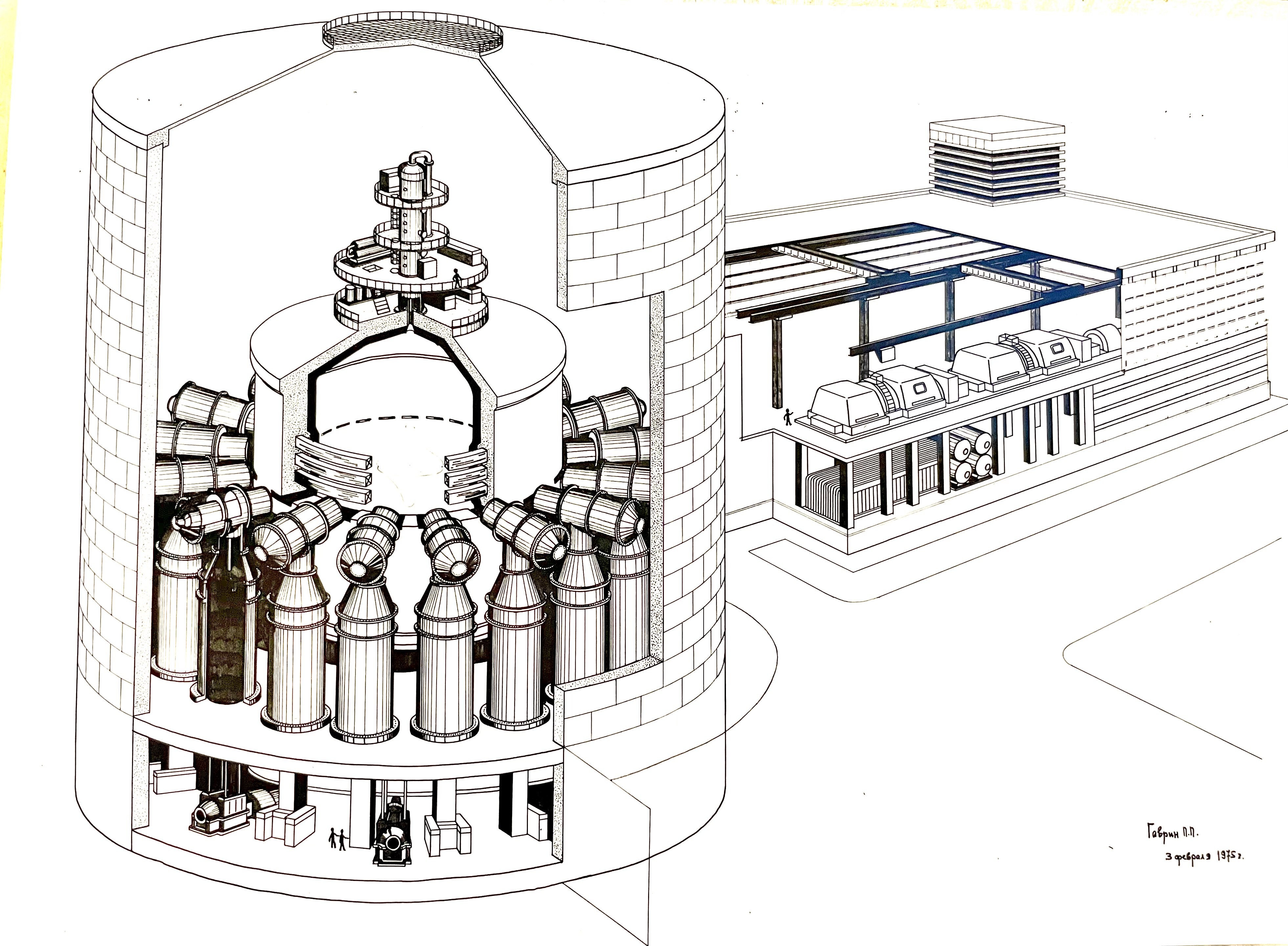
Russia’s 1975 electron beam fusion reactor
The fictional breakthrough discovery is an accident that generates one thousand times more energetic output. In addition to intended entertainment, my book’s basic messages are first that surprises happen in research when one’s imagination, creativity and enthusiasm is as important as careful well-founded analysis. My second theme is that discovery of new science is like a knife. A knife can be used to butter your bread or slit someone’s throat. Technology is a literal double-edged sword. I believe that there will always be applications of scientific achievements that are both civilian and military—that can be used for peaceful innovation or for weapons of war. I also believe that there will always be people who can invent and stimulate ideas as well as people who know how to stand in the way of progress. The path to scientific innovation often involves the sort of characters that appear in the pages of The Dragon’s C.L.A.W.
I spent much of my career striving to achieve a breakthrough that could lead to clean, unlimited energy. Now, as an author I have created a fictional breakthrough that reaches that goal. So, naturally that begs the question—will scientists achieve that fusion goal in real life? When it comes to recent fusion breakthroughs, the rhetoric is exciting and invigorating. Examples of recent not too specific government fusion statements are “a game changer for efforts to achieve President Biden’s goal of a net-zero carbon economy,” and “new ways to power our homes and offices in future decades.” When I read such announcements, I cannot but help remembering Reagan’s Star Wars speech in 1983 that the goal of his missile defense program would make “nuclear weapons obsolete.” The outcome of the Reagan initiative was not technical but a strategic/political event that took place at Reykjavik Iceland in 1986 as told in my Potomac Institute article, It’s Laboratory or Goodbye.
Another famous president’s call for action was Kennedy’s 1962 challenge to “land a man on the moon” by 1970. In my first year as a grad student, after I listened to a detailed Caltech colloquium after the Kennedy speech, I was convinced that the technology was already well developed, the achievement was not that far off and a race with the Soviets would provide plenty of political support for the program. Kennedy’s words shaped public enthusiasm for the space program. Words can change the way people think about science. Words can change the way governments fund science.
This approach to imagining and planning for a very distant future suggested to me a story that begins with “it was dark and stormy night.” The story is about two cave men who sat in the cold, dark, dampness of their cave when a bolt of lightning struck and ignited for the first time in the history of human development, a pile of wet branches at the mouth of their cave. The pile of wet wood was ignited into a growing fire rather than just a thin whisk of smoke they had previously experienced. One cave man could hardly believe that a lightning bolt could create a roaring fire in wet wood. He was astonished, warm, happy, and started to roast a small rodent on a stick, but the other, probably one of the first human engineers spoke up, “What if the lightning bolt ignited a new reaction that transformed the wood into new materials and created a way to make cheap, clean, inexhaustible energy?”
If you want to spend more time thinking about the scientific process, the quest for inexhaustible energy and the unavoidable connection between peaceful innovation and military applications, pick up a copy of The Dragon’s C.L.A.W. at your local bookstore or order online:
On May 16, I will release my first novel, The Dragon’s C.L.A.W. The book is fiction, loosely based on my more than 50 years of my real-life experiences related to the quest for the ultimate energy source. The scientists in the novel are striving to create a clean, affordable, inexhaustible commercial energy source using a fictitious technology. In real life, I spent my career pursuing the dream of creating fusion energy through applications of high power particle beams and pulsed power technology.
I was first introduced to the concept of using a focused high-current electron beam to ignite fusion burn in 1967 when I started work a small company called Physics International in San Leandro, California. The company was a spin off from the Lawrence Livermore National Laboratory, a nuclear weapons lab. The small company had created a program to use advanced pulsed power technology to create radiation sources for weapons effects testing. During my interview, the Livermore scientists told me about their work on the Electron Lighted Thermonuclear Explosion, or ELITE, and their quest to create, control and focus a multimillion ampere relativistic electron beam.
In 1971, I attended an international conference on fusion and happened to meet a Russian scientist named Lyonid Rudakov. I soon learned that Lyonid seemed to know a lot about both beams and fusion. His lab, the Kurchatov Institute in Russia, was a recognized leader in fusion research and scientists there were already engaged in electron beam applications. Lyonid and I formed a working friendship as we shared a vision of creating fusion in the lab.
The following year I joined Sandia National Laboratories with the goal of pursuing the ELITE concept. I started a small program taking advantage of Sandia’s existing pulsed power technology. Within a year, I was applying my electron beam experience to the challenge of beam focusing. With the foolishness of youth and the support of Sandia Vice President Al Narath, who became my long-term mentor and friend, I advocated for a $14 million investment in a Sandia fusion program facility. In my previous post I described the Sandia fusion program that began in 1972 and is ongoing; however, I neglected to describe the vital importance of the cooperation and competition with the Russians, and that must be included in any review of my Sandia work.
It looks now as though the Russians probably understood the real requirements for pulsed power-driven fusion all along, and I learned a lot about science and marketing from my Russian colleagues. My first introduction to their specific predictions was at a conference in Moscow in 1973, where Rudakov presented a concept for a high gain fusion explosion driven by a 10 million joule electron beam. At the time our estimates for fusion ignition were much lower, and we pressed on to get funding for our first big machine, the Electron Beam Fusion Accelerator, EBFA.
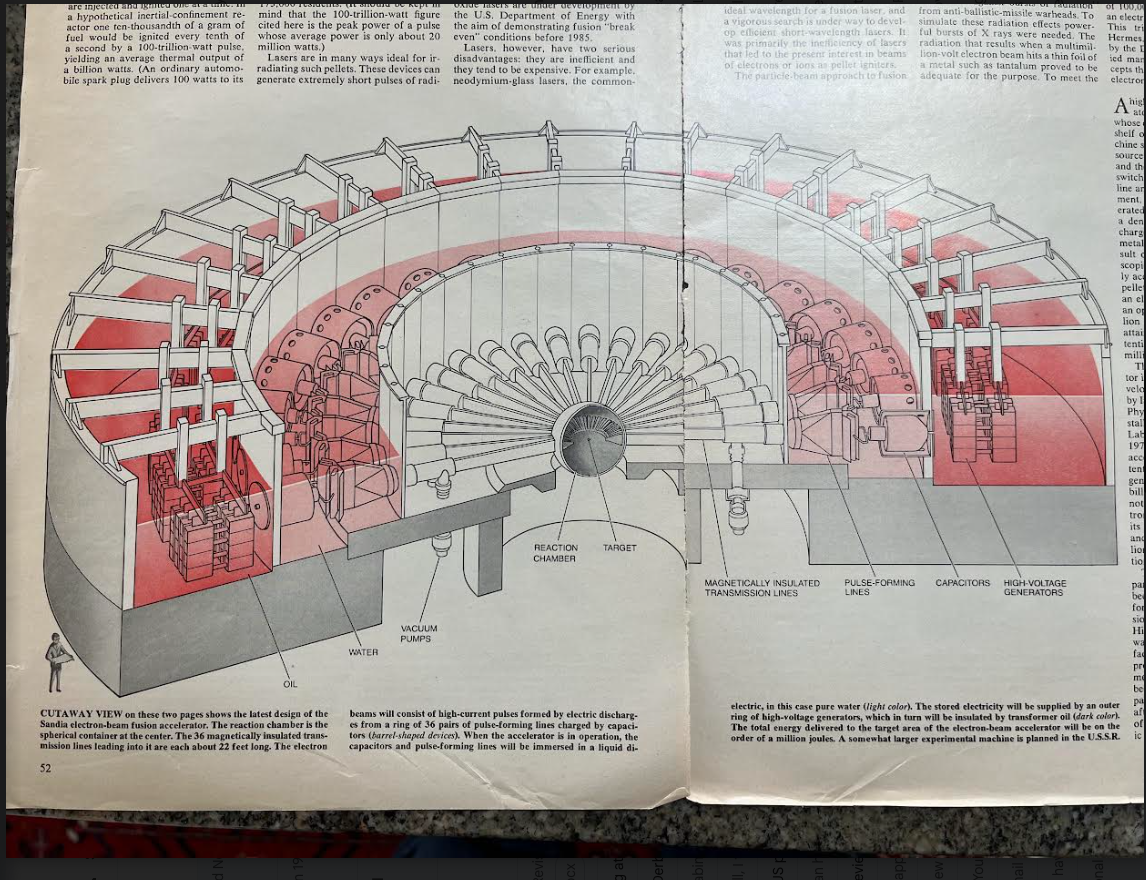
Scientific American article on EBFA.
My imagination was way ahead of real physics, and, in 1975, I even received a patent on an e beam fusion reactor concept. Since the patent expired in 1992, anybody is free to go ahead and use it to solve the world’s energy problems. In 1978, I published an article on particle beam fusion in Scientific American magazine. I also invented an international electron beam conference that I hosted in Albuquerque and began a tradition of international cooperation and competition. I even had conference pins made up for all of the attendees following the tradition that the Russians followed in their conferences. Even though we had connections with many research groups including Japan, England, France and Israel, our strongest alliance in our fusion quest was from our technical colleagues and Cold War adversaries, the Russians.
With the help of Sandia management and funding from Congress, we broke ground for EBFA in 1977 and began operation in 1980. At the same time the Russians continued with their electron beam approach. In 1979, a New York Times front page article quoted Rudakov announcing that Russia’s new pulsed power machine, Angara 5, “would produce more energy than it consumes… and demonstrate that an industrial pilot plant can be built.”
Competition with the Russians helped me get funding for continued operation of EBFA and allowed our team to respond to new theoretical discoveries with ion driven rather than electron beam targets. As usual in the fusion funding business, getting funding consumed my attention, and we created support for the program by emphasizing use of ions and proposing a new machine, the particle beam fusion accelerator, PBFA. I predicted that PBFA would produce a 100TW output by 1984. I even got away with telling decision makers that I was negative on electrons and positive about ions. I recall the day when I took down the EBFA sign and put up the PBFA sign, abruptly switching from electrons to ions. This change turned out to be the key not just to getting continued funding, but to ensuring program survival. There were many people, not just at Sandia but other labs around the world, who had invested their time and effort in electron beams who were upset with me. The head of the Soviet electron beam research at the Lebedev Institute began referring to me as “Lysenko,” an infamous Russian scientist known for his dangerous pseudoscience ideas. But the Russians were doing more than insulting my work, they were studying it and considering how they could compete with us and win.
I was a total amateur in the business of selling fusion funding to decision makers, but I learned that the Russians were already way ahead in this vital aspect of fusion research. On my first visit to the Kurchatov Institute in Moscow 50 years ago, was shown their world-famous fusion device, the Tokamak. Their experiment demonstrated real fusion output and became the world leader in fusion research as well as the first of hundreds of claims from all over the world of fusion breakthroughs since then. I remember the comment from my guide, Lev Artsimovich, considered as a founder and leader of their Tokamak program. I asked him what is the most serious problem with the Tokamak, and he replied that the “real problem with achieving fusion with my Tokamak, will be how to convince the bureaucrats to continue to spend so much money for me to satisfy my own curiosity.” The Tokamak concept went well beyond Artsimovich’s curiosity when Reagan and Gorbachev agreed at their summit meeting in 1985 at Reykjavik to a cooperative international fusion reactor program that actually began construction in 2010 with a goal of beginning real fusion operation in 2035 and achieving practical energy gain possibly sometime after that. This method of creating a joint program to sustain investment in a long-term program was not a new idea and was employed in the funding of the 1975 U.S. /Russian Apollo-Soyuz program. This joint activity was part of the Cold War transition to a relationship of détente, which characterized my interactions with Rudakov and other Russians.
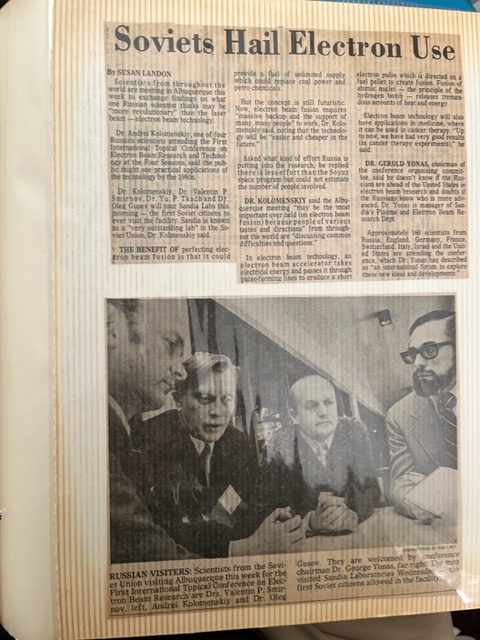
Albuquerque Journal reports on Soviets’ 1975 visit to Sandia.
At some point in the evolution of Tokamaks, some Russians, with I suppose weapon lab connections, began to think the way to achieve a large fusion gain in the lab was to use high power lasers as well as pulsed power. The Soviet scientists I knew played a great deal of attention to our research, and one of these was N.G. Basov, the 1964 Nobel Prize winner (shared with Townes and Prokhorov) winner for their original contributions to lasers. Basov was the father of their giant but mysterious missile defense pulsed laser program called Terra 3. We learned much later that in 1963 Basov had proposed a missile defense approach using a nuclear explosion pumped laser with an output of 10 million joules, and he was very aware of the United States’ work in our weapon labs. Interestingly, he was way ahead of the U.S. program championed by Edward Teller in 1983 to use nuclear explosives to excite X-ray lasers. The Russians were building enigmatic, giant facilities and spending lots of rubles. Russia received lots of misguided attention for these efforts in Aviation Week magazine. Basov was also the first to admit that such efforts were futile. After he canceled their program he stated, “Well we made sure that nobody can shoot down a ballistic missile by a laser beam.”
I had many interactions with leading Russian scientists, including Valentin Smirnov, who I invited to attend our Albuquerque conference and to be the first Soviet to visit Sandia in 1975. I recall when I invited him to be the first, his reply, with a bit of a smirk on his face, was “that you know of.” Smirnov worked with Rudakov on their own version of PBFA called Angara, received awards for his pioneering pulsed power-driven z pinches and went on to head the Nuclear Fusion Institute at the Kurchatov Institute. My frequent contact in Moscow was his boss Evgeny Velikhov, who became the science adviser to Gorbachev during the 1980s arms control talks. He was an enthusiastic supporter of the application of pulsed power to fusion ignition, was anxious to stimulate the competition and cooperation with Rudakov and was my host when I attended conferences as a guest of the Soviet Union. On one of these visits, he had been told we had made a secret fusion breakthrough with PBFA, and he met me at the door of my arriving flight and with a worried look on his face asked me if the rumor was true that we were first to achieve fusion ignition. I assured him that the race was still on and noted his immediate sense of relief.
I also vividly recall my conversation in Moscow after the end of the Cold War in the office of Viktor Mikhailov, Russia’s head of their nuclear weapons programs, and close follower of our work. In that meeting he offered to join with Sandia on the pulsed power approach to fusion ignition. He told me that ignition would require a 10 million joule pulse and 1000 trillion watts, and that would require a machine several times or maybe 10 times more powerful than what we had at Sandia. He offered to build that giant machine in a joint program, but with our money. He offered the use of an existing Russian facility, and he said our cost would “only be $30 million.” I gasped and gulped and almost spit out from my glass of tea, but made no other response. I soon found out that Department of Energy was almost instantly informed by the State Department representative who witnessed the offer, and to say the least, was greatly disturbed that I even listened to his proposed initiative.
The emergence of increasing international competition is accelerating every day. The parallel to the Sandia program, but this time with no cooperation, appeared a few years ago when the Chinese nuclear weapons lab announced they are building their version of Z that is “designed to produce about 60 million joules… 22 times that generated on the Z machine at Sandia.” They claim “it will dwarf the machine in Sandia.” The Chinese don’t seem to be short on cash. They have paid close attention to our publications and they really understand pulsed power technology. This is obvious from many of their publications, including the details on the operation of their electron beam accelerator called Dragon, the name I chose in my novel for the fictitious accelerator in the secret underground Chinese facility.
Basov scowls at EBFA
So, the competition for more funding and more fusion ideas continues and there are even now, not just governments, but also several fusion research entrepreneurs and private investments of several billion dollars. The media is filled with the ever-present announcements of yet another “fusion breakthrough” and certainly, this is just the beginning of increasing investments in fusion research with new ideas emerging every day. Recently, the Chinese announced a new world record with “plasma confinement of 403 seconds” and announced they are aiming to build the world’s first fusion demonstration reactor. They are probably not aware that Rudakov’s promises for a demo reactor preceded theirs by over 40 years.
Government funded programs may benefit from the increasing publicity, and should be able to sustain wide spread public interest in fusion research. For example, one privately funded company is building a “scalable Z-pinch energy system… a seriously cheap, compact, scalable fusion core with the shortest path to commercially viable fusion.” With international competition as well as large private investments, we should see the rate of breakthrough announcements escalate rapidly and start a cycle of more and more private competition, but don’t count out the role of politics. As usual, congressional leaders will be enthusiastically emphasizing the “safe and clean” fusion energy payoff, with a subtle inference that nuclear power based on fission does not have those attributes. They often emphasize the benefits of fusion based power plants since this appears to be a goal the public will support.
My soon to be published novel, The Dragon’s C.L.A.W. captures the behavior of decision makers, the politics and economics of fanciful science and the frequent exaggerated claims of one more fusion breakthrough. Examples of recent not too specific but often hyperbolic government fusion statements are “a game changer” and “new ways to power our homes and offices in future decades.” When I read such announcements, I remember Reagan’s Star Wars speech in 1983 that the goal of his missile defense program would make “nuclear weapons obsolete.” As it turned out, one of the only other people who wanted to eliminate nuclear weapons was Mikhail Gorbachev, but the military industrial complex in both countries was totally opposed and the nuclear arms race continues and escalates every day. My point is that exploration of science and technology and its application is not just a technical exercise, but also an activity that depends on politics driven by human imagination, fear, greed and belief in what can and should be accomplished.
With the advent of the Covid lockdown in 2020, I decided to try my hand at writing science fiction, as an activity to maintain some semblance of sanity. Based on my experiences in the Pentagon, national labs, and consulting for the government, I wrote about the fictitious discovery of an unlimited, cheap, safe energy source. The result was a series of technothriller novels, called the Project Z series. The first book, The Dragon’s C.L.A.W., will be published this May.
Now, you may ask, how much of this series is based on reality? How close are scientists to creating the ultimate energy source? Recently, as my book headed to print, scientists achieved a major fusion breakthrough at Lawrence Livermore National Laboratory. This fusion research program exists to support the nation’s nuclear weapon program, but the breakthrough made headlines because of the potential to use fusion as an alternative energy source.
On Dec 13, 2022, Secretary of Energy Jennifer M. Granholm, announced an outstanding scientific and technical achievement. Lawrence Livermore’s device, called the National Ignition Facility (NIF), had demonstrated “fusion ignition” in a laboratory for the first time. The machine had created a nuclear reaction that generated more energy than it consumed.
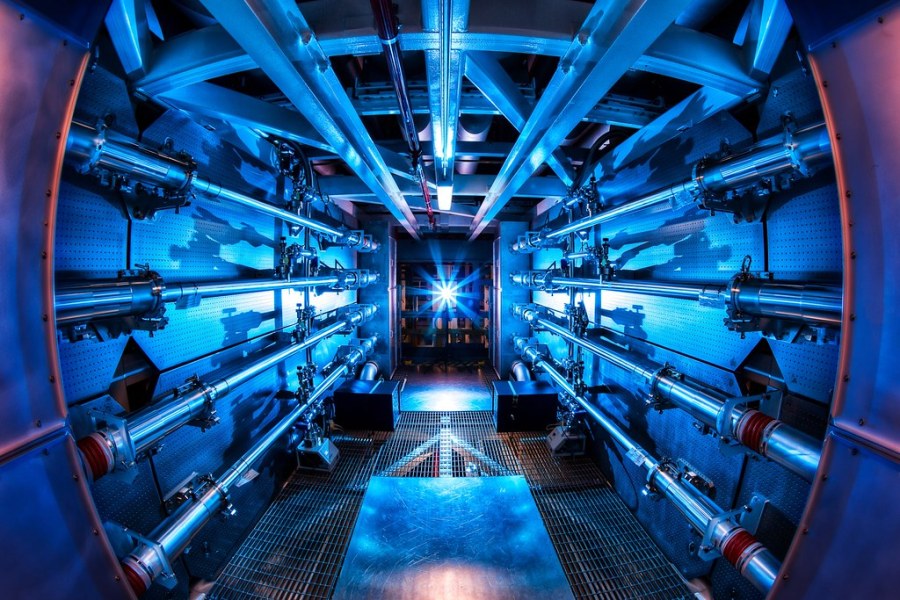
Construction on NIF began in 1997 and the device started operating more than 10 years ago. The machine takes energy from a giant capacitor bank, as large as an apartment building, and transforms that energy into 192 pulsed laser beams focused onto a very complex, tiny fusion capsule. The facility is as long as three football fields and 10 stories tall, but the final energy output comes from a tiny sphere you can barely see in the palm of your hand. Does this sound like another of those government exaggerations, maybe similar to Reagan’s “Star Wars” program he announced in 1983? Indeed, achieving fusion ignition is an incredible achievement. Let’s take a look at what happen on that fateful day at NIF.
To begin with, there was an incredible amount of stored energy in the capacitors, namely two million joules in each of 192 capacitor banks, to excite the lasers. Next the laser energy entered a 1 centimeter-long cylinder through holes on the ends and heated the inner surface of the tiny cylinder. One of the first technical challenges was that the laser pulse had to be tailored to the right shape over time. The laser light had to be precisely injected into small holes on the ends of the cylinder, and the energy had to be directed and precisely absorbed in a predetermined pattern on the inner wall of the cylinder. Both of these goals were achieved. That exquisitely tailored and perfectly focused energy was absorbed and a fraction of that energy was converted into a hot ionized gas, called a radiating plasma, expanding from the heated cylindrical target’s inner wall.
Inside the cylinder sat a tiny sphere, only 2 millimeters in diameter. Using a microscopic tube, the hollow, flawless, gold-plated diamond shell had been filled with fusion fuel. When the lasers hit the cylinder creating the hot ionized gas, radiation flowed around the sphere and heated its outer surface. This made the outer wall of the sphere explode, causing a violent implosion. A small fraction of that implosion energy compressed to heat a tiny, high density, high-temperature spot at the center of the fuel. This triggers the fusion reaction. The energy released by the fusion reaction heated a fraction of the surrounding compressed fusion fuel releasing more energy.
This was the miraculous achievement of creating a burning fusion fuel using NIF. The compression and heating of the fuel was not the really significant result, the true breakthrough was creating a small hot spot that ignited adjacent cold material. Hot spot ignition is the event that may open the way to the future. There were many tradeoffs of nonlinear variables that had to be adjusted after years of very complex experiments and calculations. And repeating the achievement is still yet to come.
Frankly, before NIF was approved by congress, I had my doubts that such a complex process based on hot spot ignition would ever work, and my skepticism did not please my friends on the NIF team. It is still very hard for me to comprehend the entirety of what happened. The sustained investment of so much money and many years of total dedication in the face of repeated failures is remarkable. The complexity of the concept, and brilliance of the scientific and engineering team, as well as the enormous difficulty of the achievement contributed to this historic event, but it is natural to question the result.
However, based on an extensive array of diagnostic sensors backed up by modeling and simulation of the complex physics, we know it really happened. There were so many incredibly challenging engineering requirements, and so many interdependent very nonlinear physical phenomena that could only be modeled on giant computers. I was skeptical at first, and I am now totally impressed that the NIF team accomplished this remarkable result. Although the phenomenon may be rather hard to duplicate, it happened once, and that makes all of the difference in the long and arduous journey of fusion research. It is just one more of those miracles of engineering and physics!
But what about my attempt at inventing a fictional engineering and science breakthrough in my soon to be published novel, The Dragon’s C.L.A.W. I imagined my story and began writing it several years before this real miracle occurred. In my futuristic technical mystery novel, a low energy nuclear reaction is triggered by an intense relativistic electron beam. The beam triggers a transmutation of the target material into rare earth elements, and the energy output in the form of an electromagnetic pulse is thousands of times greater than the input. No question. This is pure fiction physics, but it draws on some real research I conducted during my career. In 1972 I initiated a fusion program at Sandia National Labs, even applied for and was awarded a patent on an e-beam fusion reactor concept with construction of what I called the Electron Beam Fusion Accelerator. I’ll discuss my fusion research journey in my next post.


 Seventeen years ago, I was invited to give a presentation to a group of intelligence analysts at the Joint Military Intelligence College. At that time, I was managing the Advanced Concepts Group at Sandia National Labs, and my group was focusing much of our attention on emerging threats. A current issue was what was called “the global war on terrorism.” This war began in Afghanistan in 2001 after the Al-Qaeda attack and continued for 20 years. During that period, it expanded to include Iraq in 2003 with one justification being the belief that Iraq was linked to Al-Qaeda.





 SDI Guy