It’s not a lie if you believe it

One of the most famous lines from the TV show “Seinfeld” was, “It’s not a lie…if you It's not a lie if you believe itbelieve it.” This concept also applies to intersection between science and politics. My last post discussed a commonly believed fallacy in the world of military technology development. The engineers and scientists who believe their latest invention will lead to certain victory and when they market that idea with the certainty of their faith, they are not lying.

One of the strongly marketed ideas currently for missile defense is the concept called “Brilliant Pebbles.” This idea has a long history going back to the 1958 Bambi
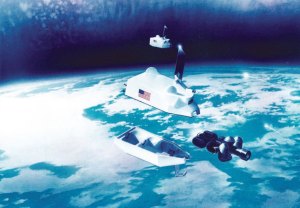
Brilliant Pebbles
This image shows a Brilliant Pebble anti-ballistic missile interceptor emerging from its protective “life jacket”, the white shell. It shows an earlier model of the interceptor design with three fuel tanks, later designs had four much larger tanks wrapped around the missile body. A second Pebble remains inside its life jacket in the background. Several Soviet missiles are shown in the lower right, but these would be too close for the Pebbles to intercept.

concept of hundreds of space based missiles that would detect the launch of attacking missiles and destroy them early in their flight. The technology of the time was far from adequate, and the concept reappeared in 1979 as the High Frontier concept, advocated by General Daniel Graham who claimed the technology was off the shelf. The advocates believed they had the certain path to an effective missile defense, but the dream of the ultimate space based defense weapon in the form of giant spaced based lasers captured the imagination and funding of the Pentagon. The laser weapon funding grew rapidly after Reagan’s Star Wars speech in 1983, and the laser advocates believed they finally had the answer, but again technology was wanting and the funding drifted down after a few years.

The enthusiasm for small space based missiles was reborn as “smart rocks.” This
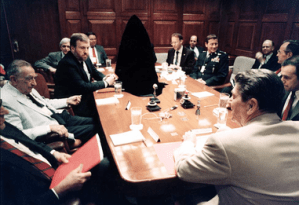
Pebbles presentation
In March 1988, Teller and Wood (on the left) present the original Pebbles concept to Reagan, Bush, Abrahamson and members of the SDIO. The model of the pebble was theatrically draped in black cloth to hide it from the reporters.

approach achieved enhanced support when Lowell Wood’s LLNL concept became “brilliant pebbles” that would be so small and inexpensive that they could be permanently deployed in space and do the job of boost phase intercept. That idea gained support for a while and then it died in the early 90s, but the true believers never lost faith, and the idea is back again, and is being touted, by Henry Cooper of the new High Frontier organization as a possible component of Donald Trump’s Space Force proposal.

The technology has advanced to the point that the new system concepts are focusing on cost effective approaches to actual deployment using the industrial adaptations of the new ideas for small satellites. With enough space based missile interceptors, there could be a multilayer defense all the way from boost phase, to midcourse, to early re-entry. So this is the new last move that will finally and certainly solve the problem of missile defense, and the Pentagon is showing interest. And the advocates believe it … so it is not a lie.deception

I believe that this “last move” is one more fallacy, and there are certain to be reactions to this latest “last move.” These reactions, called counter measures, can come in the form of physical attacks on the space based hardware including jamming of the communications, dazzling and blinding of the sensors and hacking of the software. The reaction to these countermeasures will be “hardening” to achieve a robust and resilient system to counter the countermeasures, and the advocates will claim they have the final answer this time, as modifications and enhancements will lead to program extensions and cost growth that were not anticipated, but everybody involved will honestly claim that nobody was lying when they provided the initial cost estimates.

Is there any way out of what will become a new escalating space race? Is there no way out? How will this new space arms race end? There could be negotiated agreements that we used to call “arms control,” but today’s global strategic environment is more complex than it used to be. Today Russia and the U.S. are facing space competitors from China and before too long India. But what about Europe, Japan and Israel? Here we go again with the warning of President Eisenhower to beware of the growing power of the military industrial complex. It is too late for agreements – so fasten your seat belts and get ready for a fast and very expensive ride toward an unknown outcome.




Voltaire

Are you smoking something?

One of the readers of my latest couple of blog posts asked me if I was smoking funny cigarettes. I don’t think he appreciated my satire. I really did not know I was in the satire business, until one of the readers of my book, “Death Rays and Delusions,” commented that I was trying to be another Voltaire. Being an engineer, I thought that was an automobile model, (perhaps a Chevy), so I looked it up and found Voltaire was a 16th century philosopher who poked fun at political leaders using a style characterized by wild exaggeration, irony and subtle humor. In my recent blog posts, I poked fun at the obviously silly idea of a new branch of the military, the space force. I knew enough about the subject that I figured the Air Force already had the job well in hand so I opined that one financial benefit would be the use of the surplus uniforms left over from the Star Trek TV series. My other post dealt with the concept that we could dominate space control through investing in new and revolutionary technologies.

In my book, I described the outrageous notions that we could defend ourselves against the threat of nuclear tipped ballistic missiles if we only had to deploy hundreds of giant space-based lasers, or thousands of tiny missiles, or maybe just a few orbiting nuclear weapons to create beams of x rays. When I was the chief scientist of the SDI program, I enjoyed the satirical humor in the “Bloom County “cartoons where I was described as a plump penguin who argued, “Why fer crying out loud…. research physicists need Porches too.”

Maybe the message of my book was lost in the satire, but my point was that decisions were being driven by the tech sales forces of the military industrial complex. They were extremely successful in extracting large sums for unlikely programs, that turned out to be the heart of an elaborate mind game with the Soviets.

The policy decision makers on both sides had no clue about the reality of the technology, but they were mostly motivated by their own philosophical, strategic and economic concepts. Gorbachev hated nukes, the arms race and the impending financial collapse of the Soviet empire. Reagan hated nukes, believed the Soviet Union was on the edge of financial extinction and was willing to make a deal that even shared our technology with the Soviets.

As it turns out, scientists and engineers were involved, but were only along for the ride. Many of them believed that their next miracle would give us the winning move.

duck and cover

Duck and Cover 2.0


students ducking and covering

ACTIVE SHOOTER IN THE SCHOOL. DUCK AND COVER. THIS IS NOT A DRILL.

When recent horrible events caused me to envision such an announcement in a school, I was reminded of President Reagan’s call for a missile defense system that would that would eliminate the duck and cover approach and replace it with a program to “make nuclear weapons obsolete.” He asked us in the defense community to put together a plan to deploy an effective missile defense system. Although we asked for five years and $25 billion to just study the needed technologies, we were nowhere near what was needed. The key elements of the system were a space-based warning and attack tracking system, interceptor directed energy and missile weapons and computer controlled information and battle management. An effective method to protect schools would be trivial in comparison, but would still need many of the same system elements. But first, let’s consider the threat to schools. 

Let’s imagine that the school had already held several active shooter drills and the students and teachers knew what to do, namely duck and cover. Unfortunately, a deranged shooter with an assault weapon with lots of ammunition could hunt his helpless prey until his ammunition or victims were no longer available. The shooter could have been shooting through doors and walls without interruption, leaving dozens of dead and dying. 

Now let’s consider an early warning system at the school perimeter, entry detection and tracking sensors and a layered defense. This would begin with a comprehensive mental health system, highly restricted weapons of war, including background checks and licensing, legal preventive measures and a commitment not only to see something, say something, but also to do something. The defenses at the school would include a secure and monitored perimeter, CCTV and gunshot detectors in every room, as well as a highly trained and readily available armed response. The school would have been mapped so the sensors could inform the response system where and when to act. There might also be a debilitating piercing sound or bright flashing light system to incapacitate the shooter. None of these elements require new technology. But what about where I started with missile defense? Let’s look at how the same systematic approach could apply to the as yet unsolved problem of effective missile defense.

In 1984, when I was the Strategic Defense Initiative Chief Scientist, one of our most serious problems was the cost of space launch. I recall an image of the Manned Maneuvering Unit, manned maneuvering unit and I was acutely aware of the cost of transporting sensors and weapon hardware into space. One of our concepts was a space-based chemical laser that would weigh 100 tons. Deploying a single laser would require 10 space shuttle launches and the transportation cost would be $10 billion. This cost did not include the needed maintenance and fuel. It was hard to imagine the cost of just getting there when you could buy a cross-country air ticket for a few hundred dollars, and the cost of a modern fighter plane was a few tens of millions, so we imagined methods that might reduce the launch cost by an order of magnitude, but there has been little progress in cost reduction … until now. Tesla in space

Now we can realistically consider that factor of 10 cost reduction, since Elon Musk, and his private venture has claimed that the 100-ton launch could cost as little as $1 billion. The implications to missile defense for deploying heavy payloads is nothing less than remarkable. But wait there’s more. In the last 10 years, powerful electrically pumped fiber lasers have been demonstrated and widely used in commercial industry. Now high-power space-based lasers are a realistic possibility. Even a less demanding space launch and maintenance requirement would be air-based lasers and use of lightweight space relay mirrors. 

The combination of low cost launch and lightweight space relay mirrors driven by air based electrical lasers makes a space based global defense system a technologically achievable goal. The outcome of such deployments might also lead to an unstable environment for space wars, and many of the issues of terrestrial war stability would have to be dealt with. The implications of space wars will need new thinking about space rules of the road, and it is not too soon to seriously consider the possibility that space will turn out to be a dangerous place. But schools might then be safe places. 


Hawaii missile mistake alert

What if the missile attacks were real?

In January, an early-morning emergency alert mistakenly warned people in Hawaii of an incoming ballistic missile attack. Less than an hour later the warning was revoked, but the mistake started a panic. More importantly, what if the missile attack were real?

Several commentators have dealt with the question of what if the missile attack on Hawaii had been real. Our military would have known almost immediately that a real missile was launched and on its way. The flight time from North Korea would have been 18 minutes and in that time we could activate our responses and send our interceptors on their way. But does that mean that the probability of stopping the attack was so high that there was no reason for fear? One commentator, without even mentioning defense, suggested that people should duck and cover. That was the “method” for surviving nuclear attack that we practiced when I was in junior high school. kids ducking under desks

Others in the military have written that our missile defenses would be activated and interceptors would be launched and could destroy a single attacking missile.  This assumes that our deployments are effective, the right decisions could be made in time, and that the response would be to launch enough interceptors to increase the probability of successful defense. But what if the first missile was really only one more test and the missile landed harmlessly in the ocean? Or maybe this was part of a strategy of seeing how fast and how well we could respond? And what if the intercept really was successful? Would we then retaliate or just send a warning?

But such issues have always been on the table during the decades of deterrence-Reagan on Time Magazinebased strategy. That is until Ronald Reagan questioned the entire basis for our survival. He asked if we could develop a high-tech defense based on assured survival instead of assured destruction. His idea was totally out of favor with all of his strategic weapons advisors who believed that the threat of total mutual guaranteed annihilation would be the only way to achieve deterrence.

Now all of that seems to be no longer acceptable and nuclear weapons proliferation is a growth industry. Our new nuclear posture review is calling for more modern low-yield nuclear weapons to strengthen deterrence since Russia and China have adopted this approach. The argument against assured destruction is that deterrence is no longer credible if the other side has developed more usable low-yield nukes and is increasingly relying on them for deterrence. So the argument is that by making our ability to wage nuclear war more credible, our deterrence is more credible. No more talk of irrevocable destruction of society.

But what about Reagan’s 1983 concept of reducing the nuclear stockpiles and creating more credible defense? As I explain in my book “Death Rays and Delusions,” the needed technology was way off in the future and we were not ready to move in this revolutionary direction. But now 35 years later we have made dramatic progress in sensors, platforms and interceptor missiles so effective defense should be taken more seriously than crawling under desks.