

 For decades, the Soviet military lagged behind us technologically, and by dominating one half of the budget it fatally weakened their economy. The military was stuck in the quagmire of Afghanistan yet they remained committed to compete with us and maintain their control of Soviet society. A key element of their approach was stealing our secrets. We had discovered how they were shop lifting our technology, and we cooperated by “enhancing” the ingredients of their shopping bag. The chief Soviet thief was actually working for us, and he wanted to get even with his KGB bosses.
According to Thomas Reed, former Secretary of the Air Force, we were “blowing up Soviet pipelines, infiltrating Soviet computers, bollixing their software, …electronics infected with bugs, viruses, and Trojan horses placed there by the US intelligence community.”
Gorbachev wanted to terminate the arms race and turn his economy around, but in the fateful 1986, everything seemed to go from bad to worse: Gorbachev was planning an anti vodka campaign to deal with what he thought was contributing to his country’s mental and financial depression. His faulty governing plan was based on a commitment to a contradictory strategy of both entrepreneurial and communist economies that would become a worsening financial decline. Then the Chernobyl reactor explosion destroyed his confidence in Soviet technology, followed by the sinking in clear weather of their only luxury cruise ship Adm. Nakhimov. These accidents caused wide spread distrust of incompetent leadership and a growing level of anxiety in his country. Then just before the Reykjavik summit — one more stunning disaster. A critical component of their nuclear deterrent, a rocket on the k219 nuclear submarine with 30 nuclear warheads aboard caught fire and the sub sank with a trailing American sub watching the entire debacle.
With all of the Soviet catastrophes in mind, his military advisors told him we really had substantial advances in missile defense, yet his military industrial complex was on the verge of launching a space weapons race. He was convinced his country could not simultaneously compete and also salvage their disintegrating economy.
He was ready to make a deal and Reykjavik was the place to agree to end the arms race, but he could not close the deal with Reagan. Above everything else he was determined to stop his own military industrial complex from launching their giant Polyus space laser, and that meant he needed the leverage from persuading Reagan to keep SDI in the laboratory and not in space. He told Reagan after three days of back and forth arguing “It’s the laboratory or goodbye”. Reagan, with his totally unrealistic confidence in near term SDI deployment, said no deal. The world leaders acting on their own walked away from changing the course of history.
Our own military and our allies breathed a sigh of relief since they were totally committed to a nuclear deterrent based on mutually assured destruction, and at the same time the press argued that Reagan had screwed up.
The deal was off, but their space laser experiment Polyus was not deployed because of a software problem. Negotiations continued in 1987 as both sides realized missile defense was not ready for any sort of deployment, and slowing the arms race was beneficial to both countries. An agreement was reached, by two politically weakening leaders, to eliminate intermediate range missiles. For a few years the Soviet Union continued to implode without our help, and then Gorbachev was removed by a coup, followed by the coup plotters jailed by the new Soviet leader Yeltsin.
Did Star Wars sink the deal? Will Star Wars ever become real? And what about the North Korea’s ICBM?


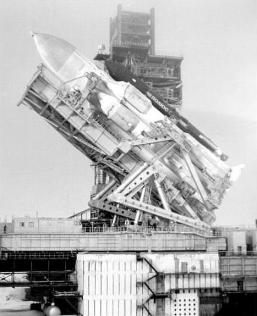


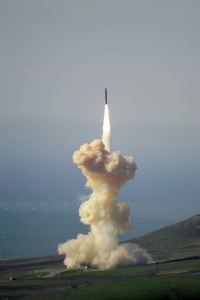

 This “fake news” headline appeared on a May 1985 article in the Los Angeles Times:
  a mirror on the space shuttle, so I was not to be believed. Well, technically he was correct about what we did, but he neglected to say that our laser was on top of a cloud free mountain. So the real story should have mentioned that several laser locations would be needed in high altitude relatively cloud free areas, like in Arizona, or even a more futuristic concept would require a high power laser on an aircraft, which is not unrealistic in the near future. But these recent advancements in the GBL could pose a problem. What if the GBL, whose technical basis has advanced rapidly, is used by a future adversary to attack our defense satellites as the first or second step of an escalating global conflict?
 SDI Guy