
Last month in Vietnam, two leaders of their countries sat down one-on-one to negotiate on the subject of regime survival and prevention of a nuclear war as the first step toward elimination of nuclear weapons in a region of the world. The two leaders had created a working relationship based on increased feelings for the other and even some level of fondness. Each had his own understanding of the other side, but both had incomplete information of what the other was really thinking. They both had confidence that they could use their interpersonal skill in persuasion to get the other side to go along in order to get along. In my view, the situation was not unlike what happened 33 years ago during the strategic weapon negotiations between Reagan and Gorbachev. Both meetings ended abruptly with no agreement because one of the participants walked away.

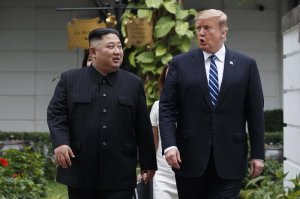
Donald Trump says sometimes you have to walk away from a negotiation since no deal is better than a bad deal, and, if you want to eventually make a good deal, it is best to walk away. There are arguments that this is what Reagan did at the Reykjavik summit in 1986, but I don’t agree. Many analysts claim that Trump, like Reagan, was doing the right thing by walking away from a bad deal. But the comprehensive U.S. and Soviet records of that summit in Reykjavik showed that Gorbachev walked away when they were on the verge of an agreement that would change the world. The deal fell apart because Reagan wanted to test SDI in space. Unlike Trump, Reagan did not walk away. In fact Reagan was almost on the verge of getting everything he wanted. Gorbachev was also close to getting everything he wanted, but at the last moments of their meeting, he walked away.
Contrary to some accounts of the event, Gorbachev did not demand the end of SDI, but he insisted that it stay in the laboratory for 10 years. He said, “It’s the laboratory or goodbye.” Reagan, however, argued that space testing was necessary to continue the program that he was willing to share.
What Reagan did not know was that the Soviets were preparing to test their own giant space-based laser weapon, and Gorbachev desperately wanted to stop it by getting Reagan to go along with his demand for the U.S. to “stay in the laboratory.” Faced with a crumbling society riddled with corruption, deception and economic mismanagement Gorbachev believed the only way to salvage the situation would be to put an end to the enormous commitment to ever increasing military budgets. Starting a new space weapons race was the last thing he wanted, and getting Reagan to go along with keeping SDI testing out of space would give him the leverage to put a stop to his own program.
As their negotiation reached its culmination, both Reagan and Gorbachev agreed to their shared vision to get rid of all nuclear weapons and they even agreed to go along with missile defense research, which was far from any realistic applications. Ten years of laboratory research would be a reasonable approach for the United States’ struggling program. The notion to jointly rid the planet of nuclear weapons and cooperate on missile defense to transition to a safer world was Reagan’s long term goal, and Gorbachev was in total agreement. Contrary to much incorrectly written about the Reykjavik summit, Gorbachev did not want to stop our SDI, he wanted desperately to stop his own SDI, and the price of the agreement was for all of us to “stay in the laboratory.” More than likely the military, industrial and congressional complexes of both super powers would have fought the agreement that almost happened, but the two global leaders had the opportunity to at least try to make it happen, but Gorbachev walked away, and Reagan had no idea why Gorbachev was so desperate to keep SDI in the laboratory. I believe they missed the best chance to gradually and eventually de-nuke the planet.
So what about an agreement to de-nuke the Korean peninsula? The key is not to walk away, but to convince Kim Jong Un to get what he wants as long as we get what we want. I believe we want to de-nuke North Korea, and Kim wants to stay in power. So we should start by agreeing to not threaten the North Korean regime, and they should agree to gradually and eventually get rid of their nukes. That does not sound so terribly hard to me as long as nobody walks and we keep on talking. In the meantime, as I have argued in this blog, we should deploy drone based missile defense to destroy any threatening North Korean missiles in their early flight. A jointly managed 10 year transition to reduced offensive threats, steady reductions in any nuclear weapons and a limited boost phase intercept capability would be a reasonable approach if the talks continue. Sadly, North Korean officials are now threatening to resume nuclear and missile tests. The breakdown of the Hanoi summit is the second time talks to achieve denuclearization have failed after a negotiator walked away.
 SDI Guy
Thanks for this analysis of our current situation with North Korea. I wish that our president were open to such information and wisdom. Oleta
________________________________
LikeLike
This analysis of Reagan-Gorbachev’s Iceland summit reminds me that partisan groups – and the news media – tend to oversimplify things to promote their own agendas. And the oversimplification sometimes is just erroneous.
LikeLike
Both Trump are Kim are irrational, unpredictable. They are sociopaths, whose sense of right and wrong is different than ours. Their logic is chaos as far as we can understand. Both are untrustworthy, cruel, and narcissistic. As with Kim, Trump’s goal is to stay in power.
LikeLike
You are overly critical of Kim.
LikeLike