
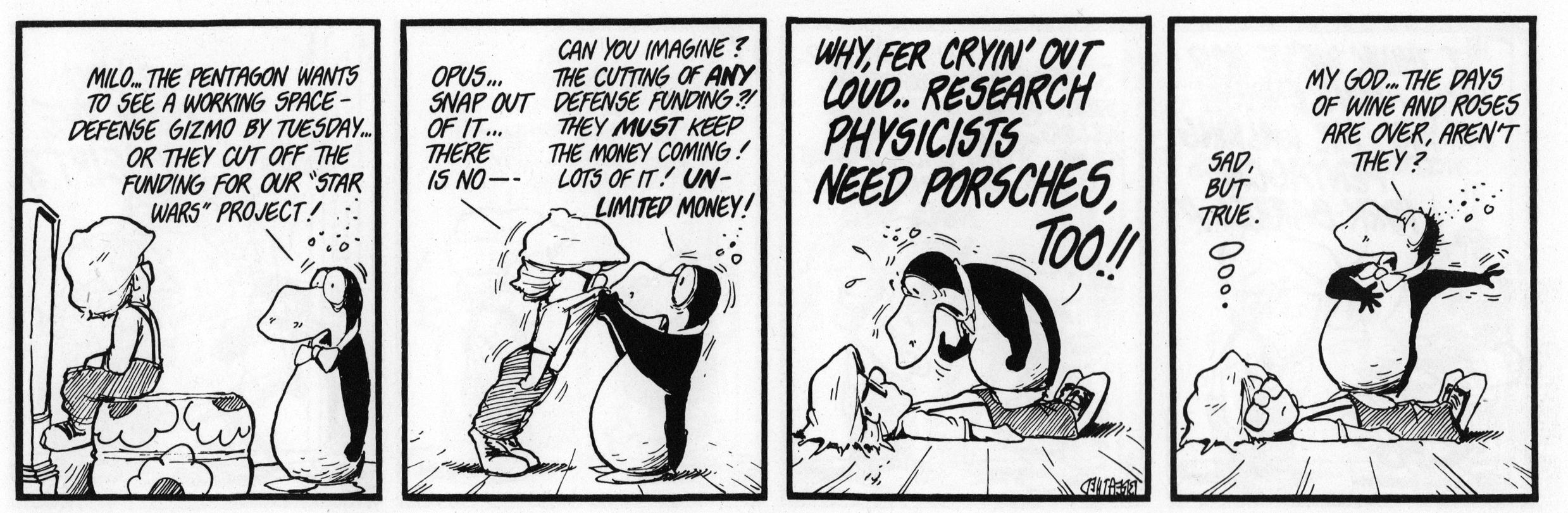
I was sitting at my desk in the E ring of the Pentagon only a short stroll from the office of the Secretary of Defense. It was in February 1985 and one of those miserable rainy days in Washington. I was skimming through the latest outrageous proposal to the Strategic Defense Initiative Office. It was a concept for some sort of nonsense gamma ray laser that could be the death ray that would intercept the Soviet missile attack and protect us if they chose to launch all of their missiles at us. I never was surprised at the ridiculous attacks on the program that was little more than 1 year old and struggling to attract reasonable rather than a series of outlandish comparisons and proposals and even worse attacks on ourcredibility. I had learned to wait for and enjoy the latest Bloom County comic strip that described me as a slightly overweight penguin.
In walked my military assistant, Air Force Captain Rod Liesveld and said the office of Senator DeConcini had called and wanted me to go over and talk to him immediately about something rather important. I was the chief scientist of one of the nation’s most ambitious R&D program called either by its formal name SDI, or Star Wars, by most of the public, and I knew that when a senator said jump, I jumped, so I headed over to see him, and had one of the most strange discussions I ever had with a member of the legislative branch.
It was a short ride on the Metro to Capitol Hill and when I waked in, the senator did not waste any time and wanted to know why we would not let his constituent, a reporter from “Arizona Republic,” get an airplane ticket and fly to Kwajalein Island in the Pacific. I explained that was where we had test facilities and he would need a clearance to go there. I actually knew only that we had radars to track interceptor experiments, but I had never been there myself, because it did not seem that interesting, and I told that to the senator.
He responded with an angry look on his face and made a definite accusation that we were hiding an alien space craft on the island and he demanded that we go public with our discovery. I insisted that there was no such space craft and that I doubted if the reporter could get approval for the visit. I abruptly left his office and wrote a very silly memo to my boss General Abrahamson that said I was worried that the aliens would beam me up and suck out my brain. Fortunately, my boss, who everybody called Abe, never got the memo.
A few days later Abe, along with Colonel Frank Sterling, who had the memo in his briefcase and had probably read it and decided I was a nut, grabbed me and said the senator wanted to see us. Frank decided not to waste Abe’s time, and we headed over for a hastily arranged meeting, where the senator demanded we explain what was going on that far away island. Abe, who was adept at dealing with Congress, said that we would get to the bottom of this and he would arrange a proper hearing on the issue. Of course I could not believe that anything would come of this until I was summoned to a meeting at one of those windowless conference rooms in the interior of the Pentagon.
I walked into the room and found five military heads of the SDI programs on one side of the conference table and on the other side, Senator DeConcini, and two people that introduced themselves as Darrow “Duke” Tully, the editor of the “Arizona Republic,” and Dick Rose, the reporter who wanted to go to Kwajalein. Abe sat at one end of the table and I was instructed to stand at the other as if I was the one on trial. Rose then asked, “If the questions would be answered truthfully?” Abe said he agreed “except if there were security restrictions.”
At that point I decided that I needed to get out of there in a hurry, but then Rose proceeded to ask me question after question about something I had not thought about for over 20 years, namely a “liquid metal rotary MHD system.” Being ready for nonsense, I denied any knowledge of the subject. Then they dropped the bomb on me and accused me of developing the device, and that I was in fact one of the forerunners of the technology, and that was why I had been chosen for the SDIO. I was speechless when I suddenly with some embarrassment recalled that I had in fact built such a gadget as an undergraduate student at Cornell University and had even presented a paper on the subject at a conference. Somehow they had tracked down the obscure information because they believed that was the key to the alien space craft propulsion system. The reporter then turned to Abe, and asked the following:
“Is the U.S. Air Force, the Department of Defense, or NASA currently operating a self-launched, self-propelled, manned spacecraft?”
I yelled, “No,” and Abe jumped in to my defense, but I knew I needed to escape, and I abruptly announced I had to leave, and waked out of the room. I found out later that he meeting went on without me, with more discussion about a proposed visit to Kwajalein. Eventually they left and I assumed that the incident was over when I received a copy of an article from the official secret protectors at the Pentagon. They asked for an official classification review since the article was to be published next week. Then I looked at it and realized that it was written by that Arizona reporter and was entitled “A Prophecy of Peace.” My immediate job was to assure that no secrets were revealed and I was looking forward to its publication. The article claimed, “The research projects centering on an alien spaceship provided technical information that allowed American scientists to move their knowledge of space sciences a hundred years or more.”
The notion of learning enough about the alien technology to once and for all defend the United States from a Soviet missile attack seemed to be an amusing prospect, and then the article went on to say, “The Soviets have launched a massive program to duplicate the Lightning spacecraft technology” …and, “The Soviets had flown the first prototype of their spacecraft,” and we should “not keep the story from the American people.” I was in agreement and approved the article as unclassified, but it never appeared.
After a few weeks went by and the article did not appear, I asked the review people at the Pentagon what had happened to the article, and I was told that the reporter had been vaporized and the article was withdrawn. They asked if I still had it and I said I would get back to them. The vaporization of the reporter seemed reasonable in the face of all that had happened, but then I asked what about the senator, what about the editor of the largest newspaper in the State of Arizona, and a few months later everything became clear as the sky in New Mexico.
I learned from an article in the “Los Angeles Times” that, “Even though Tully wore a dress uniform as an Air Force Lt. Colonel when he attended social functions…a man regarded one of the state’s most influential had been living a lie.” Another article wrote, “His war record as a fighter pilot in Korea and Vietnam was fake and at that time he was actually selling ads for a newspaper in West Virginia.” Dick Rose, the famous reporter, was apparently still among the solid citizens, and was quoted as saying, “Tully was a good friend… and he talked real military language.” One article described him as a “man with an imagination as big as his ego.” Tully then quietly left town and I was curious to find any record of what happened to the reporter, but I failed to learn anything further about him, although I still have a copy of his unpublished article. I went back to my job searching for the answers to many more questions that would need to be answered if we would ever be safe from attack by nuclear tipped missiles from the Soviet Union.
 SDI Guy
WONDERFUL Information. Now that you have exposed this likely TOP SECRET information I am concerned that I too will be vaporized. AND, I must remind you that the whole truth, and noting but the truth in this report is that contained in the BLOOM COUNTY Security level documentation provided. However, it too has a minor, but important error, and that is that not all of the “RESEARCH SCIENTISTS NEEDED PORSCHE’S TOO”, as I have other TOP SECRET info that some of them needed and wanted USA designed and constructed Corvettes. That too, a verified secret that this whole project was a Certified Buy American affair.
LikeLike
The truth is I had a 1963, a 1986, and now a 2005 Corvette! Should have kept the first one!
LikeLike
Great story Gerry!! Is this part of your memoirs? 😊😊😊
Sent from my iPhone
>
LikeLike
It is a revised version of the Duke Tully story in my book “Death Rays and Delusions”.
LikeLike
I really enjoyed reading this Gerry. You have made great contributions to the National Defense and I am so grateful that I had a chance to work for you in the “old days”. Keep the articles coming.
LikeLike