

duck and cover

Duck and Cover 2.0


students ducking and covering

ACTIVE SHOOTER IN THE SCHOOL. DUCK AND COVER. THIS IS NOT A DRILL.

When recent horrible events caused me to envision such an announcement in a school, I was reminded of President Reagan’s call for a missile defense system that would that would eliminate the duck and cover approach and replace it with a program to “make nuclear weapons obsolete.” He asked us in the defense community to put together a plan to deploy an effective missile defense system. Although we asked for five years and $25 billion to just study the needed technologies, we were nowhere near what was needed. The key elements of the system were a space-based warning and attack tracking system, interceptor directed energy and missile weapons and computer controlled information and battle management. An effective method to protect schools would be trivial in comparison, but would still need many of the same system elements. But first, let’s consider the threat to schools. 

Let’s imagine that the school had already held several active shooter drills and the students and teachers knew what to do, namely duck and cover. Unfortunately, a deranged shooter with an assault weapon with lots of ammunition could hunt his helpless prey until his ammunition or victims were no longer available. The shooter could have been shooting through doors and walls without interruption, leaving dozens of dead and dying. 

Now let’s consider an early warning system at the school perimeter, entry detection and tracking sensors and a layered defense. This would begin with a comprehensive mental health system, highly restricted weapons of war, including background checks and licensing, legal preventive measures and a commitment not only to see something, say something, but also to do something. The defenses at the school would include a secure and monitored perimeter, CCTV and gunshot detectors in every room, as well as a highly trained and readily available armed response. The school would have been mapped so the sensors could inform the response system where and when to act. There might also be a debilitating piercing sound or bright flashing light system to incapacitate the shooter. None of these elements require new technology. But what about where I started with missile defense? Let’s look at how the same systematic approach could apply to the as yet unsolved problem of effective missile defense.

In 1984, when I was the Strategic Defense Initiative Chief Scientist, one of our most serious problems was the cost of space launch. I recall an image of the Manned Maneuvering Unit, manned maneuvering unit and I was acutely aware of the cost of transporting sensors and weapon hardware into space. One of our concepts was a space-based chemical laser that would weigh 100 tons. Deploying a single laser would require 10 space shuttle launches and the transportation cost would be $10 billion. This cost did not include the needed maintenance and fuel. It was hard to imagine the cost of just getting there when you could buy a cross-country air ticket for a few hundred dollars, and the cost of a modern fighter plane was a few tens of millions, so we imagined methods that might reduce the launch cost by an order of magnitude, but there has been little progress in cost reduction … until now. Tesla in space


Now we can realistically consider that factor of 10 cost reduction, since Elon Musk, and his private venture has claimed that the 100-ton launch could cost as little as $1 billion. The implications to missile defense for deploying heavy payloads is nothing less than remarkable. But wait there’s more. In the last 10 years, powerful electrically pumped fiber lasers have been demonstrated and widely used in commercial industry. Now high-power space-based lasers are a realistic possibility. Even a less demanding space launch and maintenance requirement would be air-based lasers and use of lightweight space relay mirrors. 

The combination of low cost launch and lightweight space relay mirrors driven by air based electrical lasers makes a space based global defense system a technologically achievable goal. The outcome of such deployments might also lead to an unstable environment for space wars, and many of the issues of terrestrial war stability would have to be dealt with. The implications of space wars will need new thinking about space rules of the road, and it is not too soon to seriously consider the possibility that space will turn out to be a dangerous place. But schools might then be safe places. 
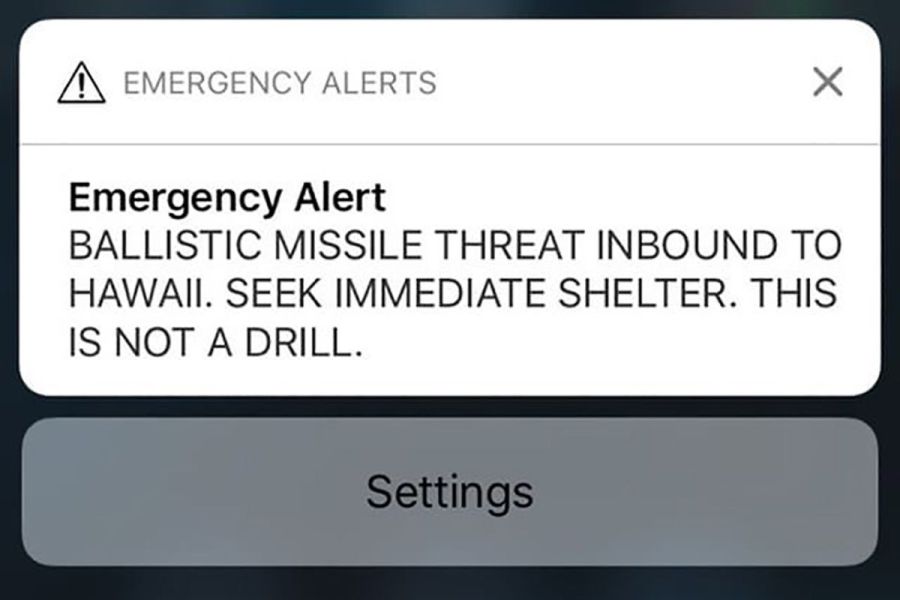
 

Hawaii missile mistake alert

What if the missile attacks were real?

In January, an early-morning emergency alert mistakenly warned people in Hawaii of an incoming ballistic missile attack. Less than an hour later the warning was revoked, but the mistake started a panic. More importantly, what if the missile attack were real?

Several commentators have dealt with the question of what if the missile attack on Hawaii had been real. Our military would have known almost immediately that a real missile was launched and on its way. The flight time from North Korea would have been 18 minutes and in that time we could activate our responses and send our interceptors on their way. But does that mean that the probability of stopping the attack was so high that there was no reason for fear? One commentator, without even mentioning defense, suggested that people should duck and cover. That was the “method” for surviving nuclear attack that we practiced when I was in junior high school. kids ducking under desks

Others in the military have written that our missile defenses would be activated and interceptors would be launched and could destroy a single attacking missile.  This assumes that our deployments are effective, the right decisions could be made in time, and that the response would be to launch enough interceptors to increase the probability of successful defense. But what if the first missile was really only one more test and the missile landed harmlessly in the ocean? Or maybe this was part of a strategy of seeing how fast and how well we could respond? And what if the intercept really was successful? Would we then retaliate or just send a warning?

But such issues have always been on the table during the decades of deterrence-Reagan on Time Magazinebased strategy. That is until Ronald Reagan questioned the entire basis for our survival. He asked if we could develop a high-tech defense based on assured survival instead of assured destruction. His idea was totally out of favor with all of his strategic weapons advisors who believed that the threat of total mutual guaranteed annihilation would be the only way to achieve deterrence.


Now all of that seems to be no longer acceptable and nuclear weapons proliferation is a growth industry. Our new nuclear posture review is calling for more modern low-yield nuclear weapons to strengthen deterrence since Russia and China have adopted this approach. The argument against assured destruction is that deterrence is no longer credible if the other side has developed more usable low-yield nukes and is increasingly relying on them for deterrence. So the argument is that by making our ability to wage nuclear war more credible, our deterrence is more credible. No more talk of irrevocable destruction of society.

But what about Reagan’s 1983 concept of reducing the nuclear stockpiles and creating more credible defense? As I explain in my book “Death Rays and Delusions,” the needed technology was way off in the future and we were not ready to move in this revolutionary direction. But now 35 years later we have made dramatic progress in sensors, platforms and interceptor missiles so effective defense should be taken more seriously than crawling under desks.

North Korean anthrax threat leaves U.S. with six options

As the new year dawns, the United States faces the issue of what to do about North Korea. Although North Korean leaders have denied charges of building facilities to produce deadly microbes and labs that specialize in genetic modification, the discovery that a North Korean defector tested positive for anthrax antibodies has raised fears that Kim Jong Un’s regime is developing lethal biological weapons. So how should the U.S. respond?

Getty imagesAs I see it, our country has at least six options and 2018 is likely to be the year we decide what road to take. The options consist of the six Ds: deterrence, defense, deals, destruction, deceit and delay. We faced a similar decision at the height of the Cold War when I was in the middle of the muddle of what to do about the Soviet Union, as I describe in my recently published book, “Death Rays and Delusions.”
During the early 1980s, President Ronald Reagan had charged my team with the goal of creating ballistic missile defense. At the time, none of us knew that the Soviet Union had not only aggressive programs in both offensive missiles and missile defense, but also had a very secret manufacturing and deployment program in biological weapons including warheads for their giant SS 18 missile.

While we debated the six Ds, the Soviets pursued strategies for spreading anthrax along with a nuclear strike. I had assumed that we had already made a deal with the Soviets to ban biological weapons, and I only became aware of the biological weapon threat when a letter containing a few grams of anthrax spores arrived at the Hart Senate Office Building.

In 2001, I walked out of a long meeting in the Hart Senate Office building and ran into yellow police tape in the corridors. Waiting police hurriedly ushered me and my colleagues out of the building and informed us that the building had been contaminated by a small envelope containing a few grams of anthrax spores.  Several days later, when I had already returned to Albuquerque, I received a message to get a nasal swab and start an extended treatment of Cipro, which turns one’s tongue black. The treatment was supposed to be effective if started immediately after exposure, but if delayed by a few days, death was certain. Of course, several days had already passed when I received the message. Fortunately, I was not infected but five people died from inhalation and infection. Another 17 became infected but survived. There was wide spread disruption and the cleanup cost was $27 million.

Caution Bio Warfare

This encounter with biological weapons clearly demonstrated the extent of this danger. I can’t imagine what a surprise attack spreading tons of anthrax spread over our major cities would do. The combination of a biological and nuclear strikes could only have one purpose–to kill us all.

In retrospect, during my time working with the Strategic Defense Initiative, we mostly engaged in delay in decision making, coupled with a certain amount of deception. Right now, the most likely D may not be one the big six. Instead the U.S. may turn to another D… denial.

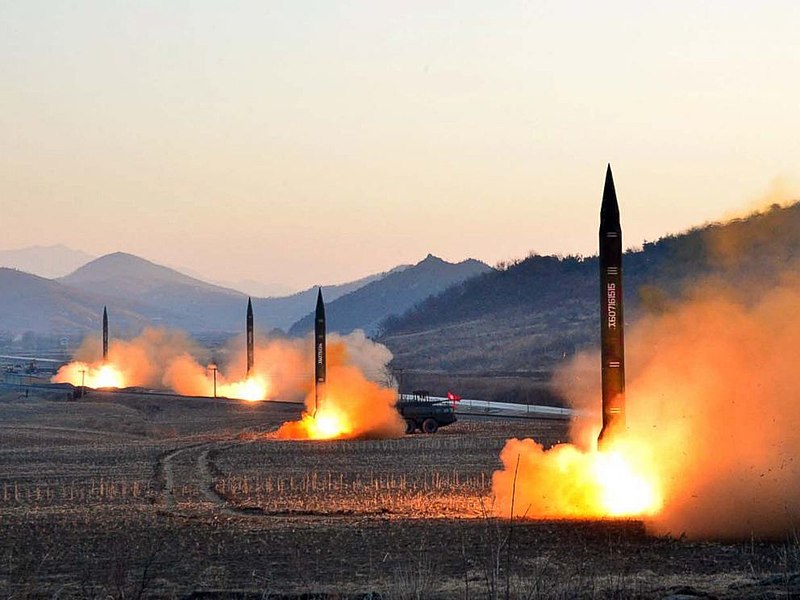
North Korean missiles

War with North Korea looms closer

According to Senator Lindsey Graham (R-South Carolina), the U.S. is getting much closer to war with North Korea. Last week, Graham stated that if North Korea conducts a seventh nuclear test, there is a 70 percent likelihood that Donald Trump will launch a preemptive war. (See http:// nymag.com/daily/intelligencer/2017/12/graham-70-percent- chance-of-war-if-n-korea-tests-7th-nuke.html.)

In prior posts, I have discussed boost phase intercept (BPI)
of North Korean missiles. Not too long ago, our near term capability and the need to be able to do this seemed remote, but the world seems to have changed
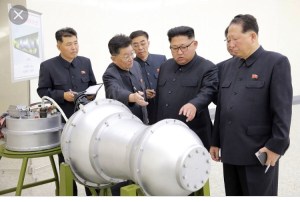
rapidly. First we saw photos of what the North Koreans claimed to be a modern miniaturized hydrogen bomb, and then they demonstrated a credible intercontinental ballistic missile that could reach all of the U.S. The surprise was

North Koreans with bomb
North Korean H bomb?

they had both an H bomb as well as a long range ICBM. This capability threatens a near term EMP (electromagnetic pulse) attack that could damage our electric grid. Recently, we saw reputable experts quoted as claiming that “North Korea could kill 90 percent of Americans” with an EMP nuclear explosion delivered over the U.S. Some experts claim such a single weapon could be very effective. William Graham, President Reagan’s science advisor, testified to Congress regarding this danger in October, 2017 (http://docs.house.gov/meetings/HM/HM09/20171012/106467/HHRG-115-HM09-Wstate-PryP-20171012.pdf). Should we worry? Naturally, it depends on whom you ask. A recently released report said the U.S. Air Force “has microwave weapons that could fry Kim’s missiles.”


EMP
EMP depicted as weak radio wave.

EMP is an old story and even 10 years ago a congressionally-mandated commission reported that EMP could damage our electronics and our electric power grid so severely that the very existence of our entire society could be threatened. The report caused an enormous yawn because nobody could conceive of a perpetrator who would have the desire and capability to do such a thing. But now we have all been surprised by the rapid development of the North Korean threat, and we seem to be caught with a major intelligence failing.

I reported that we might be able to respond to a missile attack with our midcourse interceptors if the countermeasures such as decoys were limited, but that a more effective approach would be boost phase intercept using high velocity air to air missiles on high altitude drones. The addition of BPI to midcourse intercept would enhance the effectiveness of the entire defense system.

EMP attack
Artist’s overly dramatic rendering of EMP attack.

Is electromagnetic energy so lethal that it can destroy our grid or even be used to disarm missiles about to be launched? Well, sort of. It depends on a lot of details that are hard to quantify without extensive tests and analysis. So the EM vulnerability of electronic systems and the rigorous ability to destroy electronic systems using EM waves has yet to be adequately quantified. For every attack mode there are many countermeasures to defeat the attack and survive, so it is a question of experimental and analytical risk evaluation. In my opinion, there is a need for affordable infrastructure hardening, as well as a short- term missile defense response. Fast missiles on drones seems to be the most likely to succeed. Fortunately Congress is considering a $4 billion addition to the defense budget for rapid development of both cyberattacks and a drone approach to BPI. I hope we will expedite our response and avoid any more surprises.